PLMR3 1310 nm 3 GHz 5 mW Coaxial Analogue DFB Laser
- Technology
- Fibre lasers
- Partner
- AGx Technologies
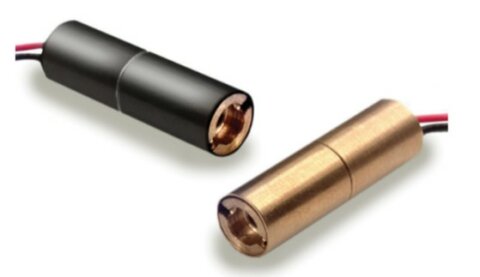
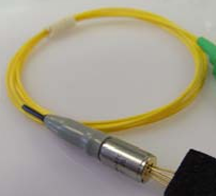
The PLMR3 coaxial analogue DFB laser is a fibre-coupled laser diode module optimised for transmitting RF signals over fibre with minimal distortion. Housed in a compact coaxial package, it provides a stable 1310 nm optical output up to 5 mW without requiring active cooling. This makes it ideal for applications like CATV return-path transmitters, wireless distributed antenna systems, and other broadband RF-over-fibre links.
The module’s design emphasises linearity and low noise, ensuring that even complex modulated signals are carried faithfully over long fibre spans. A built-in monitor photodiode allows engineers to actively monitor and control the output power for consistent performance. With its hermetically sealed construction and wide operating temperature range, the PLMR3 laser can reliably operate in field installations and harsh environments while maintaining signal integrity.
Range features
A high level overview of what this range offers
- Broad 3 GHz modulation bandwidth – Supports high-frequency RF signals (up to microwave range) for versatile analogue communications applications.
- Distributed Feedback (DFB) laser design – Narrow-linewidth 1310 nm DFB laser provides stable wavelength and low chirp, improving signal quality over fibre compared to Fabry–Perot lasers.
- High linearity and low noise – Delivers low RIN noise and minimal distortion, enabling clear transmission of analogue amplitude-modulated signals (e.g. CATV or wireless) with excellent fidelity.
- Up to 5 mW optical output – Sufficient output power for short to medium-range fibre links, providing a robust link budget for return-path and radio-over-fibre systems.
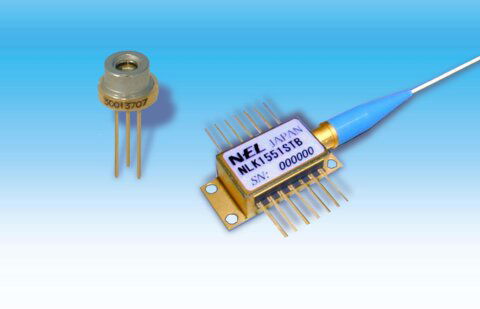
- Coaxial package with fibre pigtail – Compact metal can module with a single-mode fibre pigtail simplifies integration into optical transmitters and nodes, saving space and cost.
- Hermetic sealing & wide temp operation – Uncooled design operates reliably over a broad ambient temperature range, suitable for outdoor enclosures and uncontrolled environments.
- Built-in monitor photodiode – Internal photodiode monitors the laser output, allowing active power control loops to stabilise output and compensate for temperature or aging effects.
- Optional optical isolator – Available with an internal Faraday isolator on request, to suppress back-reflections and enhance noise performance in feedback-prone networks.
- Custom pin-out and connector options – Offers standard pin configurations and choice of fibre connectors (e.g. FC/APC, SC/APC), or even a receptacle-style version (RLMR3), to fit different system requirements.
Downloads
for PLMR3 1310 nm 3 GHz 5 mW Coaxial Analogue DFB Laser
What’s in this range?
All the variants in the range and a comparison of what they offer
| Specification | Value |
|---|---|
Laser type | 1310 nm DFB (analogue coaxial laser diode) |
Optical output power | Up to 5 mW (CW, fibre-coupled) |
Modulation bandwidth | 3 GHz (analogue small-signal bandwidth) |
Modulation format | Analogue intensity modulation (direct drive) |
Monitor photodiode | Yes – internal, for output power monitoring |
Optical isolator | Optional single-stage isolator available |
Fibre pigtail | Single-mode fibre, typical 1 m length (connectorized) |
Connector options | FC/APC, FC/UPC, SC/APC, others on request |
Operating temperature | Wide range (uncooled operation, no TEC required) |
Package type | Hermetic coaxial can, industry-standard pin footprint |
FAQs
for PLMR3 1310 nm 3 GHz 5 mW Coaxial Analogue DFB Laser
It means the PLMR3 can faithfully modulate or carry analogue signals with frequency components up to 3 GHz. In practice, this wide bandwidth supports a broad range of RF and microwave signals – for example, it can transmit multi-GHz wireless signals or high-channel-count CATV spectra over fibre without significant loss of fidelity. Engineers can use this laser for any application where RF signals in the MHz to low GHz range need to be transported over an optical link.
No. The PLMR3 is designed as an uncooled laser module and can operate reliably over a wide temperature range without an active TEC. Its coaxial package and DFB chip are optimised for stability across ambient temperature variations. This simplifies the design and power requirements of systems using the PLMR3, since only standard temperature compensation (via the monitor photodiode and drive circuit) is needed rather than full thermal regulation.
The PLMR3 is typically driven by a bias-tee or laser driver circuit that combines a DC bias current with the high-frequency RF input. The coaxial package is designed to accommodate high-speed modulation; it usually features a 50 Ω RF input path or connector for the microwave signal. To use it, you provide a constant bias current to set the laser’s optical output (often using an automatic power control loop via the monitor diode) and superimpose your RF signal. The laser’s intensity will then vary linearly with the RF modulation up to 3 GHz, converting the electrical RF signal into an optical modulation.
This laser module includes a built-in monitor photodiode that allows for active feedback control of the output power, which is essential for maintaining consistent signal levels over time and temperature. The DFB laser structure offers inherently stable single-mode output with low chirp. Additionally, the device has low relative intensity noise (RIN) and can be ordered with an internal optical isolator to minimise any performance degradation from back-reflections. Together, these features ensure that the transmitted analogue signal remains clean and undistorted.
Yes. The PLMR3 is part of a family of analogue coaxial lasers. For instance, PLMW3 offers similar specifications (1310 nm, 5 mW, 3 GHz) but is often used for wireless RF links, while PLMF3 is a higher-power version providing up to 14 mW for CATV forward-path applications. There are also models with Fabry–Perot lasers (like FPMR3) and versions covering CWDM wavelengths (PLMR1XXC) or receptacle-style packages (RLMR3). This allows you to select the most suitable laser module depending on your required wavelength, power output, and application focus.
The PLMR3 comes with a pigtailed single-mode fibre output. In other words, a short length of optical fibre is permanently attached to the laser module to carry the output light. You can specify the fibre to be terminated with various connector types according to your needs – common options include FC/APC, FC/UPC, SC/APC, or others. If a pigtailed fibre isn’t desired, the manufacturer also offers a receptacle variant (e.g. RLMR3) where you can plug in a fibre connector directly. This flexibility makes it easier to integrate the laser into different system architectures and existing fibre infrastructure.