Alvium GM2 series GMSL2™ Interface camera modules
- Technology
- Imaging camera modules
- Partner
- Allied Vision
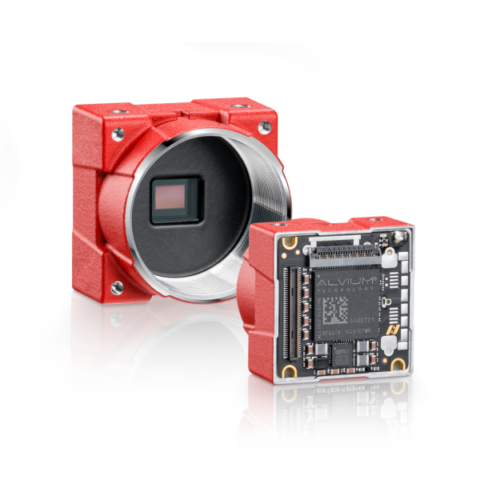
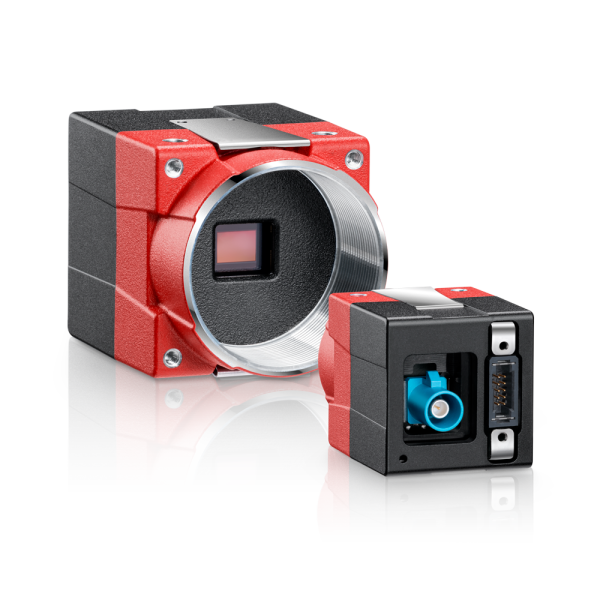
The Alvium GM2 GMSL2 camera modules enable long-distance, high-bandwidth image capture for demanding embedded vision applications. Unlike standard MIPI CSI-2 cameras limited by short cables, Alvium GM2 modules can reliably transmit data over coaxial cables up to 15 metres or flexible STP cables up to 8 metres without loss. Each camera in the series has a closed, robust housing with a choice of rugged FAKRA coax or HSD connectors, ensuring stable operation under shock, vibration, and electrical noise. With a broad selection of over 30 CMOS sensor configurations, including global and rolling shutter options from VGA to 24.6 MP, as well as UV- and SWIR-sensitive models, the series supports a wide variety of imaging tasks.
These modules are well suited to embedded and industrial vision systems that require remote camera placement, multi-camera setups, or operation in electrically noisy environments. Engineers benefit from GenICam feature access on a CSI-2 platform, open-source drivers, and Video4Linux compatibility for streamlined integration. In summary, Alvium GM2 cameras deliver high-speed, long-range vision capability in a compact industrial form factor for robotics, automation, inspection, and other advanced embedded vision applications.
Range features
A high level overview of what this range offers
- GMSL2 long-range interface: High-speed image transmission over coax or STP cables allows camera placement far from the host system
- Integrated serializer: Converts MIPI CSI-2 output into a robust serial link for low-latency transmission and efficient multi-camera architectures
- Rugged connector options: FAKRA coaxial and HSD shielded twisted-pair connectors improve reliability under shock, vibration, and EMI
- Wide sensor portfolio: Resolutions from 0.3 MP to 24.6 MP with both global and rolling shutter CMOS options suit high-speed and high-detail imaging
- Broad spectral coverage: Available models support visible, near-infrared, ultraviolet, and SWIR imaging for specialised applications
- Flexible lens mounts: C-Mount, CS-Mount, and S-Mount options support a broad range of industrial and compact optics
- Dual GPIO support: Two programmable I/O lines enable hardware trigger integration and camera synchronisation
- GenICam and V4L2 compatibility: Standardised control and Linux-friendly software support simplify embedded integration
- Compact industrial housing: Closed aluminium design with industrial-grade robustness supports embedded, factory, and vehicle-based deployments
What’s in this range?
All the variants in the range and a comparison of what they offer
| Part Number | Resolution (MP) | Image Resolution (H × V) | Sensor | Pixel Size | Special Feature | Interface |
|---|---|---|---|---|---|---|
Alvium GM2-030 VSWIR | 0.3 | 656 × 520 | Sony IMX991 (InGaAs) | 5.00 µm | VSWIR | GMSL2 |
Alvium GM2-040 | 0.4 | 728 × 544 | Sony IMX287 | 6.90 µm | — | GMSL2 |
Alvium GM2-050 | 0.5 | 800 × 600 | ON Semi PYTHON 480 | 4.80 µm | — | GMSL2 |
Alvium GM2-052 | 0.5 | 816 × 624 | Sony IMX426 | 9.00 µm | — | GMSL2 |
Alvium GM2-120 | 1.2 | 1280 × 960 | ON Semi AR0135CS | 3.75 µm | — | FPD-Link III |
Alvium GM2-1236 | 12.4 | 4112 × 3008 | Sony IMX304 | 3.45 µm | — | GMSL2 |
Alvium GM2-1240 | 12.2 | 4024 × 3032 | Sony IMX226 | 1.85 µm | — | GMSL2 |
Alvium GM2-1242 | 12.4 | 4128 × 3008 | Sony IMX545 | 2.74 µm | — | GMSL2 |
Alvium GM2-130 VSWIR | 1.3 | 1296 × 1032 | Sony IMX990 (InGaAs) | 5.00 µm | VSWIR | GMSL2 |
Alvium GM2-158 | 1.6 | 1456 × 1088 | Sony IMX273 | 3.45 µm | — | GMSL2 |
Alvium GM2-1620 | 16.2 | 5328 × 3040 | Sony IMX542 | 2.74 µm | — | GMSL2 |
Alvium GM2-203 | 2 | 1632 × 1248 | Sony IMX422 | 4.50 µm | — | GMSL2 |
Alvium GM2-2040 | 20.4 | 4512 × 4512 | Sony IMX541 | 2.74 µm | — | GMSL2 |
Alvium GM2-2050 | 19.7 | 5376 × 3672 | Sony IMX183 | 2.40 µm | — | GMSL2 |
Alvium GM2-210 | 2.1 | 1928 × 1088 | ON Semi AR0521SR (HD mode) | 2.20 µm | — | GMSL2 |
Alvium GM2-234 | 2.4 | 1936 × 1216 | Sony IMX249 | 5.86 µm | — | GMSL2 |
Alvium GM2-235 | 2.4 | 1936 × 1216 | Sony IMX174 | 5.86 µm | — | GMSL2 |
Alvium GM2-240 | 2.4 | 1936 × 1216 | Sony IMX392 | 3.45 µm | — | GMSL2 |
Alvium GM2-2460 | 24.6 | 5328 × 4608 | Sony IMX540 | 2.74 µm | — | GMSL2 |
Alvium GM2-291 | 2.9 | 1944 × 1472 | Sony IMX421 | 4.50 µm | — | GMSL2 |
Alvium GM2-319 | 3.2 | 2064 × 1544 | Sony IMX265 | 3.45 µm | — | GMSL2 |
Alvium GM2-320 VSWIR | 3.2 | 2080 × 1544 | Sony IMX993 (InGaAs) | 3.45 µm | VSWIR | GMSL2 |
Alvium GM2-500 | 5 | 2592 × 1944 | ON Semi AR0521SR | 2.20 µm | — | GMSL2 |
Alvium GM2-501 NIR | 5 | 2592 × 1944 | ON Semi AR0522 | 2.20 µm | NIR | GMSL2 |
Alvium GM2-507 | 5.1 | 2464 × 2056 | Sony IMX264 | 3.45 µm | — | GMSL2 |
Alvium GM2-507 Pol | 5.1 | 2464 × 2056 | Sony IMX264 Polarizer | 3.45 µm | Polarized | GMSL2 |
Alvium GM2-508 | 5.1 | 2464 × 2056 | Sony IMX250 | 3.45 µm | — | GMSL2 |
Alvium GM2-508 Pol | 5.1 | 2464 × 2056 | Sony IMX250 Polarizer | 3.45 µm | Polarized | GMSL2 |
Alvium GM2-510 | 5.1 | 2464 × 2064 | Sony IMX548 | 2.74 µm | — | GMSL2 |
Alvium GM2-511 | 5.1 | 2464 × 2064 | Sony IMX547 | 2.74 µm | — | GMSL2 |
Alvium GM2-530 VSWIR | 5.3 | 2592 × 2056 | Sony IMX992 (InGaAs) | 3.45 µm | VSWIR | GMSL2 |
Alvium GM2-811 | 8.1 | 2848 × 2848 | Sony IMX546 | 2.74 µm | — | GMSL2 |
Alvium GM2-812 UV | 8.1 | 2848 × 2848 | Sony IMX487 | 2.74 µm | UV | GMSL2 |
Alvium GM2-895 | 8.9 | 4112 × 2176 | Sony IMX267 | 3.45 µm | — | GMSL2 |
FAQs
for Alvium GM2 series GMSL2™ Interface camera modules
GMSL2 is a high-speed serial interface that transports MIPI CSI-2 camera data over much longer distances than standard CSI-2 ribbon connections. In the Alvium GM2 series, it enables reliable image transmission over coaxial cable runs up to 15 metres or STP cable runs up to 8 metres with minimal latency. This makes it ideal for remote camera placement, distributed embedded vision systems, and installations exposed to electrical noise.
Alvium GM2 cameras support coaxial cables and shielded twisted pair (STP) cables. Coax versions with FAKRA connectors support runs up to 15 metres, while STP versions with HSD connectors support up to 8 metres. Coax is typically preferred for static installations, while STP is better suited to applications involving movement or tighter bend radii.
The primary difference is the connector and cable type. FAKRA coax models are optimised for long, robust, static cable runs and offer the maximum reach. HSD STP models are more flexible and better suited to moving systems such as robotic arms or cable chains. Camera performance remains equivalent, so the choice depends mainly on the mechanical and routing requirements of the application.
Yes. Alvium GM2 cameras support single-cable operation, where the same cable carries both data and power. In coax configurations this is commonly referred to as Power over Coax (PoC). This simplifies system wiring and is especially useful in compact, mobile, or distributed embedded vision designs.
The series spans 0.3 MP to 24.6 MP and includes both global shutter and rolling shutter CMOS sensors. In addition to standard visible-light models, the range also includes versions for UV, NIR, and SWIR imaging. This broad sensor portfolio allows the GM2 family to address everything from fast motion capture to ultra-high-resolution inspection and specialised spectral imaging.
Depending on the model, Alvium GM2 cameras are available with C-Mount, CS-Mount, or S-Mount (M12) lens interfaces. This gives designers flexibility to choose between standard industrial optics and more compact embedded lenses based on sensor size, image quality, and enclosure constraints.
Yes. Each camera provides 2 programmable GPIO lines that can be used for trigger input, output signalling, or synchronisation tasks. This supports precise hardware triggering and makes the series well suited to multi-camera systems, stereo vision, 3D imaging, and inspection setups requiring coordinated acquisition.
Because Alvium GM2 cameras transmit data over GMSL2, they require a compatible deserializer board on the host side to convert the signal back to MIPI CSI-2. These boards connect the camera via coax or STP and present a standard CSI-2 interface to the processing platform. For multi-camera systems, deserializer boards with multiple inputs are typically used.
The cameras support GenICam-based control on CSI-2 platforms and are also compatible with Video4Linux2 (V4L2). Open-source driver support simplifies integration with embedded Linux systems and common development workflows using frameworks such as OpenCV or GStreamer. This makes the series suitable for a wide range of embedded vision platforms.
Yes. The series is designed with a closed industrial housing, rugged locking connectors, EMC compliance, and resistance to shock and vibration. With an operating housing temperature range of –20 °C to +65 °C, Alvium GM2 cameras are well suited to demanding factory, mobile, and vehicle-adjacent environments where reliability is essential.