Alvium C series industrial-grade CSI-2 camera modules
- Technology
- Imaging camera modules
- Partner
- Allied Vision
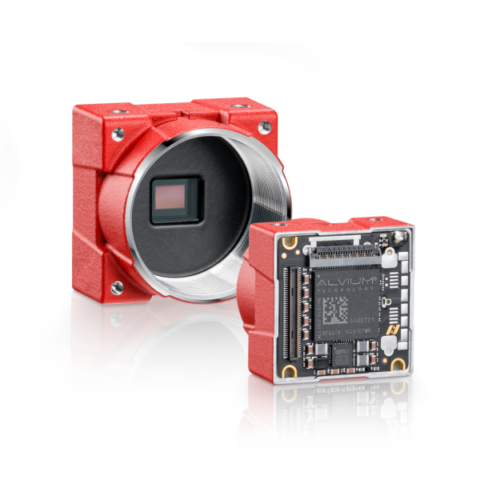
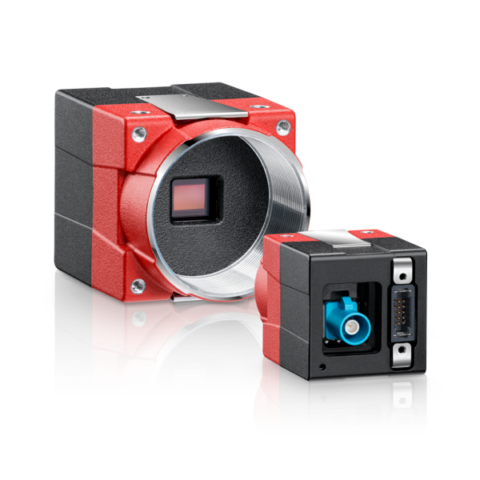
The Alvium C series industrial camera modules are built for demanding embedded vision applications where compact size, reliable image quality, and efficient integration matter. Each module uses a MIPI CSI-2 interface for direct connection to single-board computers and SoCs used in robotics, IoT, and machine vision systems. With a compact footprint of roughly 29 × 29 mm, the series still offers resolutions up to 24.6 MP and frame rates up to 689 fps, depending on model. Integrated ALVIUM® on-board image processing performs corrections and preprocessing inside the camera, helping reduce host processor workload and improve overall system efficiency.
The range includes both Alvium 1500 C series and Alvium 1800 C series models, allowing developers to scale performance while keeping the same interface and driver approach. Multiple lens mount and housing options support flexible mechanical integration in space-constrained designs. Monochrome, colour, NIR, UV, and SWIR-capable variants broaden suitability for specialised imaging tasks. Low power consumption and industrial-grade design make these board-level industrial cameras well suited for portable devices, automation systems, scientific instruments, and advanced machine vision deployments.
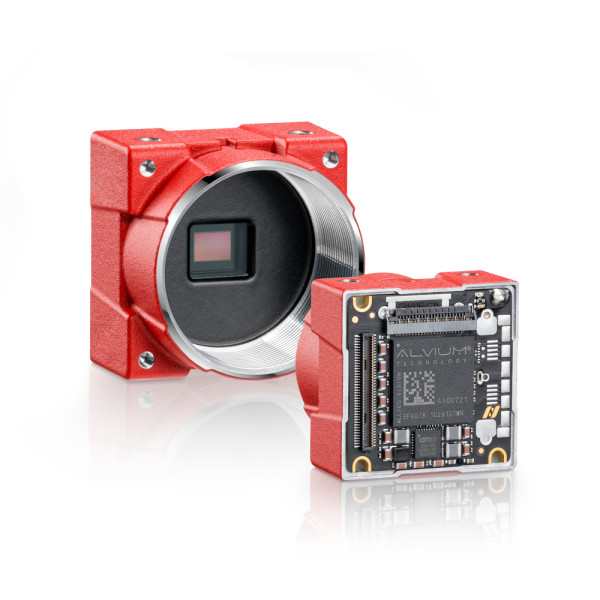
The Alvium C series is a family of compact MIPI CSI-2 camera modules designed for embedded vision systems that need industrial-grade reliability in a small format. These cameras combine Sony CMOS sensors, integrated image processing, and broad platform support to simplify deployment in robotics, automation, IoT, scientific imaging, and portable vision devices. Engineers can move between Alvium 1500 C series and Alvium 1800 C series models while maintaining a consistent interface, driver environment, and compact board-level form factor.
Range features
A high level overview of what this range offers
- On-board ISP processing: Built-in image signal processing performs image corrections and preprocessing in-camera, reducing host CPU load and improving output quality.
- High resolution and speed: Supports up to 24.6 MP and frame rates up to 689 fps, depending on model, for both detailed inspection and fast motion capture.
- Unified driver architecture: A common software approach across all models simplifies integration, maintenance, and future upgrades.
- Embedded platform compatibility: Designed for major platforms including NVIDIA Jetson, NXP i.MX8, and Xilinx SoCs.
- Low-power operation: Efficient power management helps minimise heat generation and suits thermally constrained or battery-powered systems.
- Flexible mechanical options: Available as bare-board or open-housing modules with C-Mount, CS-Mount, or S-Mount (M12) lens options.
- Wide imaging choice: Offered in monochrome and colour versions, with specialised NIR, UV, and SWIR variants for advanced imaging tasks.
- Industrial software and I/O support: Compatible with GenICam and V4L2, with GPIO and trigger support for synchronised multi-camera systems.
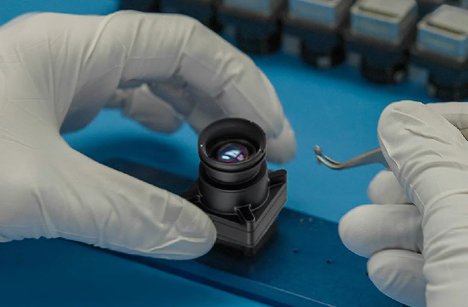
- Precision sensor alignment: Factory alignment of sensor and lens mount helps ensure consistent sharpness and optical performance.
Downloads
for Alvium C series industrial-grade CSI-2 camera modules
What’s in this range?
All the variants in the range and a comparison of what they offer
| Part Number | Resolution (MP) | Image Resolution (H × V) | Sensor | Pixel Size | Max Frame Rate | Special Feature |
|---|---|---|---|---|---|---|
Alvium 1500 C-050 | 0.5 | 800 × 600 | ON Semi PYTHON 480 | 4.80 µm | 117 fps | — |
Alvium 1500 C-210 | 2.1 | 1928 × 1088 | ON Semi AR0521SR (HD mode) | 2.20 µm | 119 fps | — |
Alvium 1500 C-500 | 5 | 2592 × 1944 | ON Semi AR0521SR | 2.20 µm | 68 fps | — |
Alvium 1500 C-501 NIR | 5 | 2592 × 1944 | ON Semi AR0522 | 2.20 µm | 68 fps | NIR |
Alvium 1800 C-030 VSWIR | 0.3 | 656 × 520 | Sony IMX991 (InGaAs) | 5.00 µm | 249 fps | VSWIR |
Alvium 1800 C-040 | 0.4 | 728 × 544 | Sony IMX287 | 6.90 µm | 494 fps | — |
Alvium 1800 C-052 | 0.5 | 816 × 624 | Sony IMX426 | 9.00 µm | 689 fps | — |
Alvium 1800 C-1236 | 12.4 | 4112 × 3008 | Sony IMX304 | 3.45 µm | 22 fps | — |
Alvium 1800 C-1240 | 12.2 | 4024 × 3032 | Sony IMX226 | 1.85 µm | 41 fps | — |
Alvium 1800 C-1242 | 12.4 | 4128 × 3008 | Sony IMX545 | 2.74 µm | 40 fps | — |
Alvium 1800 C-130 VSWIR | 1.3 | 1296 × 1032 | Sony IMX990 (InGaAs) | 5.00 µm | 130 fps | VSWIR |
Alvium 1800 C-158 | 1.6 | 1456 × 1088 | Sony IMX273 | 3.45 µm | 262 fps | — |
Alvium 1800 C-1620 | 16.2 | 5328 × 3040 | Sony IMX542 | 2.74 µm | 32 fps | — |
Alvium 1800 C-203 | 2 | 1632 × 1248 | Sony IMX422 | 4.50 µm | 225 fps | — |
Alvium 1800 C-2040 | 20.4 | 4512 × 4512 | Sony IMX541 | 2.74 µm | 25 fps | — |
Alvium 1800 C-2050 | 19.7 | 5376 × 3672 | Sony IMX183 | 2.40 µm | 26 fps | — |
Alvium 1800 C-234 | 2.4 | 1936 × 1216 | Sony IMX249 | 5.86 µm | 40 fps | — |
Alvium 1800 C-235 | 2.4 | 1936 × 1216 | Sony IMX174 | 5.86 µm | 155 fps | — |
Alvium 1800 C-240 | 2.4 | 1936 × 1216 | Sony IMX392 | 3.45 µm | 192 fps | — |
Alvium 1800 C-2460 | 24.6 | 5328 × 4608 | Sony IMX540 | 2.74 µm | 21 fps | — |
Alvium 1800 C-291 | 2.9 | 1944 × 1472 | Sony IMX421 | 4.50 µm | 166 fps | — |
Alvium 1800 C-319 | 3.2 | 2064 × 1544 | Sony IMX265 | 3.45 µm | 54 fps | — |
Alvium 1800 C-320 VSWIR | 3.2 | 2080 × 1544 | Sony IMX993 (InGaAs) | 3.45 µm | 131 fps | VSWIR |
Alvium 1800 C-321 | 3.2 | 2064 × 1552 | Sony IMX900 | 2.25 µm | 111 fps | — |
Alvium 1800 C-500 | 5 | 2592 × 1944 | ON Semi AR0521SR | 2.20 µm | 68 fps | — |
Alvium 1800 C-507 | 5.1 | 2464 × 2056 | Sony IMX264 | 3.45 µm | 34 fps | — |
Alvium 1800 C-507 Pol | 5.1 | 2464 × 2056 | Sony IMX264 Polarizer | 3.45 µm | 34 fps | Polarized |
Alvium 1800 C-508 | 5.1 | 2464 × 2056 | Sony IMX250 | 3.45 µm | 95 fps | — |
Alvium 1800 C-508 Pol | 5.1 | 2464 × 2056 | Sony IMX250 Polarizer | 3.45 µm | 95 fps | Polarized |
Alvium 1800 C-510 | 5.1 | 2464 × 2064 | Sony IMX548 | 2.74 µm | 81 fps | — |
Alvium 1800 C-511 | 5.1 | 2464 × 2064 | Sony IMX547 | 2.74 µm | 79 fps | — |
Alvium 1800 C-530 VSWIR | 5.3 | 2592 × 2056 | Sony IMX992 (InGaAs) | 3.45 µm | 84 fps | VSWIR |
Alvium 1800 C-811 | 8.1 | 2848 × 2848 | Sony IMX546 | 2.74 µm | 59 fps | — |
Alvium 1800 C-812 UV | 8.1 | 2848 × 2848 | Sony IMX487 | 2.74 µm | 58 fps | UV |
FAQs
for Alvium C series industrial-grade CSI-2 camera modules
Alvium C series cameras are designed for embedded vision applications across industries such as industrial automation, robotics, quality inspection, scientific imaging, and IoT. Their compact form factor, industrial-grade reliability, and efficient power use also make them well suited to portable or battery-powered devices including UAVs, handheld systems, and smart sensing platforms.
The Alvium 1500 C series is aimed at essential embedded imaging needs and generally covers lower-resolution, cost-effective options. The Alvium 1800 C series offers a wider sensor portfolio, higher resolutions up to 24.6 MP, and specialised variants such as SWIR, UV, and polarisation models. Both lines share the same compact form factor, CSI-2 interface, and unified software approach, making future upgrades easier.
Integration is straightforward using the camera’s MIPI CSI-2 interface and a compatible ribbon cable plus adapter board where required. The series supports major embedded platforms including NVIDIA Jetson, NXP i.MX8, and Xilinx-based systems. After connecting the hardware, you can use the unified driver environment and control the camera through GenICam or Video4Linux2 (V4L2).
Each camera includes the ALVIUM on-board image processor, which handles tasks such as sensor corrections, debayering, white balance, colour correction, and additional image enhancements in real time. By performing this work inside the camera, the module delivers optimised image data while reducing the processing burden on the host system.
Depending on model and configuration, Alvium C series cameras support C-Mount, CS-Mount, or S-Mount (M12) optics. This allows use of both larger machine vision lenses and compact board lenses, giving engineers flexibility to optimise field of view, optical quality, and system size.
Yes. The range includes specialised models for imaging beyond visible light. Examples include NIR-enhanced models in the 1500 C family, VSWIR variants in the 1800 C family, and dedicated UV models. These options support advanced applications such as semiconductor inspection, biomedical imaging, and low-light or wavelength-specific machine vision tasks.
Alvium C cameras are designed for low-power embedded operation and are typically powered through the CSI-2 connection via a 5 V supply from the host or adapter board. Their efficient design helps keep power consumption low and heat generation modest, making them suitable for compact systems without active cooling in many use cases.
Yes. Multi-camera operation is possible when the host platform provides the required CSI-2 interfaces or a suitable multi-channel adapter. With the unified driver and support for trigger and GPIO, multiple cameras can be controlled independently or synchronised for applications such as stereo vision, multi-angle inspection, or 360-degree imaging.