IR6 – Wide Dynamic Range Infrared Machine Vision Camera
- Technology
- LWIR cameras
- Partner
- Teledyne FLIR
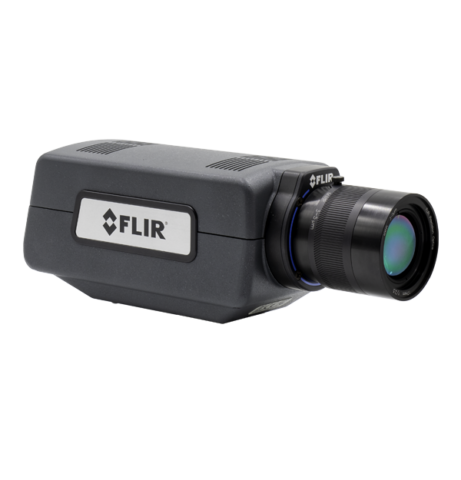
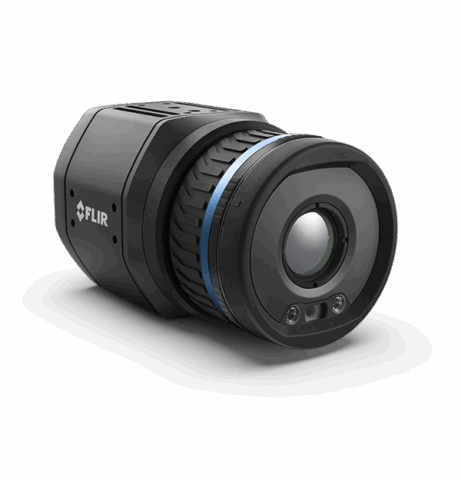
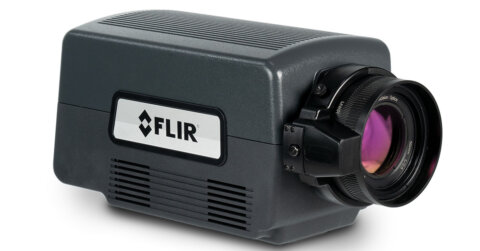
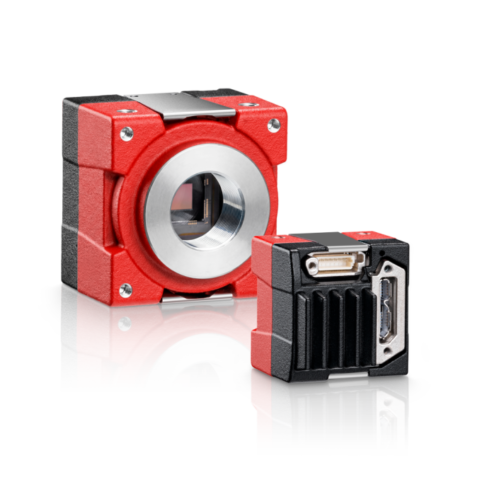
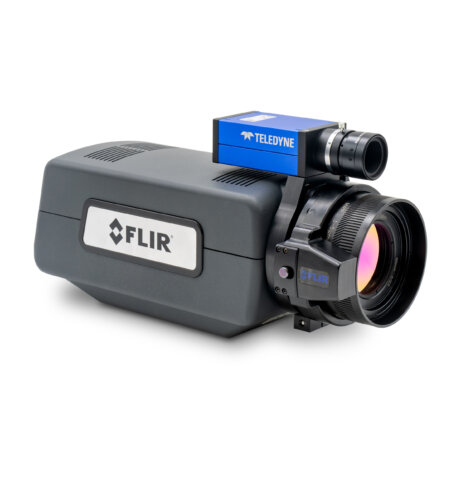
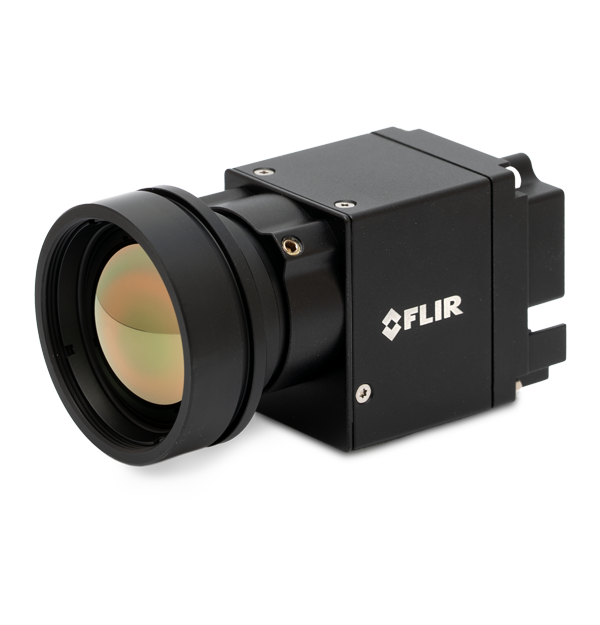
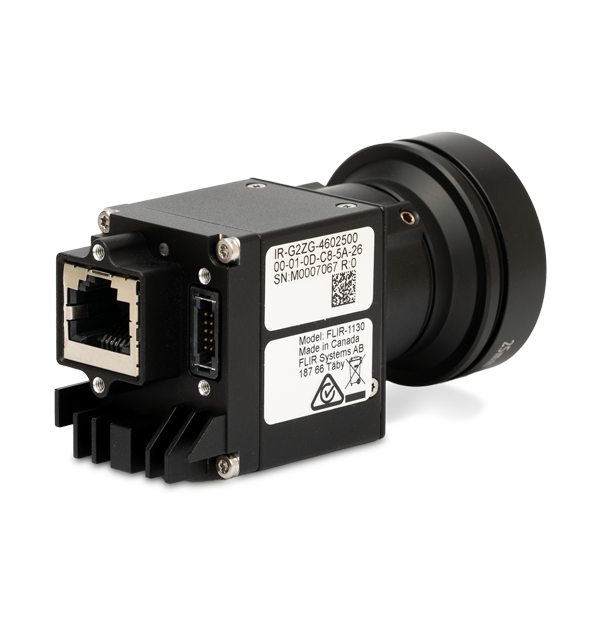
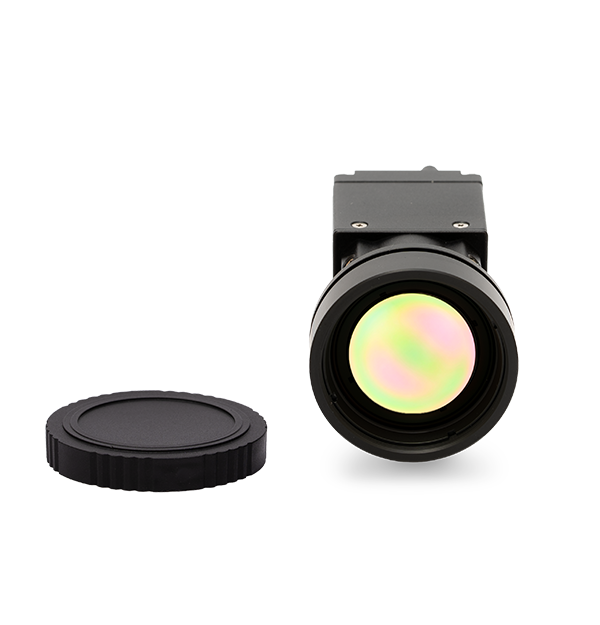
The FLIR IR6 infrared machine vision camera is a fixed-mount radiometric platform for machine builders, automation engineers, system integrators and research teams. Its uncooled 640 × 480 LWIR microbolometer has a 17 µm pixel pitch and provides per-pixel temperature data at a 60 Hz full-frame rate. A single measurement mode covers −20 to 600 °C safely and extends to 1500 °C with burn-in management, helping avoid interruptions caused by range switching. GigE Vision, GenICam, Gigabit Ethernet, PoE and a synchronisation input support integration into host-controlled machine vision and OEM systems. The camera body measures 29 × 37 × 56 mm and weighs 65 g without a lens, making it suitable for space-constrained machinery and enclosures. Five manual-focus F/1.2 lenses accommodate wide-area observation and narrower fields of view. Typical applications include seal, weld and adhesive monitoring, electronics and battery production, early fire detection, and continuous monitoring of cabinets, motors, transformers and bearings.
Range features
A high level overview of what this range offers
- Single measurement mode from −20 to 600 °C, extendable to 1500 °C: Maintains thermal observation without manual subrange switching when appropriate burn-in controls are applied.
- 640 × 480 radiometric output: Provides per-pixel temperature data for automated inspection, process control and thermal analysis.
- 60 Hz full-frame imaging with advanced windowing: Supports moving production processes and short-duration thermal events, subject to validation under actual application conditions.
- Temporal NETD of ≤40 mK under stated conditions: Resolves small temperature differences in controlled measurement environments.
- GigE Vision and GenICam compatibility: Supports integration with established machine vision control and image-streaming environments.
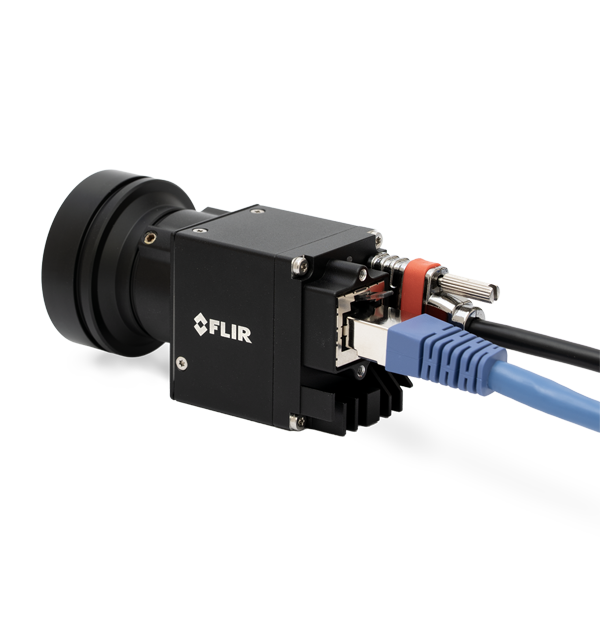
- PoE and synchronisation input: Combines network and power connectivity while supporting coordinated image acquisition with machinery or other sensors.
- Compact 29 × 37 × 56 mm, 65 g body: Fits into space-constrained machines, enclosures and OEM assemblies without a lens.
- Five F/1.2 manual-focus lens options: Allows the field of view, working distance and target pixel coverage to be matched to the installation.
- Atlas and Spinnaker SDK support: Provides development options for radiometric data integration, image streaming and application control.
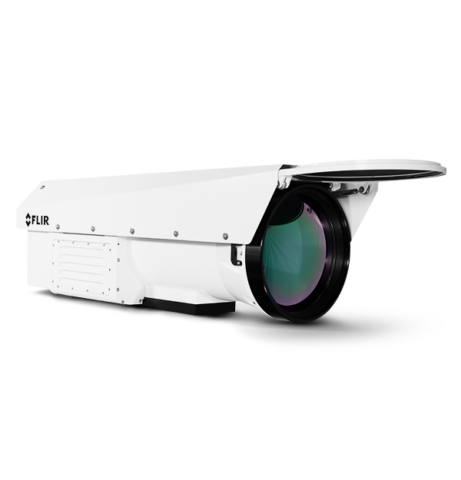
- Optional IP67 and IP69K protective housings: Adapts installations for harsh or washdown environments, with airknife and sunshield options also available.
Downloads
for IR6 - Wide Dynamic Range Infrared Machine Vision Camera
What’s in this range?
All the variants in the range and a comparison of what they offer
Core specifications
| Specification | Value |
|---|---|
Product range | IR6 |
Camera type | Fixed-mount radiometric thermal machine vision camera |
Detector | Uncooled LWIR microbolometer |
Spectral band | 7.3–14 µm |
Detector resolution | 640 × 480 pixels |
Pixel pitch | 17 µm |
Full-frame rate | 60 Hz |
Windowed readout | Advanced windowing supported |
Temporal NETD | ≤40 mK at f/1; ambient temperature 22 °C, object temperature 25 °C, with spatial and temporal filtering |
Measurement range | One mode: −20 to 600 °C safely; extendable to 1500 °C with burn-in management |
Accuracy in most situations | ±5 °C or ±5%, whichever is higher, following fixed-pattern-noise recommendations |
Accuracy under stable conditions | ±3 °C or ±2%, whichever is higher, at 21 °C, low relative humidity, fixed distance and an approximately 70 × 70-pixel target |
Drift management | Ambient compensation |
Lens options | 7 mm, 8.5 mm, 14 mm, 19 mm and 25 mm |
Aperture | F/1.2 |
Focus | Manual |
Lens mount | M25 VGA mount |
Machine vision standards | GigE Vision and GenICam |
Data connection | Gigabit Ethernet |
Power | Power over Ethernet |
Synchronisation | Synchronisation input |
Software and SDK support | Research Studio, Atlas and Spinnaker |
Kit options | Standard Kit and Science Kit |
Maximum stated operating temperature | 60 °C |
Camera dimensions | 29 × 37 × 56 mm without lens |
Camera mass | 65 g without lens |
Detector-load guidance | 400 °C blackbody-equivalent radiation; noticeable artefacts should not persist beyond five seconds after source removal and two shutter NUC operations |
Protection options | IR6-specific IP67 and IP69K protective housings available separately |
Lens variant comparison
| Effective focal length | Horizontal field of view | Vertical field of view | Minimum working distance |
|---|---|---|---|
7.0 mm | 82° | 63° | 0.6 m |
8.5 mm | 67° | 52° | 0.6 m |
14.0 mm | 46° | 34° | 0.6 m |
19.0 mm | 32° | 24° | 1.4 m |
25.0 mm | 24° | 18° | 1.0 m |
All five lenses use an F/1.2 aperture, manual focus and the M25 VGA mount.
Standard Kit and Science Kit comparison
| Included item | Standard Kit | Science Kit |
|---|---|---|
IR6 camera with selected lens | Included | Included |
Calibration certificate | Included | Included |
Product documentation | Included | Included |
Research Studio Professional | Not included | Perpetual licence |
Pelican hard case | Not included | Included |
PoE injector | Not included | Included |
GigE Ethernet cable | Not included | Included |
Order codes
| Lens | Standard part number | Standard model | Science part number | Science model |
|---|---|---|---|---|
7 mm | 41607-0101 | IR6-07 | 41607-0201 | IR6-07-SC |
8.5 mm | 41608-0101 | IR6-08 | 41608-0201 | IR6-08-SC |
14 mm | 41614-0101 | IR6-14 | 41614-0201 | IR6-14-SC |
19 mm | 41619-0101 | IR6-19 | 41619-0201 | IR6-19-SC |
25 mm | 41625-0101 | IR6-25 | 41625-0201 | IR6-25-SC |
FAQs
for IR6 – Wide Dynamic Range Infrared Machine Vision Camera
Yes, but operation above 600 °C requires burn-in management and validation using the intended scene. The camera uses one measurement mode from −20 to 600 °C safely and can extend readings to 1500 °C, avoiding manual subrange changes as process temperatures vary. Detector-load guidance uses 400 °C blackbody-equivalent radiation as a reference condition: noticeable artefacts should clear within five seconds after the source is removed and two shutter NUC operations are initiated. Very small or cold targets close to much hotter backgrounds can also experience SSR-related accuracy loss. For high-temperature installations, control the exposure duration and scene geometry, then verify measurement accuracy and image recovery with the real process before commissioning.
Select the lens according to the required scene width, mounting distance and target pixel coverage rather than focal length alone. The 7 mm and 8.5 mm options provide the widest views at 82° × 63° and 67° × 52°, both with a 0.6 m minimum working distance, while the 14 mm lens provides 46° × 34° at the same minimum distance. The 19 mm and 25 mm options narrow the view to 32° × 24° and 24° × 18°, with minimum working distances of 1.4 m and 1.0 m respectively. A narrower lens places more pixels across a distant target, whereas a wider lens covers more of a machine, production cell or conveyor. Confirm framing, focus and target pixel coverage at the actual installation distance before finalising the lens and order code.
Plan around ±5 °C or ±5%, whichever is higher, for most situations when the recommended fixed-pattern-noise procedures are followed. The tighter figure of ±3 °C or ±2%, whichever is higher, applies under stable conditions at 21 °C, low relative humidity, a fixed distance and an approximately 70 × 70-pixel target. At 600 °C, the percentage terms correspond to ±30 °C for the general figure and ±12 °C for the stable-condition figure. System accuracy can vary with the integration and scene conditions, so the stable figure should not be treated as a universal field guarantee. Validate the final target size, distance, thermal background and acceptance thresholds using the installed arrangement.
The 60 Hz full-frame rate provides a new thermal frame approximately every 16.7 milliseconds, supporting many moving-product and in-cycle inspection tasks. Whether this rate is sufficient depends on the line speed, target size, thermal contrast and the length of time the relevant feature remains within the field of view. Advanced windowing can support faster readout when only a selected image region is needed, although no maximum windowed rate is specified here. Full-frame resolution may still be preferable when several inspection points must be observed simultaneously. Run trials at the intended process speed to confirm that defects or thermal events remain visible across enough consecutive frames for dependable processing.
The IR6 is designed to supply radiometric image data to a host-controlled vision, automation or OEM system. GigE Vision and GenICam provide standardised camera control and image streaming over Gigabit Ethernet, while PoE supports power delivery through the network connection. A synchronisation input is available when image acquisition must be coordinated with machinery, triggers or other sensors. Atlas and Spinnaker SDKs support application development, while Research Studio provides thermal analysis functions. The integration design should account for host processing, network capacity, power provision, synchronisation and the required temperature-data workflow rather than treating the camera as a standalone alarm appliance.
Both kits include the IR6 camera with the selected lens, a calibration certificate and product documentation. The Science Kit additionally provides a perpetual Research Studio Professional licence, a Pelican hard case, a PoE injector and a GigE Ethernet cable. The Standard Kit can suit OEM and machine vision projects that already have compatible network hardware, software and protective packaging. The Science Kit offers a more complete package for laboratory work, evaluation, product development and detailed thermal data analysis. Lens choice remains part of the order code for either kit, so the required field of view should be established before selecting the final part number.
The camera body measures 29 × 37 × 56 mm and weighs 65 g without a lens, supporting installation in compact machinery and OEM enclosures. Its stated operating temperature extends up to 60 °C, but the complete thermal environment around the camera must still be assessed. Optional IR6-specific protective housings provide IP67 or IP69K protection for harsher or washdown locations; these ratings apply to the selected housing and not automatically to the bare camera. An airknife and sunshield can help keep the viewing window clear, while L-bracket, hinge and double-hinge accessories support positioning. Enclosure protection, cooling, window cleanliness and mounting stability should all be treated as system-level design requirements.