Industrial infrared monitoring systems
Continuous thermal monitoring for industrial environments
Industrial infrared monitoring systems provide continuous visibility of temperature and thermal behaviour across industrial processes, equipment and assets. By combining infrared cameras with suitable optics, mounting, software and monitoring interfaces, they can identify changes in thermal conditions and help operators respond before issues develop into larger problems.
Unlike a standalone thermal imager, which is often used for inspection, troubleshooting or general thermal analysis, a monitoring system is designed around continuous observation and automated response. It can monitor defined areas or assets, track temperature trends, trigger alarms and integrate thermal information with wider plant monitoring or control systems.
These systems can be used across a wide range of industrial applications, from monitoring electrical and mechanical equipment to supervising processes where changes in temperature can indicate faults, overheating or abnormal operating conditions. For more specialised environments, such as high-temperature furnaces or remote flare stacks, dedicated furnace and flare monitoring cameras may be more appropriate.
The right monitoring system therefore depends not only on the camera itself, but on the targets, measurement requirements, installation environment and level of automation required.
Do you want to know more about this technology? Try out our new Chatbot!
Why our portfolio is right for you
Our industrial infrared portfolio covers the different levels of monitoring required across industrial environments, from individual thermal imagers through to complete monitoring systems and specialised furnace or flare cameras.
We can help you select the right combination of infrared camera, optics, mounting, protection and monitoring functionality for your application. Whether you need straightforward continuous temperature monitoring or a more integrated system with automated alarms and plant connectivity, we can help balance measurement performance, environmental requirements and system complexity.
Our specialist engineering support helps you consider the complete installation rather than selecting a camera in isolation, ensuring the imaging system is appropriate for the targets, distances, operating conditions and monitoring requirements involved.
Key selection factors
-
What needs to be monitored – Define whether the system is observing a single asset, a process, a wider area or multiple locations.
-
Temperature range and measurement accuracy – The camera needs to cover the expected operating temperatures while providing the measurement performance required for the application.
-
Detector resolution and optics – Resolution, focal length and field of view determine how much detail can be resolved at the required distance.
-
Continuous operation – Consider whether the camera and associated hardware are designed for 24/7 operation and the environmental conditions at the installation site.
-
Monitoring and alarm requirements – Decide whether the system needs simple temperature thresholds, region-of-interest monitoring, trend analysis, automated alarms or more advanced image processing.
-
System integration – Interfaces with plant control systems, SCADA, recording systems or other monitoring infrastructure can be important where thermal information needs to trigger an operational response.
-
Environmental protection – Dust, moisture, heat, vibration, contamination and other site conditions may require appropriate housings, cooling or protective windows.
Technical overview
Industrial infrared monitoring systems combine infrared cameras, optics, software and supporting hardware to provide continuous visibility of temperature and thermal behaviour within an industrial environment. Rather than being used only for periodic inspection, these systems are designed to monitor a process, asset or area over time and provide information that can support maintenance, safety and process control.
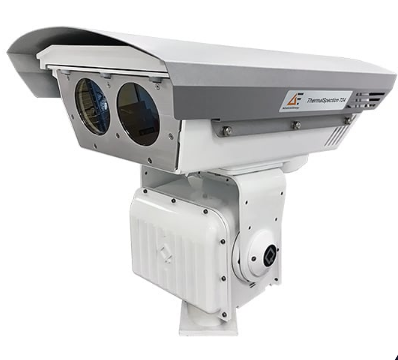
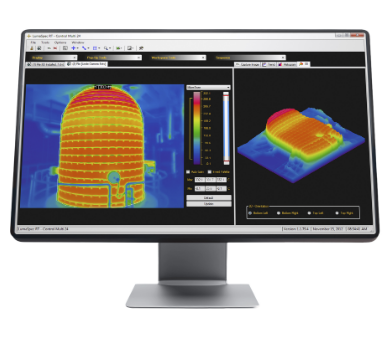
Depending on the application, a monitoring system may use a fixed thermal camera or a camera mounted on a pan/tilt platform, together with image processing, temperature measurement, recording and alarm functions. Systems can be configured to monitor defined areas of interest and identify changes or temperatures outside expected limits.
Most industrial monitoring applications use uncooled LWIR cameras because they offer a practical balance of sensitivity, size, cost and integration. More demanding applications may require different detector technologies, higher measurement performance or specialised optics.
Monitoring systems are particularly useful where continuous visibility is more valuable than occasional manual inspection. Typical applications include equipment condition monitoring, process supervision, overheating detection, electrical and mechanical assets, storage areas and other environments where temperature changes can indicate an emerging problem.
The key difference from a general-purpose thermal imager is the level of system integration. A thermal imager provides the thermal image and measurement capability; a monitoring system is built around using that information continuously and turning it into an operational response.
Integration notes
A monitoring system needs to be considered as a complete installation rather than just a camera. The camera, lens, mounting arrangement, housing, communications and software all contribute to the final performance.
Fixed cameras are often suitable for monitoring a defined area or asset, while pan/tilt systems can extend coverage across larger areas. In either case, the mounting position and field of view should be selected carefully so that the required targets remain visible and measurable.
Where temperature thresholds or automated alarms are used, the measurement conditions also need to be understood. Emissivity, reflected radiation, atmospheric effects, viewing angle and the distance to the target can all influence temperature readings. A reliable monitoring system therefore depends on appropriate camera configuration as well as correct installation and calibration.
Integration with existing plant systems should also be considered early. Depending on the application, this may include Ethernet or other communications interfaces, video and data recording, alarm outputs, software APIs or connections to SCADA and control systems.
For long-term installations, maintenance access and environmental protection are equally important. A contaminated viewing window, changing ambient conditions or a poorly positioned camera can reduce monitoring reliability even when the underlying camera is well suited to the application.
FAQ’s
Depending on the camera and application, systems can detect temperature changes, hot spots, overheating, thermal patterns, flame presence, leaks, and other abnormal conditions. Detection capabilities depend on the camera’s spectral range, sensitivity, resolution, optics, and monitoring software.
Monitoring software can analyse incoming thermal images and compare measured or calculated values against predefined thresholds or conditions. When an abnormal condition is detected, the system can generate alarms or send information to operators and connected control or monitoring systems.
Yes. Industrial IR monitoring systems can often integrate with plant control, SCADA, PLC, DCS, or other supervisory systems. Available communication protocols and outputs depend on the camera, monitoring software, and system architecture, so interface requirements should be defined during system design.
Yes. Monitoring systems can capture thermal images, temperature data, alarms, and associated metadata for later analysis. Historical data can help engineers identify trends, investigate events, compare operating conditions, and support maintenance decisions.
Key considerations include camera resolution, spectral range, thermal sensitivity, temperature measurement range, frame rate, lens and field of view, operating environment, installation distance, data interfaces, software capabilities, alarm functionality, and required availability. The complete monitoring system should be evaluated rather than the camera specification alone.
Industrial installations may require protective housings, air or water cooling, optical-window protection, air purging, and appropriate environmental sealing. The protection required depends on ambient temperature, dust, moisture, vibration, corrosive conditions, and proximity to the monitored process.
Common challenges include selecting the correct spectral band and optics, maintaining a clear optical path, accounting for emissivity and reflections, managing data and communications, integrating alarms with existing control systems, and ensuring reliable operation in harsh environments. Proper installation and system commissioning are essential for dependable long-term monitoring.