Flare monitoring cameras
Infrared imaging for remote flare observation and safety
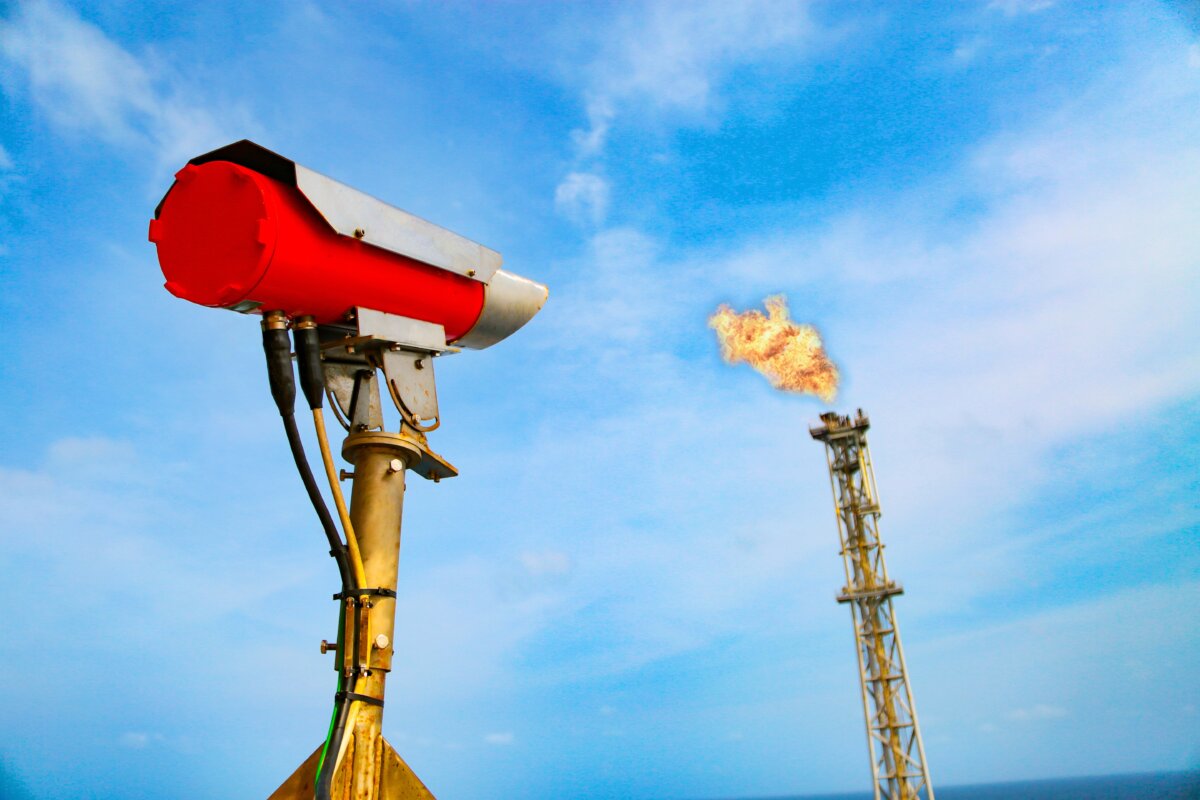
Flare monitoring cameras are designed to observe flare stacks and combustion processes from a safe distance, providing operators with a continuous view of flame presence and behaviour. They are an important part of industrial monitoring where reliable visibility is needed for safety, compliance, and operational decisions.
Unlike furnace cameras, which are designed to operate close to an extreme heat source, flare monitoring systems are positioned remotely. Their main challenge is therefore maintaining a clear and reliable image over long distances while dealing with weather, vibration, and changing atmospheric conditions.
Selection typically depends on the distance to the flare, required field of view, flame characteristics, optical performance, installation environment, and how the camera will connect to the wider monitoring or safety system.
Do you want to know more about this technology? Try out our new Chatbot!
Why our portfolio is right for you
We provide flare monitoring camera solutions from specialist suppliers with experience in long-range industrial and combustion monitoring. Our team can help you match the camera, optics, mounting arrangement, and environmental protection to the physical layout and operating conditions of your site.
Whether you need continuous flame observation, combustion verification, or integration with an existing monitoring and safety system, we can help define a solution around the required observation distance, image detail, environmental conditions, and system interfaces.
By combining long-range infrared imaging with practical engineering support, we help you establish reliable visibility of flare operations without exposing the imaging equipment to the extreme conditions found at the process itself.
Key selection factors
-
Observation distance: The camera and lens combination needs to provide sufficient detail at the distance between the installation point and flare stack.
-
Environmental exposure: Wind, rain, temperature changes, dust, and other outdoor conditions can affect both the camera and the quality of the image.
-
Flame detection reliability: The system should provide dependable visibility of the flare under different operating and environmental conditions.
-
Optics and zoom capability: Long-range optical performance is critical. Focal length, field of view, and zoom should be selected around the size and location of the flare.
-
Mounting stability: Small amounts of movement can become significant over long distances, so the mounting structure and vibration characteristics should be considered carefully.
-
Application distinction vs furnace cameras: Flare monitoring systems are intended for remote observation of combustion, whereas furnace cameras are designed for close-range or internal process monitoring in high-temperature environments.
Technical overview
Flare monitoring cameras combine infrared imaging with long-range optics to provide visibility of flames and combustion processes from towers, buildings, or other suitable structures. Infrared imaging can be particularly useful where flame visibility varies with ambient conditions or where continuous monitoring is required.
The optical system is a key part of the overall solution. Focal length, field of view, zoom capability, and detector performance all need to be considered together to ensure the flare can be resolved clearly at the required distance.
Unlike furnace cameras, flare monitoring systems are not normally exposed to the same levels of radiant heat at the camera itself. Instead, they need to cope with outdoor conditions such as wind, rain, temperature changes, vibration, and atmospheric effects. Stable mounting and reliable environmental protection are therefore central to the system design.
These cameras are commonly connected to monitoring, alarm, or safety systems, providing operators with information about flame presence and behaviour rather than directly controlling the combustion process.
Integration notes
Integration is primarily concerned with stable mounting, environmental protection, clear line-of-sight, and reliable transmission of video and control data. Cameras are often installed on elevated structures, so access for maintenance and the stability of the supporting structure should be considered during the design.
Compared with furnace cameras, there is generally less emphasis on active cooling and more on weather protection, structural stability, and long-range optical performance. Depending on the installation, pan-and-tilt positioning may also be used to maintain or adjust the viewing direction.
The wider monitoring architecture is important too. Video may need to feed into operator displays, recording systems, alarms, or site safety infrastructure. A common pitfall is underestimating atmospheric conditions: heat shimmer, haze, rain, and other effects can reduce long-range image quality even when the camera and lens are correctly specified.
FAQ’s
Flare monitoring cameras provide continuous visual and/or infrared observation of flare stacks and combustion zones. They can help operators verify flame presence, monitor flare behaviour, identify abnormal conditions, and maintain operational visibility in demanding industrial environments.
Yes, properly selected and installed systems can provide reliable flame detection and monitoring. Performance depends on factors such as spectral band, optical resolution, atmospheric conditions, flare characteristics, viewing distance, and the camera’s ability to distinguish the flame from its background.
The appropriate spectral band depends on the flare composition, temperature, background conditions, viewing distance, and monitoring objective. Different infrared bands can provide different levels of flame contrast and atmospheric performance, so wavelength selection should be based on the specific application rather than assuming one band is optimal for every flare.
Infrared imaging can provide advantages when visible-light imaging is affected by smoke, haze, or changing illumination. However, atmospheric absorption, turbulence, humidity, rain, dust, and other environmental factors can still affect image quality, particularly over long viewing distances.
Common challenges include:
long viewing distances atmospheric absorption and turbulence changing weather and lighting conditions vibration and structural movement contamination of the optical window reliable power and communications maintaining a clear line of sight
The complete installation should be designed around the environmental conditions at the flare location.
Not necessarily. Unlike cameras installed directly inside or immediately adjacent to furnaces, flare monitoring cameras can often be positioned far enough from the flame that active detector cooling is not required. However, ambient temperature, solar loading, enclosure design, and the selected detector technology still need to be considered.
Long-range flare monitoring typically requires optics selected for the required working distance, field of view, target size, and spectral band. Engineers should consider focal length, angular resolution, atmospheric transmission, and the ability to maintain the required image quality across the full monitoring range.
It is critical for long-range imaging. Small angular movements at the camera can translate into significant movement of the image at the flare stack. A rigid mounting structure and appropriate vibration control help maintain consistent framing and reliable monitoring.
Many industrial systems are designed for continuous operation. For 24/7 deployment, engineers should consider enclosure protection, environmental ratings, thermal management, optical-window contamination, power reliability, communications, and maintenance requirements.
Key factors include spectral range, detector type, resolution, sensitivity, frame rate, optical focal length, working distance, field of view, environmental rating, enclosure design, mounting requirements, communications, software, and integration capabilities. The flare’s size, composition, operating conditions, and distance from the camera should also be included in the specification.