SLC8000 out-of-band modular console manager
- Technology
- Routers, gateways, modems and switches
- Partner
- Lantronix
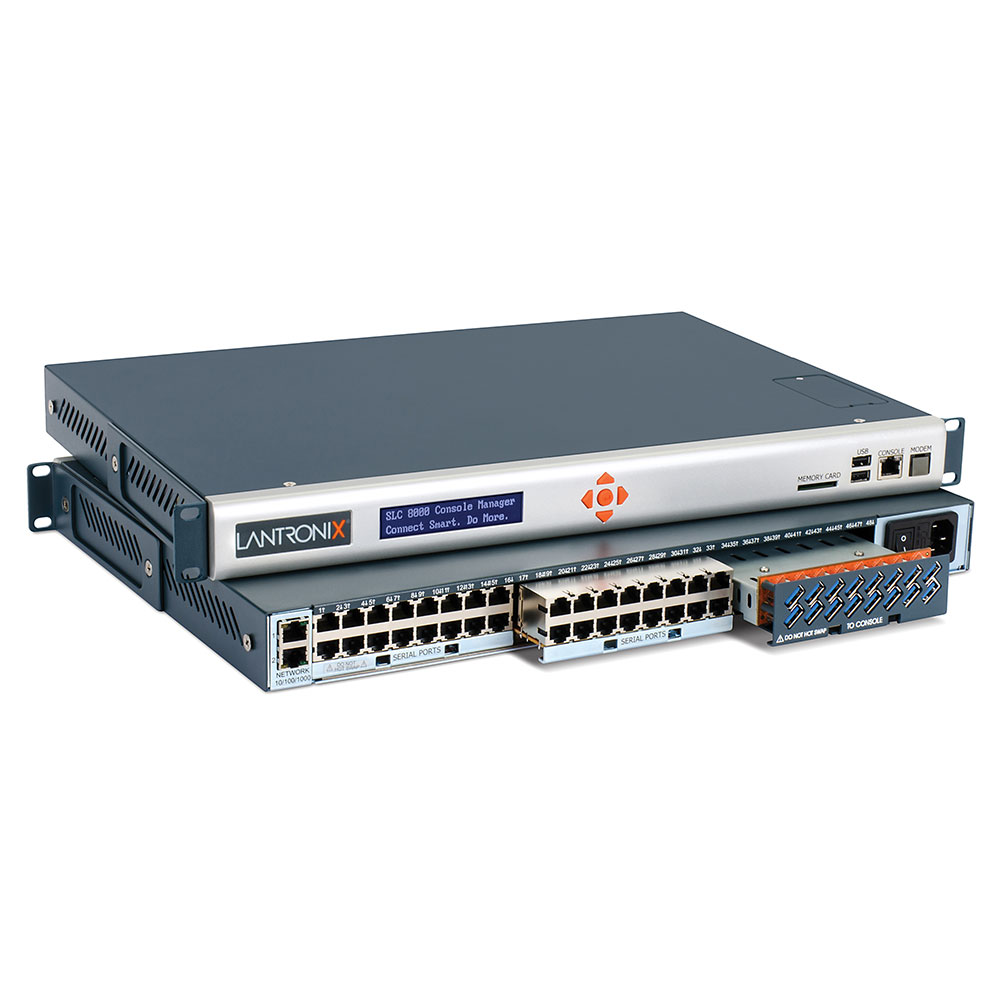
The SLC 8000 out-of-band console manager is a modular device that provides IT administrators with secure remote access to servers, network hardware, and other critical equipment. It’s designed for data centre and branch deployments where always-available management is essential. By combining traditional serial RJ45 console ports with newer USB console interfaces, the SLC 8000 allows you to manage a broad range of devices on one platform. The unique chassis accepts swappable 16-port modules, so you can customise each unit with the right mix of serial and USB ports and scale up to 48 total connections as your needs grow.
In practice, this means you can remotely monitor, troubleshoot, and control equipment from anywhere – even if the primary network is down – thanks to the SLC 8000’s support for out-of-band access via modem or cellular fail-over. Robust security is built in, including SSH/SSL encryption and integration with LDAP/AD authentication, ensuring that only authorised users can access sensitive console sessions. Overall, the SLC 8000 offers a reliable, centralised management solution for IT teams to maintain devices across data centres, labs, and remote sites with greater efficiency and peace of mind.
Range features
A high level overview of what this range offers
- Modular port design – Swappable 16-port modules (RJ45 serial or USB) let you mix and match console interfaces and expand up to 48 total ports, protecting your investment and simplifying future upgrades.
- Resilient out-of-band access – Supports dual Gigabit Ethernet for primary connectivity and offers dial-up modem and LTE cellular fail-over options to maintain remote access during network outages.
- Vendor-neutral management – Enables central console control of heterogeneous equipment (routers, switches, servers, PDUs, etc.) from any manufacturer, all through one unified interface.
- Enterprise-grade security – Protects console sessions with end-to-end encryption (SSH, TLS), per-port user permissions, and integration with external authentication services (LDAP, RADIUS, Active Directory), including an optional FIPS 140-2 mode for high-security environments.
- Easy remote administration – Provides browser-based HTML5 access and standard Telnet/SSH console login without proprietary software, allowing administrators to manage devices from anywhere using familiar tools.
- Power and environmental integration – Supports dual redundant power supplies (AC or DC models) for reliability, and works with intelligent PDUs and environmental sensors to let you monitor power and site conditions remotely (for proactive infrastructure management).
- Centralised monitoring ready – Can operate standalone or integrate with a central management platform to automate logging, alerts, and scripting across multiple SLC units, which helps streamline large-scale deployments.
Downloads
for SLC8000 out-of-band modular console manager
What’s in this range?
All the variants in the range and a comparison of what they offer
| Specification | Details |
|---|---|
Network Interfaces | 2 × Gigabit Ethernet (RJ45) + 2 × 1 Gb SFP fibre ports (for network access) |
Console Ports | Up to 48 device ports (via three 16-port modules: RJ45 RS-232 and/or USB) |
Out-of-Band Access | Dial-up modem (optional internal) and LTE cellular gateway (external) for fail-over |
Management Access | Web UI (HTML5 browser console), CLI via Telnet/SSH, SNMP (v1/v2c/v3) |
Security Features | SSH v2, TLS 1.2/1.3 encryption, firewall & IP filtering, user/group permissions, LDAP/RADIUS/AD auth support, FIPS 140-2 mode |
Power Supply | 100–240 V AC (single or dual); Optional -48 V DC input (dual feed) |
Power Consumption | < 30 W (typical maximum) |
Form Factor | 1U rack-mount chassis (H 44 mm × W 438 mm × D 305 mm) |
Operating Temp. | 0 °C to +50 °C ambient |
FAQs
for SLC8000 out-of-band modular console manager
Out-of-band management refers to accessing network devices through an alternate path when the primary network is unavailable or down. The SLC 8000 supports this by offering dial-up modem and cellular connectivity options in addition to the standard network ports. In practice, if a site’s main network is offline, administrators can still reach the SLC 8000 (and attached consoles) via a phone line or 4G/LTE gateway, ensuring they can troubleshoot and recover devices without on-site visits.
The SLC 8000 can accommodate up to 48 managed devices. It achieves this through three module bays, each accepting a 16-port console module. You can mix module types as needed – for example, install both RS-232 serial port cards and USB port cards in the same unit. This modular approach lets you support traditional serial console ports and newer USB-only console interfaces simultaneously, tailored to the mix of equipment in your environment.
With the SLC 8000’s modular design, you gain significant flexibility and scalability. If you need more console ports or different port types in the future, you can add or swap 16-port modules instead of replacing the entire unit. This means you can start with a smaller configuration (for example, 16 ports) and expand to 32 or 48 ports later by inserting additional modules. It also lets you transition gradually from older serial-based gear to newer USB-based gear without downtime – protecting your initial investment and minimising upgrade costs.
The SLC 8000 is built with redundancy and fail-over in mind. It has dual Gigabit Ethernet interfaces for connection to separate networks (or a bonded team), which already adds resilience. Beyond that, it supports out-of-band fail-over methods: you can equip it with an optional internal analog modem for dial-in access, or use an external cellular router/gateway to provide a wireless LTE link. The console manager can automatically switch to the backup connection if the primary link goes down, allowing you to reach your equipment consoles out-of-band until normal network service is restored.
Security is a key aspect of the SLC 8000’s design. All remote console sessions can be encrypted via Secure Shell (SSH) or TLS/SSL, preventing eavesdropping on management traffic. The device supports robust user authentication schemes – you can integrate it with directory services like LDAP, Active Directory, RADIUS, or use local username/password accounts. Administrators can define user roles and per-port access permissions so that team members only see or control designated devices. There’s also a built-in firewall for packet filtering, and the unit can be configured in a FIPS 140-2 compliant mode (meeting US government cryptographic standards) if required in high-security environments.
You do not need any proprietary software to use the SLC 8000. It features a web-based management interface (accessible via any modern browser with HTML5 support) which provides a console client and configuration GUI. It also supports industry-standard protocols like Telnet, SSH, and SNMP, so you can script or integrate it with your existing network management tools. Additionally, while the SLC 8000 can operate standalone, it’s compatible with central management solutions (for example, a cloud or on-premise console management software) if you choose to deploy one for large-scale oversight.
The SLC 8000 can manage virtually any device that offers a console or serial management port. Typical uses include connecting servers (Linux/Unix/Windows consoles), network switches and routers (Cisco, Juniper, etc. console ports), firewalls and load balancers, storage systems, and telecom gear. It’s vendor-neutral, so as long as the equipment has an RS-232 serial console or a USB console interface, you can attach it to an SLC 8000 port. This also extends to infrastructure like UPS units, PDUs, and environmental controllers – enabling remote monitoring and control of those systems through their management ports.
Yes. The SLC 8000 can integrate with intelligent Power Distribution Units (PDUs) and sensor modules to give you additional remote management capabilities. Through dedicated ports or network integration, it supports controlling remote power outlets (for example, power-cycling a server via a connected PDU) and can read status from environmental sensors (such as temperature or door sensors). Lantronix provides compatibility with its own SLP power controllers and Sensorsoft environmental devices, among others. This means the console manager can serve as a central point not only for console access but also for power management and site monitoring, which is very useful in lights-out data centres or unmanned IT closets.