RollR® Rollable Ribbon Central Core Microcable
- Technology
- Fibre optic cables, connectors and assemblies
- Partner
- Lightera (formerly OFS)
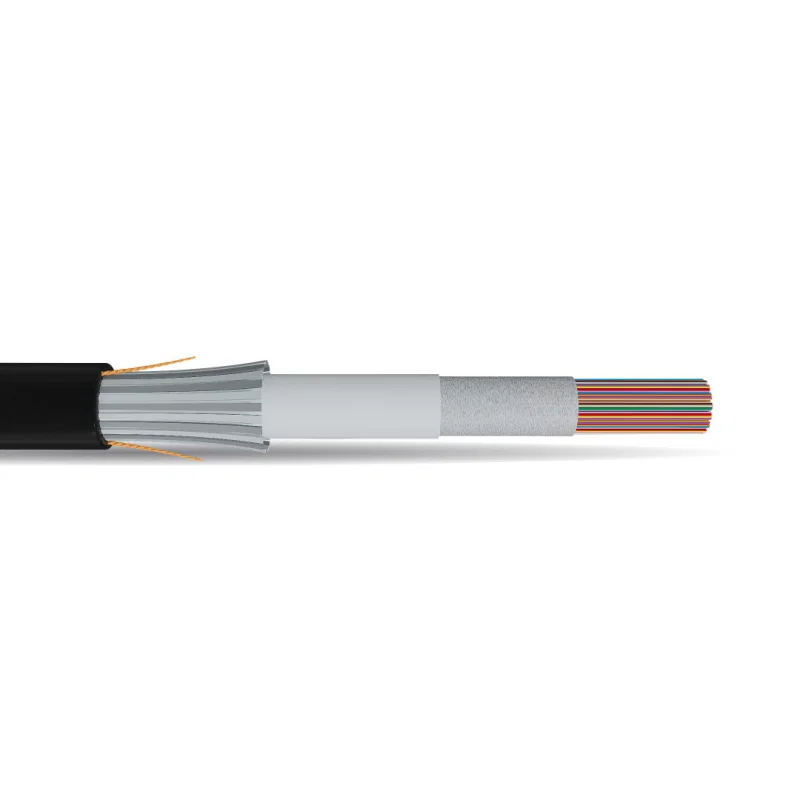
The RollR rollable ribbon central core microcable is a compact fibre optic cable designed for network operators needing to deploy large numbers of fibres in limited space. It features a central core construction with up to 288 optical fibres arranged in flexible rollable ribbons, enabling exceptional fibre density without increasing the cable’s diameter. Optimised for modern microduct installations, this microcable can be air-blown through narrow ducts in metro and access networks, making it ideal for expanding fibre-to-the-home (FTTH) and metropolitan backbone infrastructure.
The rollable ribbon design means fibres are partially bonded in ribbons that can coil and flex like loose fibres, allowing easy routing through tight bends and quick mass fusion splicing when terminating. A completely gel-free water-blocking construction further streamlines handling by eliminating sticky filling gels – technicians can prepare cable ends faster and cleaner. Overall, the RollR central core microcable offers a practical solution for high-fibre-count deployments, combining the convenience of ribbon splicing with a smaller, lighter cable that fits into existing ducts and conduits.
Range features
A high level overview of what this range offers
- Optimised for microduct blowing – Purpose-built for air-blown installation in small ducts, reducing deployment time and effort in congested routes.
- High fiber density, small diameter – Packs up to 288 fibers into a slim profile (as small as ~8–10 mm) to maximise capacity in constrained duct space.
- Rollable ribbon design – Partially bonded ribbons allow mass fusion splicing like traditional flat ribbons, yet can roll and flex individually for easy pulling and tight routing.
- Gel-free construction – Dry water-blocked core contains no gel, so cable prep is cleaner and faster with no messy gel to clean off, speeding up splicing work.
- Bend-optimised fibres – Uses 250 µm diameter single-mode fibers (ITU G.652.D/G.657.A1 compliant) that offer low bend loss, supporting installation in tight bends and corners.
- Rifled low-friction jacket – Outer jacket is ribbed internally to cut friction during blowing, enabling longer installation distances in microducts.
- Lightweight and durable – Reduced cable weight and helical strength elements improve handling and minimize strain, aiding quick placement without compromising tensile strength.
- Cost-effective deployment – Fast installation and ribbon splicing capability help lower labour costs, and high fiber count in one cable means fewer new ducts or cables are needed.
- Maximises existing infrastructure – High fiber count in a small cable lets providers utilise crowded or smaller ducts fully, avoiding the need for new excavation or additional right-of-way.
- Eco-friendly footprint – Smaller, lighter cables use less raw material and smaller reels, which can cut shipping-related CO₂ emissions by up to ~50% compared to traditional flat ribbon cables.
Downloads
for RollR® Rollable Ribbon Central Core Microcable
RollR Rollable Ribbon Central Core Microcable – Datasheet
DownloadWhat’s in this range?
All the variants in the range and a comparison of what they offer
| Specification | 144-Fibre Version | 288-Fibre Version |
|---|---|---|
Fibre count | 144 fibres | 288 fibers |
Cable outer diameter – in (mm) | 0.31″ (8 mm) | 0.39″ (10 mm) |
Cable weight – lb/kft (kg/km) | 31.8 lb/kft (47.3 kg/km) | 51.2 lb/kft (76.2 kg/km) |
Min. bend radius, with load | 24 in | 24 in |
Min. bend radius, no load | 24 in | 24 in |
Min. bend radius, storage | 18 in | 18 in |
Maximum short-term tensile load (MRCL) | 300 lbf | 300 lbf |
Maximum long-term tensile load | 120 lbf | 120 lbf |
Standard compliance (outdoor microduct cable) | IEC 60794-5-10 | IEC 60794-5-10 |
Testing standard (mechanical/ environmental) | ANSI/ICEA S-122-744 | ANSI/ICEA S-122-744 |
Operating temperature | –40 °F to 158 °F (–40 °C to 70 °C) | –40 °F to 158 °F (–40 °C to 70 °C) |
Storage temperature | –40 °F to 158 °F (–40 °C to 70 °C) | –40 °F to 158 °F (–40 °C to 70 °C) |
Installation temperature | –22 °F to 140 °F (–30 °C to 60 °C) | –22 °F to 140 °F (–30 °C to 60 °C) |
FAQs
for RollR® Rollable Ribbon Central Core Microcable
Rollable ribbon technology is a method of bundling optical fibers that combines the benefits of flat fiber ribbons with the flexibility of loose fibers. In a rollable ribbon, individual fibers are intermittently bonded together in a flexible lattice. This allows an intact ribbon of fibers to be mass fusion spliced all at once (like a traditional flat ribbon) but also enables the ribbon to be rolled or bundled into a smaller circle for routing. The result is much higher fiber density in a cable (more fibers in the same space) and easier fiber management, since the bonded fibers can flex and separate as needed during installation and splicing.
This microcable is designed for outdoor microduct installations in telecom networks – for example in metropolitan fiber routes, access networks, or fiber-to-the-premises deployments where duct space is limited. It is optimised for air-blown installation: the cable can be blown or jetted through small innerducts using compressed air. The RollR cable’s low-friction, rifled jacket and robust construction allow it to be installed over long distances in microduct pathways without getting stuck. Typically, network operators will deploy it in existing conduit or innerduct infrastructure rather than direct-burying it. (It is not intended for unsupported aerial spans unless it’s lashed to a messenger wire or installed in an aerial conduit.)
The standard RollR central core microcable comes in 144-fiber and 288-fiber versions. Both versions share the same cable design, with the 288-fibre option having a slightly larger diameter (about 10 mm) to accommodate the higher fiber count, whereas the 144-fibre cable is around 8 mm in diameter. There is also an advanced variant using 200 µm fibers (marketed as RollR 200) which can achieve even higher counts (for example 432 fibers in a similar diameter), but the primary offerings for the RollR central core series are 144 and 288 fibers. These options allow network designers to choose a cable size based on the required fiber count and duct space available.
“Central core” means all the optical fibers (organized in their rollable ribbons) are contained within a single central buffer tube in the cable. This contrasts with multi-tube cables where fibers are divided among several tubes stranded around a central strength member. The central core design simplifies the cable structure and typically results in a smaller overall diameter for a given fiber count, since there’s just one tube and no extra fillers between multiple tubes. It also means that during fiber access or splicing, all ribbons are in one place (the central tube), which can speed up preparation. The trade-off is that very high fiber counts can make a single tube crowded, but with rollable ribbons the design manages to pack fibers efficiently. Overall, the central core approach in the RollR microcable helps maximise fiber density and keeps the cable compact, which is ideal for microduct deployment.
Yes. One of the key advantages of rollable ribbon architecture is that it supports mass fusion splicing using standard ribbon splicers. Although the fibers in a rollable ribbon are only partially bonded (rather than fully glued along their entire length like a flat ribbon), they can be easily arranged into a planar ribbon form for splicing. Essentially, you can treat a group of (say) 12 fibers in a rollable ribbon just like a conventional ribbon for the splicing process – fusing all fibers in one go with a suitable mass-fusion splicer. After splicing, the ribbon can revert to its loosely bonded form, allowing the fibers to be coiled and routed neatly in a splice tray. This gives installers the best of both worlds: fast ribbon splicing when terminating many fibers, and flexible handling of fibers for routing and storage.
The RollR central core microcable is a completely gel-free (dry) cable. Instead of gel, it uses dry water-blocking technology (such as water-swellable yarns/tapes) inside the buffer tube and under the jacket to prevent water intrusion. This means there’s no greasy filling compound inside the cable. A gel-free design offers several benefits: it makes fiber access and splicing quicker and cleaner (technicians don’t need to spend time cleaning off gel from fibers), it reduces cable weight, and it is generally more environmentally friendly to manufacture and dispose of. The absence of gel has no negative impact on water penetration resistance – the cable still meets industry water-blocking standards through its dry swelling materials.
As a rule, this microcable is not recommended for standalone aerial spans. It is primarily designed for underground or protected installations (inside ducts, conduits, or microducts). The cable doesn’t have integrated strength or support for long unsupported runs in open air, and it lacks features like rodent protection or UV-resistant jacketing that some aerial cables have. If needed, it could be deployed aerially by pulling it through an aerial duct or by lashing the microduct (containing the cable) to a messenger wire, but the cable by itself isn’t meant to be strung between poles. For aerial fiber needs, other cable designs (like figure-8 self-support cables) would be more appropriate. In summary, the RollR microcable excels in below-ground duct applications but should not be hung in the air without proper support.
The RollR rollable ribbon central core microcable conforms to key fiber optic cable standards for outdoor use. It complies with IEC 60794-5-10, which is the international standard specific to microduct optical cables (ensuring it meets criteria for dimensions, materials, and environmental performance in microduct applications). Additionally, it has been tested according to ANSI/ICEA S-122-744, an industry standard for fiber optic cable performance (covering mechanical and environmental tests like tensile strength, crush resistance, temperature cycling, etc.). The cable’s optical fibers themselves adhere to ITU-T G.652.D and G.657.A1 specifications, meaning they are standard single-mode fibers with bend-insensitive characteristics. Together, these certifications and standards indicate that the RollR microcable has been designed and qualified to meet rigorous telecom industry requirements.