Analytical Instruments
- Technology
- Scientific instruments
- Partner
- Stanford Research Systems (SRS)
Stanford Research Systems (SRS) develops and manufactures a range of analytical instruments for scientists, researchers and engineers working across chemistry, materials science, electrochemistry, surface science and gas analysis.
The SRS analytical range combines specialised measurement technologies with practical laboratory instrumentation, covering applications from gas concentration and purity measurement to melting-point determination, surface and thin-film analysis, electrochemistry and pulsed UV experiments.
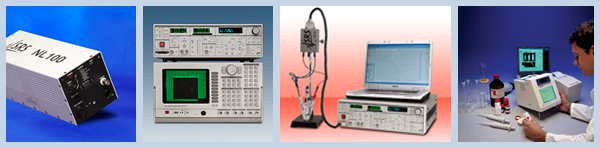
The range includes the BGA244 Binary Gas Analyzer, OptiMelt MPA100 automated melting point apparatus, DigiMelt MPA160/MPA161 student melting point systems, QCM200 Quartz Crystal Microbalance, NL100 Nitrogen Laser and EC301 Potentiostat/Galvanostat.
Designed for both routine laboratory work and advanced research, SRS instruments offer precise measurement, straightforward operation and computer connectivity, with software and interfaces available across much of the range.
Analytical instrumentation for demanding laboratory applications
Different analytical challenges require different measurement techniques. SRS’s analytical portfolio brings together complementary instruments for characterising gases, materials, surfaces, chemical compounds and electrochemical systems.
Whether you need to determine the composition of a binary gas mixture, identify the melting point of a compound, monitor nanoscale changes at a surface, investigate electrochemical behaviour or generate pulsed UV radiation for fluorescence and mass-spectrometry applications, SRS provides dedicated instrumentation for the task.
Range features
A high level overview of what this range offers
-
A broad range of analytical techniques SRS provides instruments covering gas analysis, melting-point measurement, quartz crystal microbalance measurements, electrochemistry and pulsed UV laser applications. This makes the analytical range suitable for a diverse range of research and laboratory environments.
-
Research-grade measurement performance The instruments are designed around demanding scientific measurements, with features such as high-resolution frequency measurement, precise temperature control, low-current electrochemical measurement and accurate gas-composition analysis.
-
Automation where it matters Several instruments incorporate automated measurement and control functions. The OptiMelt, for example, automatically detects melting behaviour using a built-in digital camera and image processing, while the EC301 supports automated electrochemical measurement routines through SRSLab software.
-
Powerful software and computer connectivity SRS instruments can be integrated into computer-based measurement workflows through interfaces such as USB, RS-232, RS-422, Ethernet and GPIB, depending on the instrument. Dedicated Windows software is available for products including the BGA244, QCM200, MPA100 and EC301.
-
Designed for research flexibility The EC301, in particular, provides an open command set and arbitrary waveform capability, allowing researchers to develop customised experiments and control the instrument using their own software.
-
Practical laboratory operation SRS combines advanced measurement capability with features intended to simplify everyday use. Examples include touchscreen operation on the MPA100, automatic sample packing on the DigiMelt, real-time data logging on the BGA244 and Windows-based acquisition software for the QCM200.
-
Applications across research and industry The range can support applications spanning pharmaceutical and chemical laboratories, electrochemistry, materials science, semiconductor processing, surface science, biotechnology, gas monitoring and analytical research.
-
Complementary instrumentation Several SRS instruments can be used together. For example, the QCM200 can be integrated with the EC301 for electrochemical quartz crystal microbalance (EQCM) measurements, allowing electrochemical behaviour and surface mass changes to be studied simultaneously.
What’s in this range?
All the variants in the range and a comparison of what they offer
| Product | Instrument type | Primary measurement / function | Key applications |
|---|---|---|---|
BGA244 | Binary Gas Analyzer | Gas concentration, purity and physical gas measurements | Gas blending, purity monitoring, MOCVD, helium recovery, ozone, industrial gas processes |
MPA100 OptiMelt | Automated Melting Point Apparatus | Melting point and melting range | Pharmaceutical, chemical and research laboratories |
MPA160 / MPA161 DigiMelt | Student Melting Point Apparatus | Manual/visual melting-point determination with controlled temperature ramping | Teaching laboratories and undergraduate chemistry |
QCM200 | Quartz Crystal Microbalance | Surface mass and viscosity measurements via quartz-crystal frequency/resistance | Surface science, thin films, biosensors, electrochemistry |
NL100 | Nitrogen Laser | Pulsed 337 nm UV generation | Fluorescence, MALDI-TOF, pulsed UV experiments |
EC301 | Potentiostat / Galvanostat | Electrochemical potential/current measurement and control | Electrochemistry, EIS, corrosion, batteries, sensors and materials research |
BGA244 Binary Gas Analyzer
Fast, accurate measurement of binary gas mixtures
The BGA244 Binary Gas Analyzer determines the ratio of gases and vapours in a binary mixture by measuring the speed of sound and temperature of the gas.
Unlike traditional thermal-conductivity analysers, the BGA244 operates without lasers, filaments, chemical sensors, optical sources, separation columns, reference gases or reagents. SRS states that the instrument can operate virtually maintenance-free and contains thermodynamic and molar-mass data for nearly 500 gases.
The BGA244 provides three primary measurement modes:
-Binary Gas Analyzer — determines the ratio of two gases -Gas Purity Analyzer — measures the purity of a single gas -Physical Measurements Analyzer — reports speed of sound, temperature and pressure
Applications include gas concentration monitoring, gas blending, PSA systems, helium recovery, ozone purity, MOCVD monitoring, industrial gas processing and general research.
| Model | Description | Key configuration |
|---|---|---|
BGA244 | Standard Binary Gas Analyzer | 1/8"-27 female NPT gas fittings |
BGA244HP | High-Purity Process Gas Analyzer | Welded 1/4" male VCR fittings; helium leak checked |
BGA244E | Environmental version | IP66/NEMA-4X polycarbonate enclosure |
OEM configurations | OEM integration | Configuration available to suit specific applications |
MPA100 OptiMelt Automated Melting Point Apparatus
Automated, image-based melting-point analysis
The MPA100 OptiMelt is an automated melting point apparatus designed to determine melting points and melting ranges of chemical substances.
A built-in high-resolution digital camera continuously captures the sample during heating, while digital image processing identifies phase transitions. This allows measurements to be performed automatically and provides a permanent visual record of the melt.
The instrument uses closed-loop PID temperature control and a platinum RTD sensor, with programmable ramp rates from 0.1°C/min to 20°C/min and measurements up to 400°C.
For regulated laboratories, the optional MeltView 2 Pro software provides 21 CFR Part 11-ready functionality including electronic signatures, audit trails, PDF reports and permission-based operation.
| Specification | MPA100 |
|---|---|
Measurement | Melting point and melting range |
Temperature range | Start: ambient +10°C to 396°C; stop up to 400°C |
Temperature resolution | 0.1°C |
Ramp rate | 0.1–20°C/min |
Temperature accuracy | ±0.3°C to 100°C; ±0.5°C to 250°C; ±0.8°C to 400°C |
Reproducibility | 0.2°C |
Temperature sensor | Built-in Pt RTD |
Temperature control | Closed-loop PID |
Heat-up time | Approx. 10 min, 50–350°C |
Cool-down time | Approx. 10 min, 350–50°C |
Sample capacity | Up to 3 capillaries |
Display | 5.8" back-lit touchscreen LCD |
Computer interface | USB |
Printer interface | RS-232 |
Power | 90–264 VAC, 47–63 Hz, 125 W |
Operating temperature | 0–40°C |
Weight | 9 lb |
Dimensions | 7.5" × 10" × 8.5" |
MPA160 & MPA161 DigiMelt Student Melting Point Systems
Safe, straightforward melting-point measurement for teaching laboratories
The DigiMelt MPA160 and MPA161 are digital melting point systems developed specifically for student laboratories.
Unlike traditional mercury-thermometer systems, DigiMelt uses a built-in platinum RTD and closed-loop PID temperature control. Students can set the start temperature, ramp rate and stop temperature while the instrument controls the oven automatically.
The system accommodates up to three capillary tubes and incorporates a built-in tube tapper for sample packing.
| Specification | MPA160 | MPA161 |
|---|---|---|
Application | Student laboratory | Student laboratory |
Temperature range | 50–260°C | 50–260°C |
Temperature resolution | 0.1°C | 0.1°C |
Typical accuracy | ±0.6°C below 200°C; ±1.0°C ≥200°C | Same |
Reproducibility | 0.2°C | 0.2°C |
Ramp rates | 0.5–20°C/min | 0.5–20°C/min |
Temperature sensor | Pt RTD | Pt RTD |
Control | Closed-loop PID | Closed-loop PID |
Capacity | Up to 3 tubes | Up to 3 tubes |
Sample packing | Automatic tube tapper | Automatic tube tapper |
Supply | 100–132 VAC | 200–250 VAC |
Power | 75 W nominal | 75 W nominal |
Dimensions | 6.5" × 9.5" × 5.25" | 6.5" × 9.5" × 5.25" |
Weight | 2 lb | 2 lb |
QCM200 Quartz Crystal Microbalance
High-resolution surface and thin-film measurements
The QCM200 Quartz Crystal Microbalance measures changes in mass and viscosity occurring at or near surfaces and within thin films.
The system uses a 5 MHz quartz crystal and measures both frequency and resistance. Frequency changes can be related to mass loading at the crystal surface, while resistance measurements provide additional information about the interaction between the crystal and the material being studied.
The QCM200 is supplied as a complete measurement system incorporating the controller, crystal oscillator electronics, crystal holder, three quartz crystals and Windows software.
Applications include:
-Surface science -Thin-film research -Biosensors -Protein adsorption -DNA/RNA hybridisation -Antigen-antibody studies -Biomaterials -Corrosion studies -Polymer research -Electrochemistry -Biofouling studies -Self-assembled monolayers -MEMS and nanomaterials
| Specification | QCM200 |
|---|---|
Crystal frequency | 5 MHz nominal |
Crystal type | AT-cut, plano-plano |
Frequency resolution | 0.01 Hz / 0.1 Hz / 1 Hz depending on gate |
Gate times | 0.1 s, 1 s, 10 s |
Frequency accuracy | ±1.5 ppm |
Frequency stability | <4 × 10⁻⁹ Allan variance typical |
Frequency output | 5 MHz TTL |
External timebase | 10 MHz |
Resistance range | 0–5000 Ω |
Resistance resolution | 0.001 Ω to 0.1 Ω depending on range |
Capacitance cancellation | 10–40 pF |
Analog frequency output | ±10 V, 20-bit |
Interfaces | RS-232 |
Crystal diameter | 1 inch |
Electrode options | Cr/Au; Ti/Au; Ti/Pt optional |
Operating temperature | 0–40°C |
Power | 15 W |
Dimensions | 10.625" × 2" × 7" |
Weight | 2 lb |
NL100 Nitrogen Laser
Compact pulsed UV source for fluorescence and mass spectrometry
The NL100 Nitrogen Laser provides high-energy pulsed ultraviolet radiation at 337 nm, making it suitable for fluorescence measurements, MALDI-TOF mass spectrometry and other pulsed-UV experiments.
It produces 3.5 ns pulses at 337 nm, with pulse energies of up to 170 µJ and repetition rates up to 20 Hz. This corresponds to a peak power of approximately 45 kW and an average power of approximately 3 mW.
The NL100 uses a replaceable sealed laser cartridge containing the high-voltage storage capacitors, switching element and laser tube. The cartridge is factory aligned, eliminating the need for mirror alignment during normal operation.
| Specification | NL100 |
|---|---|
Laser type | Nitrogen laser |
Wavelength | 337 nm |
Pulse width | 3.5 ns |
Pulse energy | 170 µJ |
Peak power | 45 kW |
Average power | 3 mW |
Repetition rate | Up to 20 Hz |
Triggering | Internal or external |
Laser cartridge | Replaceable sealed cartridge |
Optical alignment | Factory aligned; no mirror alignment required |
Typical applications | Fluorescence, MALDI-TOF, pulsed UV experiments |
EC301 Potentiostat / Galvanostat
Research-grade electrochemical measurement and control
The EC301 Potentiostat/Galvanostat is a high-compliance electrochemical workstation designed for research applications including electrochemical impedance spectroscopy, cyclic voltammetry, corrosion studies and materials research.
It provides ±30 V compliance voltage, ±1 A maximum current and ±15 V polarization, together with built-in EIS and GPIB/Ethernet connectivity.
The EC301 is designed particularly with electrochemical impedance spectroscopy (EIS) in mind. Stand-alone EIS measurements can be performed from 1 mHz to 100 kHz, while an external frequency-response analyser can be used for measurements up to 1 MHz via analogue connections.
Key EC301 capabilities -Potentiostatic operation -Galvanostatic operation -Zero-resistance ammeter (ZRA) mode -Electrochemical impedance spectroscopy -Cyclic voltammetry -Linear sweep voltammetry -Cyclic staircase voltammetry -Square-wave voltammetry -Differential pulse voltammetry -Differential normal pulse voltammetry -Timed holds -Arbitrary waveform generation -Rotating electrode control -EQCM measurements with QCM200
| Specification | EC301 |
|---|---|
Compliance voltage | ±30 V |
Maximum current | ±1 A |
Polarisation range | ±15 V |
Potentiostat current ranges | ±1 nA to ±1 A |
Galvanostat current ranges | ±1 nA to ±1 A |
Potentiostat voltage accuracy | ±0.2% of setting ±5 mV |
Differential electrometer input | ±15 V |
Electrometer impedance |
|
Electrometer bandwidth |
|
Acquisition rate | 250 kS/s |
EIS frequency range | 1 mHz–100 kHz |
EIS dynamic range | 120 dB |
EIS modes | Potentiostatic / galvanostatic |
EIS sweep | Linear or logarithmic |
Current interrupt switching | <5 µs |
IR compensation | 3 Ω–3 GΩ, depending on current range |
Temperature measurement | 100 Ω Pt RTD |
Temperature accuracy | ±1°C, -100°C to +200°C |
Communication | IEEE-488.2 / TCP/IP |
Software | SRSLab, Windows |
Dimensions | 17" × 5.25" × 19.5" |
Weight | 26 lb |
FAQs
for Analytical Instruments
No. The range combines five distinct instrument categories: binary gas analysis, melting-point measurement, quartz crystal microbalance work, nitrogen-laser operation and potentiostat/galvanostat control. Because these instruments address different analytical methods, they do not share a common performance envelope or system configuration. No cross-range values are defined for accuracy, interfaces, dimensions, electrical supply requirements or environmental limits. In practice, selection should begin with the required measurement principle, followed by a model-level review of ranges, tolerances, accessories, connectivity and installation conditions before a purchasing specification is released.
The BGA244 is the model listed for binary gas analysis. Compatible gas pairs, concentration range, sample pressure, flow requirements, response time and measurement accuracy are not defined at range level. These parameters determine whether an analyser can work with the intended gas stream and whether external pressure regulation, filtration or flow control may be required. Engineers should therefore treat the BGA244 as the relevant starting model rather than a fully specified measurement solution. Gas compatibility, calibration arrangements, wetted materials, communications and environmental requirements should all be confirmed before integration into a laboratory or monitoring system.
The MPA100 is listed as a melting point apparatus, while the MPA160 and MPA161 are grouped as student models. No technical comparison is defined for temperature range, ramp control, sample capacity, resolution, observation method, repeatability or data handling. The student designation indicates a separate model group, but it does not establish which performance or functional differences apply. For specification purposes, engineers should compare sample throughput, heating programmes, temperature accuracy, user controls and recording requirements at model level. This avoids selecting by model description alone when laboratory workload or method requirements may call for capabilities not defined across the range.
The QCM200 is the model identified for quartz crystal microbalance applications, but its operating parameters are not defined at range level. Important selection points include supported crystal type and frequency, sensor holder compatibility, oscillator arrangement, frequency resolution, available outputs, communications and software support. These factors affect whether existing crystals, deposition hardware or experimental cells can be used without redesign. Environmental control requirements should also be reviewed because temperature, pressure and mechanical stability can influence a QCM measurement arrangement. The complete measurement chain should therefore be evaluated before specifying the QCM200 for deposition monitoring, surface studies or other mass-sensitive experiments.
No. The NL100 is identified as a nitrogen laser, but the information needed to assess a specific optical experiment is not defined at range level. Engineers would normally need to verify wavelength, pulse energy, pulse duration, repetition rate, beam dimensions, divergence, triggering arrangements and electrical supply requirements. Without these parameters, compatibility with optical components, detectors, timing electronics and the intended sample cannot be established. Safety classification, enclosure requirements and interlock provisions must also be reviewed before installation. The NL100 should therefore be treated as the relevant product identifier while the complete optical, electrical and safety requirements are assessed separately.
The EC301 is identified as the potentiostat/galvanostat within the analytical instruments range. Compliance voltage, potential and current ranges, resolution, control modes, bandwidth, electrode connections, data acquisition functions and communications are not defined at range level. These characteristics determine whether the instrument can control the intended electrochemical cell while maintaining the required potential or current. Engineers should compare the anticipated cell impedance and current with the instrument’s model-specific limits and consider whether external shielding or low-current measurement practices are required. Electrode configuration, experiment sequencing, software integration and data export should also be established before the EC301 is selected.
Direct comparison is mainly useful between instruments serving the same analytical task. The MPA100, MPA160 and MPA161 form the only clearly shared application group, whereas the BGA244, QCM200, NL100 and EC301 use different measurement or control principles. A single numerical comparison would therefore combine unrelated parameters and could give a misleading view of suitability. Selection should instead begin with the required physical quantity, sample type, experimental method and operating environment. Once the appropriate category has been identified, model-specific accuracy, range, interfaces, accessories, installation requirements and operating limits can be compared against the application’s acceptance criteria.