NTC-550 series 5G Industrial IoT Gateway
- Technology
- Routers, gateways, modems and switches
- Partner
- Lantronix
The NTC-550 Series 5G Industrial IoT Gateway is a robust wireless gateway designed for modern Industry 4.0 and mobile applications. It provides ultra-fast 5G connectivity with automatic 4G LTE fallback to help maintain continuous broadband access. Built-in Wi-Fi 6 and Bluetooth enable local wireless connectivity for on-site devices, sensors, and client access. The platform is well suited for smart factories, industrial automation, remote utility monitoring, transportation, and public safety fleets. Its rugged metal enclosure and wide operating range support reliable use in harsh industrial and mobile environments.
Multiple antenna connections, high-speed Ethernet, serial and I/O interfaces, and integrated GNSS expand deployment flexibility. Advanced routing, VPN, and remote management functions make it easier to integrate into enterprise and industrial networks. Overall, the NTC-550 Series is designed for secure, resilient, and always-on connectivity in mission-critical IoT deployments.
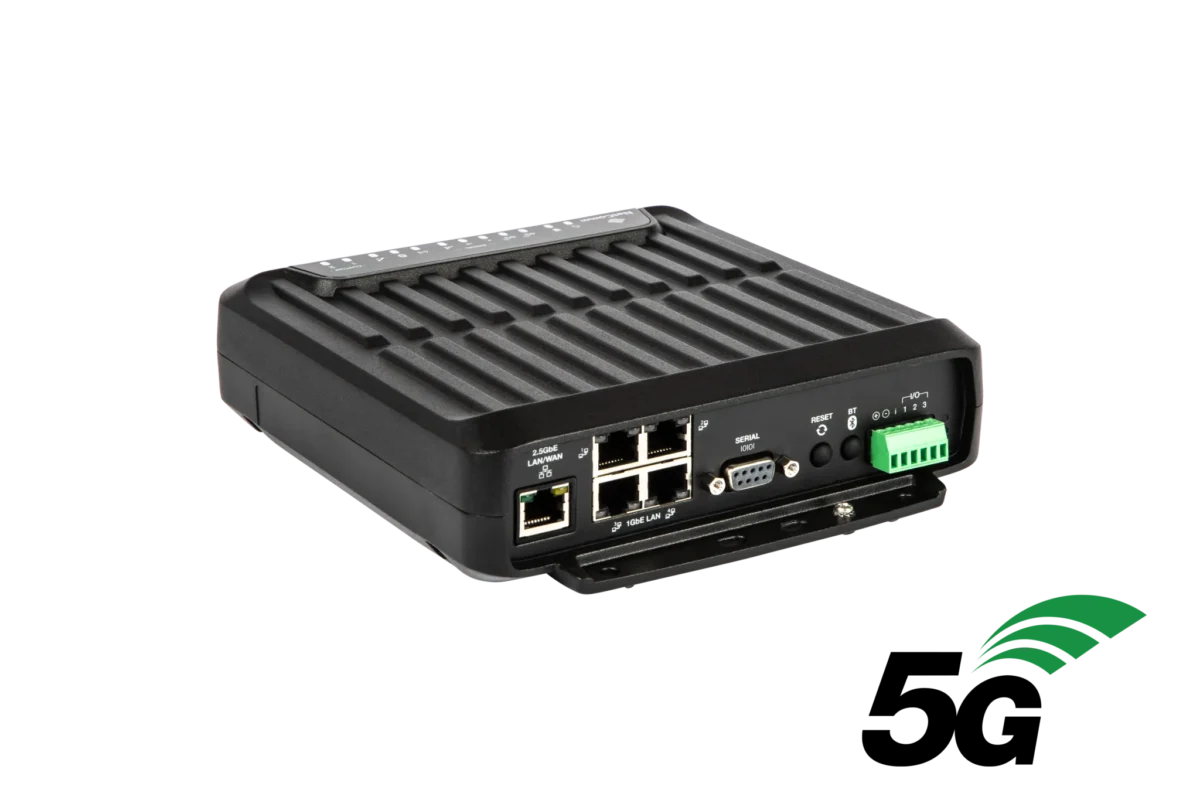
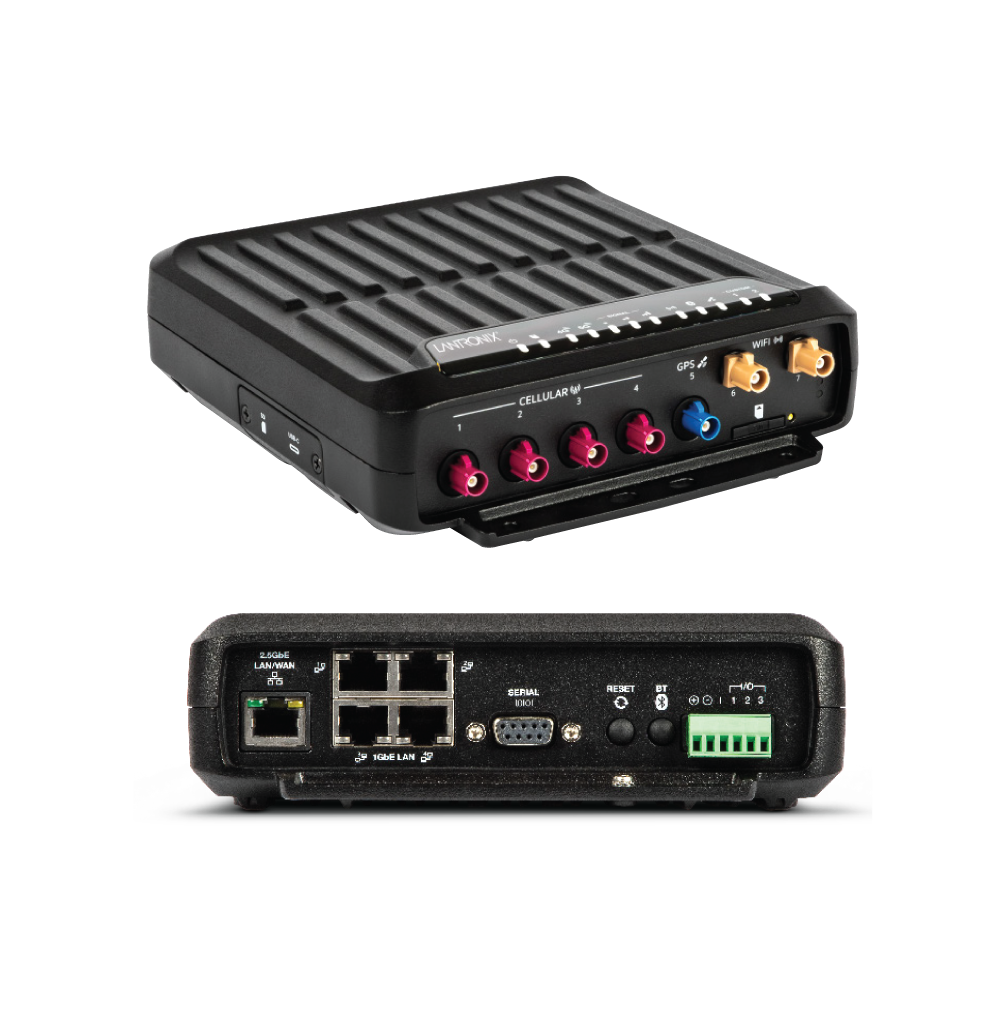
The NTC-550 Series 5G Industrial IoT Gateway is engineered for organizations that need dependable high-speed connectivity in fixed and mobile deployments. Combining 5G NR, 4G LTE fallback, Wi-Fi 6, Bluetooth, Gigabit Ethernet, serial connectivity, GPIO, and GNSS in one rugged platform, it serves as a versatile communications hub for industrial automation, fleet connectivity, utilities, and remote site networking.
With support for both NTC-551 and NTC-552 regional variants, the series helps simplify deployments across North America, EMEA, and APAC markets while maintaining a consistent hardware and management experience.
Range features
A high level overview of what this range offers
- 5G connectivity with LTE fallback: Supports 5G NR Release 16 SA/NSA with automatic fallback to 4G LTE for resilient broadband access
- Wi-Fi 6 and Bluetooth built in: Enables local wireless networking, hotspot capability, client mode, and Bluetooth LE peripheral or sensor integration
- High-speed wired connectivity: Includes 1 x 2.5 Gbps WAN/LAN port plus 4 x 1 Gbps LAN ports for flexible network design
- Industrial interfaces: Provides RS-232/422/485 serial, 3 x GPIO, USB-C, microSD, and GNSS for edge integration and tracking
- Vehicle-ready design: Features an ignition sense input for in-vehicle deployments such as emergency, transit, and fleet applications
- Advanced networking and security: Supports routing, firewalling, VPN technologies including IPsec, GRE, and OpenVPN, plus VLAN and failover capabilities
- Cloud and remote management ready: Supports TR-069, MQTT, SNMP, OMA LWM2M, SMS control, and secure OTA management
- Rugged industrial construction: Uses a durable IP41-rated metal enclosure with an operating range of -30 °C to +70 °C and up to 95% RH
- Built for continuous operation: Designed for long-term 24/7 service in remote, unmanned, and mission-critical installations
What’s in this range?
All the variants in the range and a comparison of what they offer
| Specification | NTC-551 (North America) | NTC-552 (EMEA / APAC) |
|---|---|---|
5G Bands (Sub-6 GHz) | n2, n5, n7, n12, n13, n14, n25, n26, n29, n30, n38, n41, n48, n66, n71, n77, n78 | n1, n3, n5, n7, n8, n20, n28, n38, n40, n41, n75, n76, n77, n78 |
4G LTE Bands | B2, B4, B5, B7, B12, B13, B14, B17, B25, B26, B29, B30, B38, B41, B42, B43, B46, B48, B66, B71 | B1, B3, B5, B7, B8, B20, B28, B32, B38, B40, B41, B42, B43 |
Target regions | North America (USA, Canada) | EMEA, APAC (excluding JP/CN) |
Wireless LAN & PAN | Wi-Fi 6 (802.11ax), dual-band 2.4 GHz & 5 GHz (MU-MIMO); Bluetooth LE 4.2 | Wi-Fi 6 (802.11ax), dual-band 2.4 GHz & 5 GHz (MU-MIMO); Bluetooth LE 4.2 |
Ethernet ports | 1 x 2.5 Gbps (WAN/LAN selectable), 4 x 1 Gbps LAN | 1 x 2.5 Gbps (WAN/LAN selectable), 4 x 1 Gbps LAN |
Serial & I/O | 1 x serial port (RS-232/422/485); 3 x GPIO; 1 x ignition input | 1 x serial port (RS-232/422/485); 3 x GPIO; 1 x ignition input |
USB & Expansion | 1 x USB-C port; 1 x microSD slot for storage | 1 x USB-C port; 1 x microSD slot for storage |
GNSS (Positioning) | GPS, GLONASS integrated receiver | GPS, GLONASS integrated receiver |
Operating temperature | -30 °C to +70 °C | -30 °C to +70 °C |
Operating humidity | 0%–95% RH (non-condensing) | 0%–95% RH (non-condensing) |
Enclosure rating | Rugged metal housing (IP41 ingress protection) | Rugged metal housing (IP41 ingress protection) |
Dimensions (D x W x H) | 193.3 mm x 175 mm x 51.7 mm | 193.3 mm x 175 mm x 51.7 mm |
Weight | 1.05 kg | 1.05 kg |
Certifications | CE; UKCA; FCC; RCM; RoHS/REACH compliant | CE; UKCA; FCC; RCM; RoHS/REACH compliant |
FAQs
for NTC-550 series 5G Industrial IoT Gateway
The NTC-550 Series supports 5G NR connectivity with both Standalone (SA) and Non-Standalone (NSA) operation, along with automatic fallback to 4G LTE when 5G is not available. This helps maintain reliable connectivity across a broad range of mobile network environments. The series is designed for modern 4G/5G deployments rather than legacy 3G or 2G networks.
The main difference is regional band support. NTC-551 is intended for North America, including support for bands used by US and Canadian carriers such as CBRS band 48 and FirstNet band 14. NTC-552 is intended for EMEA and APAC markets and supports the frequency bands commonly used in those regions. Core hardware features, interfaces, and platform capabilities are otherwise the same.
Yes. The NTC-550 is designed for rugged industrial and in-vehicle deployment. It uses a durable metal enclosure, supports operation from -30 °C to +70 °C, and includes an ignition sense input for vehicle integration. This makes it suitable for emergency vehicles, fleet applications, industrial facilities, and remote unmanned sites.
The gateway supports a secure web interface over HTTPS and remote management protocols including TR-069, SNMP v3, OMA LWM2M, MQTT, and SMS control. These features support centralized monitoring, configuration, firmware updates, and troubleshooting, helping reduce the need for on-site service visits.
Yes. The device includes dual-band Wi-Fi 6 for local wireless networking and Bluetooth LE 4.2 for low-power peripheral or sensor connectivity. It can be used as a hotspot, wireless client, or as part of a broader IoT edge connectivity solution.
The NTC-550 offers a broad set of interfaces including 1 x 2.5 Gbps WAN/LAN, 4 x 1 Gbps LAN, USB-C, microSD, a configurable RS-232/422/485 serial port, 3 x GPIO, ignition input, and integrated GNSS. These interfaces make it suitable for linking modern IP devices as well as legacy industrial equipment.
The platform includes advanced routing and security features such as static and dynamic routing, NAT, DHCP, WAN failover, firewalling, 802.1Q VLAN, and VPN support including IPsec, OpenVPN, and GRE. It also supports secure access methods such as HTTPS and SSH, helping protect data and remote administration.
Yes. The NTC-550 Series is well suited for private 4G/5G network deployments. The NTC-551 supports band n48/CBRS for private wireless use cases in the US, while the NTC-552 supports bands such as n77/n78 that are widely used for private network applications in other regions.
The package typically includes the gateway unit, a detachable terminal block for power input, an Ethernet patch cable, a DIN-rail mounting kit, and a quick-start guide. External antennas are not included and should be selected separately based on the deployment. A dedicated DC power supply may also be obtained separately if required.
Under ideal conditions, the modem supports multi-gigabit 5G performance, with theoretical downlink speeds around 2.4 to 2.5 Gbps depending on deployment mode, and lower but still high-performance LTE Advanced speeds when operating on 4G. Actual throughput depends on network coverage, signal quality, carrier aggregation, and operator infrastructure.