LM83X out-of-band console server solution
- Technology
- Routers, gateways, modems and switches
- Partner
- Lantronix
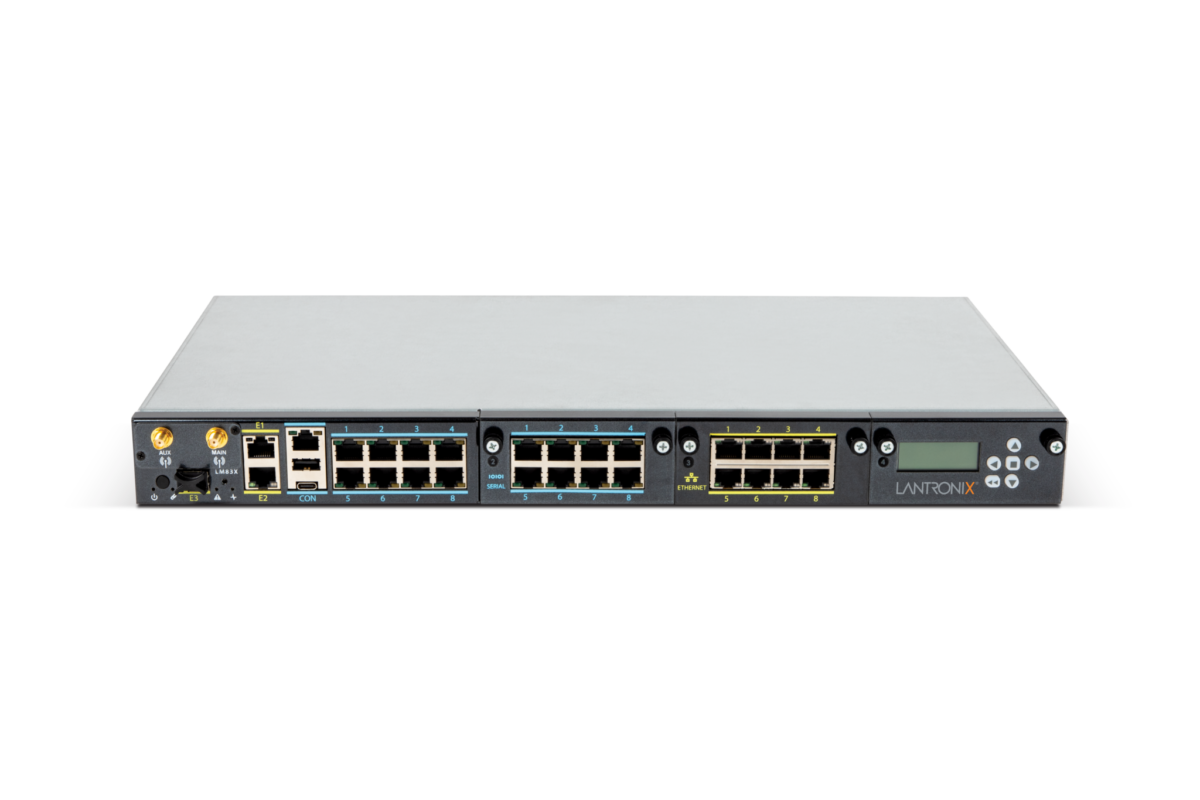
The LM83X out-of-band console server is a 1U rack-mounted device built for enterprise and data centre networks where always-available management is essential. It provides direct serial console connectivity for up to 104 devices, allowing administrators to monitor and control equipment even if the primary network is offline. With its modular design, the LM83X can be configured with a choice of expansion cards – adding extra serial ports, dedicated management Ethernet ports, or integrated modems – to suit each site’s needs. Dual AC/DC power inputs and redundant network interfaces help ensure the unit remains accessible and operational under challenging conditions.
This console manager is geared towards network engineers and IT teams responsible for distributed infrastructure, from branch offices to central data centre racks and even remote industrial sites. By acting independently of normal network pathways, it serves as an emergency lifeline for troubleshooting routers, switches, servers and other equipment via their console ports when the network is down. The LM83X’s intelligent automation can detect device faults in real time and execute predefined recovery actions, often resolving issues before they escalate. Overall, it helps organisations reduce downtime and improve network resilience by providing secure, round-the-clock access to critical systems.
Range features
A high level overview of what this range offers
Designed for maximum resilience, the LM83X offers a modular platform with up to three expansion modules, dual redundant power inputs, and multiple backup connectivity options (including cellular, dial-up, and fibre). It also features intelligent automation for network recovery, plus secure console access with enterprise-grade authentication and central management integration.
- Modular platform – Up to three expansion modules (serial, Ethernet, or cellular modem) can be added, allowing support for as many as 104 devices and tailoring the system to each site’s needs.
- Out-of-band connectivity – Supports alternate access via cellular, dial-up (POTS), fibre or even satellite links, ensuring you can reach equipment when the primary network is unavailable.
- Dual redundant power – Equipped with dual AC or DC power inputs to maintain operation during power source failures, helping to enhance reliability in critical installations.
- Automated recovery intelligence – Continuously monitors connected devices using a rules-based engine and can perform automatic remediation (reboots, configuration rollbacks, etc.) to minimise downtime without manual intervention.
- Secure remote access – Provides secure console management with a locked-down OS and integration with enterprise authentication (e.g. TACACS+, RADIUS), protecting devices and management sessions from unauthorised access.
- Central management integration – Can be managed standalone via CLI or integrated into a centralised software platform for unified control, compliance reporting and zero-touch provisioning of multiple units.
What’s in this range?
All the variants in the range and a comparison of what they offer
| Specification | Details |
|---|---|
Management interfaces | Supports up to 104 devices via serial (RS-232); 2 × 10/100/1000 Base-T Ethernet (with failover) and 1 × RS-232 local console; 1 × SFP gigabit port |
On-board storage | 256 GB NVMe SSD (with TCG Opal 2.0 support, 256-bit AES encryption) |
Peripheral connectivity | 1 × USB Type-A port; 1 × USB Type-C port |
Option slot | 1 × modular option slot (supports one add-in card: e.g. V.92 dial-up modem, cellular LTE/Cat-M1 modem, or fibre SFP module) |
Expansion slots | 3 × expansion bays for additional 8-port or 16-port serial cards, or an 8-port dedicated Ethernet card; optional LCD/keypad module available |
Dimensions (H × W × D) | 43.2 mm × 445 mm × 264 mm (1.7″ × 17.5″ × 10.4″); 1U rack height |
Weight | 3.72 kg (8.2 lbs) |
Power (AC model) | Dual AC inputs, 100–240 V AC, 50/60 Hz, max. 60 W |
Power (DC model) | -20 to -72 V DC |
Operating temperature | 0 °C to 45 °C (32 °F to 113 °F) |
Storage temperature | -30 °C to 60 °C (-22 °F to 140 °F) |
Operating humidity | 20% to 80% RH, non-condensing |
Storage humidity | Up to 90% RH, non-condensing |
Included accessories | 2 × AC power cords (or DC power connectors for DC model), 2 × rack-mount ears and screws, 1 × USB-A to USB-C console cable, quick-start guide |
Warranty | 1 year limited warranty |
FAQs
for LM83X out-of-band console server solution
Out-of-band management means controlling and monitoring equipment through a dedicated channel that is separate from the normal data network. The LM83X provides such an independent channel by using serial console connections and alternative links (like cellular or dial-up) to reach network devices even if your primary IP network is down. In practice, this means you can still access console controls, troubleshoot devices, and recover equipment via the LM83X during a network outage.
The LM83X can manage anywhere from 8 up to 104 devices, depending on how it’s configured. It comes standard with 8 serial console ports and has three internal expansion slots that accept 8-port or 16-port serial cards. By populating these slots (and using higher-density cards), you can increase the total number of serially managed devices to 104. This scalable architecture lets you start with a smaller setup and expand capacity as your network grows.
The LM83X supports multiple out-of-band connectivity options to ensure access when the main network is unreachable. It includes dual Ethernet management ports by default, and via the modular option slot you can add a V.92 dial-up modem or a cellular modem (with options ranging from high-speed LTE to deep-coverage Cat-M1). An SFP fibre port is also built in for connecting to an isolated management network. For extremely remote sites, the system even supports an Iridium satellite link (using an external LEO satellite modem kit), allowing management access virtually anywhere.
This console server has an onboard intelligence engine that continuously monitors the status of connected devices through their console outputs. If it detects a fault or an abnormal condition – for example, a device crashing into a ROMmon prompt or failing a health check – the LM83X can automatically execute pre-defined recovery actions. These actions might include rebooting the device, restoring a last-known-good configuration, or triggering failover on connected equipment. By responding immediately according to set policies, the LM83X often resolves issues on the spot, reducing the need for manual intervention and minimising downtime.
Security is built into the LM83X’s design. It runs a locked-down operating environment to minimise vulnerabilities and supports enterprise-grade authentication protocols (such as TACACS+ and RADIUS) to verify and control user access. All remote management sessions can be encrypted – for instance, administrators typically connect to the LM83X’s console via SSH for secure CLI access. The device also supports access control lists and other safeguards to ensure that only authorised personnel and systems can reach the management interfaces, keeping your out-of-band network protected.
Yes. The LM83X is vendor-neutral and works with any hardware that offers a standard serial or console management port. This includes network routers, switches, firewalls, and other appliances from virtually all major vendors, as well as servers (via their serial console or service processor ports) and ancillary devices like power controllers or environmental sensors. In essence, any device you can manage through a serial console can be integrated into the LM83X’s out-of-band management system, regardless of the manufacturer.
The LM83X is designed for easy installation in standard 19-inch racks, occupying 1U of rack space. It comes with the necessary rack-mount brackets, and you can power it with either AC mains or DC supply (the unit supports dual power inputs for redundancy). For management, you have a couple of options: you can configure and control the LM83X directly via its command-line interface (accessible through the console port or SSH), or you can manage multiple LM83X units through a central management platform. The central software (available separately) allows for zero-touch deployment – newly installed LM83X devices can automatically register and be provisioned – and provides a single dashboard for monitoring and controlling all your out-of-band console servers across various sites.