FM160 5G Sub6 GHz M.2 module
- Technology
- 5G modules
- Partner
- Fibocom
The FM160 5G Sub-6 GHz M.2 module range is designed for equipment requiring high-throughput cellular connectivity in a standard embedded form factor. It is based on an X62 modem and supports both standalone and non-standalone 5G network architectures. Five variants cover Europe, Asia, Australia, North America, Japan, South Korea and China, including a dedicated North American private-network model. Depending on the variant, the range supports LTE and WCDMA fallback alongside 5G NR operation. Typical applications include fixed wireless access equipment, CPEs, industrial routers, outdoor units, set-top boxes, industrial PCs, robots and connected infrastructure. USB and PCIe connectivity support integration with Windows, Linux and Android host platforms. The M.2 dimensions and compatibility with the FM150 module can also support migration of existing hardware designs, subject to verification of bands, firmware and host requirements.
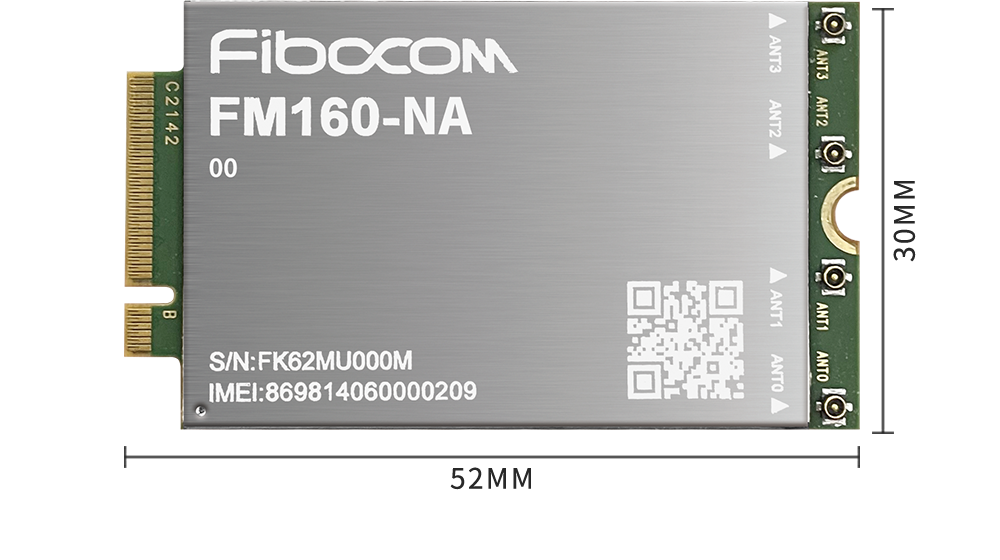
The FM160 range delivers 3GPP Release 16 5G NR Sub-6 GHz connectivity in a compact M.2 30 × 52 × 2.3 mm format for embedded broadband and industrial systems.
Five variants address different regional and deployment needs, including public-network and private-network use cases. Depending on model, the range supports 5G SA and NSA, LTE and WCDMA fallback, PCIe 4.0 and USB 3.1/3.0/2.0 host interfaces, optional VoLTE/VoNR, and multi-constellation GNSS.
Typical applications include fixed wireless access, CPEs, industrial routers, outdoor units, set-top boxes, industrial PCs, robots and other connected infrastructure.
Range features
A high level overview of what this range offers
- 3GPP Release 16 with SA and NSA modes – Supports standalone 5G networks and deployments using LTE anchoring.
- Five regional and application-specific variants – Allows the radio configuration to be matched to regional bands and approval requirements.
- Up to 3,470 Mbps EN-DC downlink – Supports data-intensive broadband, video and industrial applications.
- Up to 900 Mbps 5G SA uplink – Suitable for applications transferring substantial data from the edge.
- Downlink 4 × 4 and selected uplink 2 × 2 NR MIMO – Supports multiple spatial data streams on specified bands.
- 30 × 52 × 2.3 mm M.2 package – Provides a standard form factor for embedded cellular equipment.
- FM150-compatible format – Can support migration from an earlier module generation after design validation.
- USB 3.1/3.0/2.0 and PCIe 4.0 – Provides alternative high-speed connections to the host processor.
- Multi-constellation GNSS on selected variants – Enables positioning using GPS, GLONASS, Galileo, BeiDou and QZSS.
- Windows, Linux and Android drivers – Supports common embedded and computing platforms.
- FOTA support – Allows deployed firmware to be updated remotely.
- Optional VoLTE and VoNR – Enables voice capability where required and supported by the network configuration.
Downloads
for FM160 5G Sub6 GHz M.2 module
What’s in this range?
All the variants in the range and a comparison of what they offer
| Specification | FM160 range |
|---|---|
Air interface | 5G NR Sub-6 GHz |
3GPP release | Release 16 |
Modem platform | X62 |
Network architecture | NSA and SA |
Package | M.2 |
Dimensions | 30.0 × 52.0 × 2.3 mm |
Antenna configuration | 4 |
Operating voltage | 3.135 to 4.4 V; 3.8 V typical |
Normal operating temperature | -30°C to +75°C |
Form-factor compatibility | FM150 |
| Specification | FM160-EAU | FM160-NA | FM160-PN | FM160-JK | FM160-CN |
|---|---|---|---|---|---|
Region | Asia excluding China, Europe and Australia | North America | North American private networks | Japan and South Korea | China |
5G NR bands | n1/3/5/7/8/20/28/38/40/41/75/76/77/78 | n2/5/12/14/25/30/41/48/66/70/71/77 | n48/78 | n1/3/7/8/28/41/77/78/79 | CN-0x: n1/28/41/78/79; CN-1x: n1/3/5/8/28/41/77/78/79 |
LTE FDD bands | B1/3/5/7/8/20/28/32 | B2/4/5/12/13/29/30/66/71 | Not available | B1/3/5/7/8/18/19/21/26/28 | B1/3/5/8 |
LTE TDD bands | B38/40/41/42/43 | B41/46 LAA/48 | Not available | B39/41/42 | B34/38/39/40/41 |
WCDMA bands | B1/5/8 | Not available | Not available | Not available | B1/8 |
5G NR SA peak rate | 2,470 Mbps downlink / 900 Mbps uplink | 2,470 Mbps downlink / 900 Mbps uplink | 2,470 Mbps downlink / 900 Mbps uplink | 2,470 Mbps downlink / 900 Mbps uplink | 2,470 Mbps downlink / 900 Mbps uplink |
5G NR EN-DC peak rate | 3,470 Mbps downlink / 555 Mbps uplink | 3,470 Mbps downlink / 555 Mbps uplink | Not available | 3,470 Mbps downlink / 555 Mbps uplink | 3,470 Mbps downlink / 555 Mbps uplink |
LTE peak rate | 1,600 Mbps downlink / 211 Mbps uplink | 1,600 Mbps downlink / 211 Mbps uplink | Not available | 1,600 Mbps downlink / 211 Mbps uplink | 1,600 Mbps downlink / 211 Mbps uplink |
GNSS | GPS, GLONASS, Galileo, BeiDou and QZSS | GPS, GLONASS, Galileo, BeiDou and QZSS | Not available | GPS, GLONASS, Galileo, BeiDou and QZSS | GPS, GLONASS, Galileo, BeiDou and QZSS |
USB | USB 3.1/3.0 and USB 2.0 | USB 3.1/3.0 and USB 2.0 | USB 3.1/3.0 and USB 2.0 | USB 3.1/3.0 and USB 2.0 | USB 3.1/3.0 and USB 2.0 |
PCIe | PCIe 4.0 | PCIe 4.0 | PCIe 4.0 | PCIe 4.0 | PCIe 4.0 |
Voice | Optional VoLTE and VoNR | Optional VoLTE and VoNR | Optional VoLTE and VoNR | Optional VoLTE and VoNR | Optional VoLTE and VoNR |
Operating-system drivers | Windows, Linux and Android | Windows, Linux and Android | Windows, Linux and Android | Windows, Linux and Android | Windows, Linux and Android |
Regulatory approvals | CE, RCM and Anatel | FCC and IC | Not listed | TELEC, JATE and KC | CCC, SRRC, NAL and RoHS |
| Specification | FM160-NA |
|---|---|
Weight | Approximately 7.8 g |
Processor | Quad-core Arm Cortex-A7, up to 1.5 GHz |
Memory | 4 Gbit LPDDR4X and 4 Gbit NAND flash |
SIM configuration | Dual SIM, 1.8 V or 3 V; SIM1 USIM and SIM2 eSIM/USIM |
ADC input range | 0 to 1.45 V |
Extended operating temperature | -40°C to +85°C; performance may fall outside 3GPP specifications |
Storage temperature | -40°C to +85°C |
Recommended storage conditions | 23 ±5°C and less than 60% relative humidity |
Recommended storage life | 12 months under the stated storage conditions |
FAQs
for FM160 5G Sub6 GHz M.2 module
Yes. All five variants support 5G NR SA and NSA operation. EN-DC throughput is listed for the EAU, NA, JK and CN variants, while the PN private-network variant is specified for SA operation without an EN-DC rate.
FM160-EAU covers Europe, Australia and Asian markets outside China. Band support, network approval, operator requirements and firmware configuration should still be checked for the intended country and network.
No. The FM160 range is specified for 5G NR Sub-6 GHz operation. Applications requiring mmWave connectivity need a different radio module.
No. FM160-EAU supports LTE and WCDMA, while FM160-NA and FM160-JK support LTE without WCDMA. FM160-CN supports LTE and WCDMA, whereas FM160-PN is specified only for 5G NR bands n48 and n78.
The specified 5G SA peak rate is 2,470 Mbps downlink and 900 Mbps uplink. Variants supporting EN-DC are rated at up to 3,470 Mbps downlink and 555 Mbps uplink, while supported LTE configurations reach 1,600 Mbps downlink and 211 Mbps uplink.
The range supports USB 3.1/3.0, USB 2.0, PCIe 4.0, GPIO, UIM, I2S and MIPI. UART, SPI, I²C, SDIO and RGMII are not listed as available in the current range specification.
GNSS is available on FM160-EAU, FM160-NA, FM160-JK and FM160-CN, with GPS, GLONASS, Galileo, BeiDou and QZSS support. FM160-PN does not include GNSS.
The FM160 uses the same stated M.2 dimensions and is described as compatible with the FM150 form factor. Engineers should still verify the pin allocation, power behaviour, antenna design, supported bands, host drivers and software before treating it as a drop-in replacement.
The normal operating range is -30°C to +75°C. The FM160-NA hardware guide also defines an extended range of -40°C to +85°C, but notes that radio performance may fall outside 3GPP specifications within that extended range.
No. For FM160-NA deployments using FCC or IC approval, the host design must meet the applicable antenna, separation, labelling and emissions conditions. Changes to the approved antenna arrangement or use in other installation categories can require further assessment or authorisation.