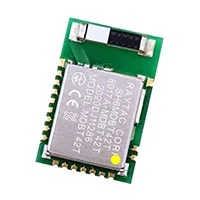
AN54LM Series, Bluetooth 6.0, LGA module; nRF54LM20A based
- Technology
- Bluetooth modules
- Partner
- Raytac
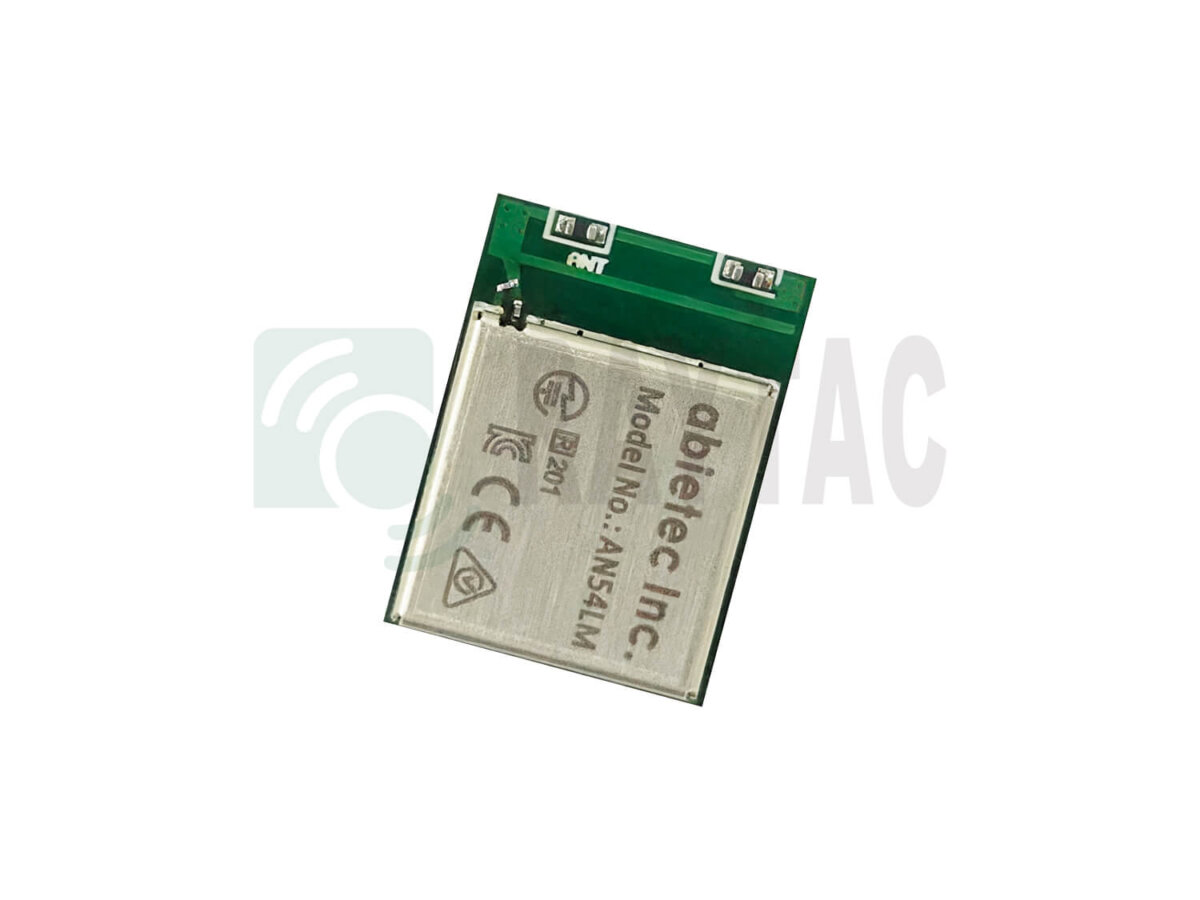
The AN54LM series represents a family of Bluetooth 6.0 LGA modules designed for demanding IoT and wireless applications. Each module in the series is built around Nordic’s latest nRF54LM20A system-on-chip, combining a 128 MHz Arm® Cortex®-M33 processor and a 128 MHz RISC-V co-processor for robust performance. With 2 MB of flash and 512 KB of RAM, these modules can support complex firmware, multiple wireless protocols, and extensive sensor interfaces. They are offered with three antenna configurations – an integrated ceramic chip antenna, a PCB trace antenna, or a u.FL connector for an external antenna – allowing engineers to optimize for size or range as needed.
Typical use cases include smart industrial sensors, next-gen wearables, building automation devices, and any application that benefits from Bluetooth Low Energy 6.0 alongside Zigbee, Thread, Matter or other 2.4 GHz protocols. The AN54LM series modules come in a surface-mount LGA form factor with 66 GPIOs and support a broad range of interfaces (USB, SPI, I²C, I²S, etc.), making them a versatile wireless solution for modern IoT designs. They are engineered for low power consumption and operate over an extended –40 °C to +85 °C temperature range, suitable for both indoor and harsh outdoor or industrial environments.
Range features
A high level overview of what this range offers
- Dual 128 MHz processors (Arm Cortex-M33 + RISC-V) – Provide high processing throughput and parallel task handling for complex IoT applications without an external MCU.
- 2 MB Flash & 512 KB RAM memory – Ample on-chip memory supports large firmware, multi-protocol stacks (Bluetooth LE, Zigbee, Thread, Matter, etc.), and future OTA updates, ensuring longevity and flexibility.
- Bluetooth 6.0 Low Energy radio – Supports the latest Bluetooth LE features (including Channel Sounding for precise location/ranging) while remaining backward-compatible with earlier BLE versions, offering reliable wireless links and new capabilities like LE Audio.
- Multi-protocol support – Built-in radio compatibility with Zigbee, Thread (IEEE 802.15.4), Matter, Amazon Sidewalk, and proprietary 2.4 GHz protocols means one module can serve various wireless standards, simplifying product variants and enabling concurrent protocol operation (depending on software).
- Multiple antenna options – Available with a chip antenna for compact size, a PCB antenna for balanced range, or a u.FL connector for an external antenna to achieve maximum range. This gives designers the choice to optimize RF performance or device footprint as required.
- High-speed interfaces including USB – Supports High-speed USB 2.0, high-speed SPI (up to 32 MHz), UART (up to 4 Mbps), I²C, I²S, PDM, PWM, TDM, ADC, NFC and more, allowing direct connectivity to sensors, actuators, audio codecs, and even PC/USB peripherals without additional bridges.
- 66 configurable GPIOs – A very large number of general-purpose I/O pins enables complex board designs and connectivity to numerous peripherals, eliminating the need for external GPIO expanders and providing design freedom.
- Secure and reliable – Features Arm TrustZone® security architecture, tamper detection, and a hardware cryptographic engine for secure boot and encrypted communication. This ensures a high level of device security and helps protect firmware and data against unauthorized access or tampering.
- Low power consumption – Ultra-low power radio design delivers very low peak currents (on the order of only a few milliamps in active receive/transmit), helping to extend battery life in energy-critical devices. Multiple sleep modes (down to microamp-level) are available for efficient power management in duty-cycled applications.
- Wide operating temperature (–40 °C to +85 °C) – Industrial-grade temperature range guarantees reliable operation in extreme cold or heat, making the modules suitable for outdoor sensors, industrial monitors, and other harsh environment deployments.
- Pre-certified wireless solution – Intended to meet major regulatory certifications worldwide (FCC, CE, IC, Telec (MIC), KC, SRRC, NCC, RCM, WPC). This can greatly streamline the compliance process for end products, reducing time-to-market and certification costs (final certification status should be confirmed as modules proceed to production).
What’s in this range?
All the variants in the range and a comparison of what they offer
| Specification | AN54LM-20 (Chip Antenna) | AN54LM-P20 (PCB Antenna) | AN54LM-U20 (External Antenna) |
|---|---|---|---|
Base SoC | Nordic nRF54LM20A | Nordic nRF54LM20A | Nordic nRF54LM20A |
Bluetooth version | Bluetooth® 6.0 Low Energy (BT LE) | Bluetooth® 6.0 Low Energy (BT LE) | Bluetooth® 6.0 Low Energy (BT LE) |
Other protocols supported | Zigbee, Thread (802.15.4), Matter, ANT+†, Sidewalk, proprietary 2.4 GHz | Zigbee, Thread (802.15.4), Matter, ANT+†, Sidewalk, proprietary 2.4 GHz | Zigbee, Thread (802.15.4), Matter, Aliro‡, Sidewalk, proprietary 2.4 GHz |
Main processor | 128 MHz ARM Cortex-M33 | 128 MHz ARM Cortex-M33 | 128 MHz ARM Cortex-M33 |
Co-processor | 128 MHz RISC-V (FLPR) | 128 MHz RISC-V (FLPR) | 128 MHz RISC-V (FLPR) |
Flash memory | 2.0 MB | 2.0 MB | 2.0 MB |
RAM | 512 KB | 512 KB | 512 KB |
GPIO count | 66 pins | 66 pins | 66 pins |
High-speed USB interface | Yes (USB 2.0, full/High-speed) | Yes | Yes |
Other interfaces | SPI (incl. high-speed SPI), UART, I²C, I²S, PDM, PWM, TDM, ADC, NFC | SPI, UART, I²C, I²S, PDM, PWM, TDM, ADC, NFC | SPI, UART, I²C, I²S, PDM, PWM, TDM, ADC, NFC |
Antenna configuration | Integrated ceramic chip antenna (2.4 GHz) | Integrated PCB trace antenna | u.FL connector for external 2.4 GHz antenna |
Peak RF output power | Up to +8 dBm (configurable) | Up to +8 dBm (configurable) | Up to +8 dBm (configurable) |
Receive sensitivity | –98 dBm (BLE 1 Mbps) typical | –98 dBm (BLE 1 Mbps) typical | –98 dBm (BLE 1 Mbps) typical |
Operating voltage | 1.7 V – 3.6 V DC | 1.7 V – 3.6 V DC | 1.7 V – 3.6 V DC |
Operating temperature | –40 °C to +85 °C | –40 °C to +85 °C | –40 °C to +85 °C |
Module dimensions (L×W×H) | 9.9 × 13.3 × 2.0 mm | 9.9 × 13.3 × 2.0 mm | 10.5 × 15.5 × 2.05 mm |
Module form factor | LGA SMT module (castellated pads) | LGA SMT module | LGA SMT module |
Intended certifications | FCC, IC, CE, Telec (MIC), KC, SRRC, NCC, RCM, WPC (pending) | FCC, IC, CE, Telec (MIC), KC, SRRC, NCC, RCM, WPC (pending) | FCC, IC, CE, Telec (MIC), KC, SRRC, NCC, RCM, WPC (pending) |
†ANT+ support is implied by the SoC capabilities (mentioned on original page for chip/P20 variants). ‡Aliro is referenced on the U20 variant page, indicating support for an emerging 2.4 GHz protocol or ecosystem; not listed on other variants’ descriptions.
FAQs
for AN54LM Series, Bluetooth 6.0, LGA module; nRF54LM20A based
In addition to Bluetooth 5.4/6.0 Low Energy, the AN54LM modules support several 2.4 GHz IoT protocols. This includes IEEE 802.15.4 protocols such as Zigbee and Thread (Matter), as well as proprietary 2.4 GHz modes. The modules also accommodate emerging standards like Amazon Sidewalk, and the U20 variant’s documentation mentions support for Aliro (an upcoming 2.4 GHz ecosystem). All of these protocol capabilities are enabled by the Nordic nRF54LM20A SoC, giving you the flexibility to use the same hardware for multiple wireless stacks (one at a time or time-sliced concurrently, as appropriate).
Yes. Bluetooth 6.0 Low Energy (as implemented in the nRF54LM20A) remains backward-compatible with Bluetooth 5.x and 4.x Low Energy devices. That means an AN54LM module can communicate with older BLE devices (e.g., smartphones, sensors or gateways using BLE 4.2/5.0) using the standard BLE protocols. The Bluetooth 6.0 specification mainly adds new features (like Channel Sounding and LE Audio enhancements), but it still uses the same fundamental radio and protocol framework, ensuring interoperability with previous generations of Bluetooth Low Energy.
Channel Sounding is a feature introduced in the latest Bluetooth spec (often informally called Bluetooth 5.4 or 6.0). It allows a receiver to evaluate the characteristics of the radio channel by using special reference signals from the transmitter. In practical terms, Channel Sounding can enable more accurate distance and positioning measurements (for example, by analyzing phase and amplitude of the received signal). For your application, this means an AN54LM module can potentially be used for high-precision indoor positioning, direction-finding (Angle of Arrival/Departure), or adaptive RF tuning to improve link reliability. If you’re building location-aware IoT devices or need stable connections in challenging RF environments, Channel Sounding support provides a new tool to enhance those capabilities.
The choice depends on your device’s size constraints and range requirements:
- The chip antenna (AN54LM-20) is a tiny ceramic antenna integrated on the module. It’s great for saving space and simplifying design, and works well for moderate-range applications (indoors or within tens of meters). Choose this for very compact devices where every millimeter counts and you want an all-in-one solution.
- The PCB antenna (AN54LM-P20) is a printed antenna on the module’s PCB. It typically offers similar or slightly improved gain compared to the chip antenna and is a cost-effective internal solution. It’s a good middle-ground if you have a bit more space – it can provide reliable range (potentially a few hundred meters line-of-sight under ideal conditions) while keeping everything self-contained.
- The u.FL connector option (AN54LM-U20) allows you to attach an external antenna of your choice (e.g., wire monopole, dipole, patch, etc.). This is ideal when you need maximum range or a specific antenna type for your application. For instance, in long-range or outdoor scenarios, you might connect a higher-gain external antenna to significantly extend the communication distance. The trade-off is a slightly larger module size to accommodate the connector, and the need to integrate an external antenna component onto your product.
In summary, use the u.FL variant for longest range or antenna flexibility, the chip variant for ultra-compact designs, and the PCB variant for a balanced internal solution in between.
The AN54LM modules are designed with regulatory compliance in mind. According to the manufacturer’s information, they are intended to achieve certifications for FCC (US), IC (Canada), CE (Europe), Telec MIC (Japan), KC (Korea), SRRC (China), NCC (Taiwan), RCM (Australia/New Zealand), and WPC (India). This means the hardware has been laid out and engineered to meet the RF emission and susceptibility limits of these regions. In practice, by using a pre-certified module, you as the product developer can often streamline your own device’s certification process (since the radio part is already tested). However, it’s important to check the latest status: if these modules are newly released, some certifications might still be in progress. Always obtain the module’s certification reports or IDs and ensure you integrate the module according to any layout guidelines provided (antenna clearance, ground plane, etc.) to maintain compliance. When in doubt, contact the module supplier for the current certification status and any region-specific considerations.
Yes – with some considerations. The underlying nRF54LM20A SoC supports multiprotocol concurrency through time-slicing. This means you can run (for example) a Bluetooth Low Energy stack and a Thread (802.15.4) stack on the same module, essentially interleaving radio events so each protocol gets timeslots to operate. Nordic’s SoftDevice and Thread SDK (or the unified nRF Connect SDK using Zephyr RTOS) provide support for such concurrent operation. In practical terms, your firmware can be written to handle, say, BLE communications and a Zigbee or Matter network at the same time. The AN54LM’s dual-core architecture (with an Arm M33 and a RISC-V coprocessor) further helps by offloading certain tasks and managing real-time constraints. Keep in mind that running multiple protocols concurrently can slightly affect throughput or latency (since the radio is sharing time), but it’s a tested feature. This is very useful for gateway-type devices or bridges – for example, a device that communicates over BLE to a smartphone and simultaneously participates in a Thread/Matter mesh network can be realized with a single AN54LM module.
The communication range depends on the antenna option and the environment:
- With the integrated chip or PCB antennas, you can typically achieve on the order of 50 to 200 meters range outdoors line-of-sight under ideal conditions. Indoors, through walls, practical range might be tens of meters (which is usually sufficient for a single room or adjacent rooms coverage). The PCB antenna variant may perform marginally better than the chip antenna in some cases, due to its size and design, but they are in a similar class.
- With an external antenna (u.FL connector), the range can be substantially increased. For example, using a quality dipole or quarter-wave whip antenna, outdoor line-of-sight range could reach hundreds of meters up to 1 km (assuming a clear environment and +8 dBm transmit power). In cluttered indoor settings, you would still get improved coverage relative to the on-board antennas.
It’s worth noting that these modules have a maximum transmit power of around +8 dBm and very good receive sensitivity (around –96 to –98 dBm for 1 Mbps BLE). This radio performance, combined with a decent external antenna, means long-range links (similar to Bluetooth Long Range scenarios) are achievable. Actual results will vary with obstacles, interference, and antenna gain – so your mileage may vary, but the AN54LM series certainly can cover typical smart home or industrial site distances, and the U20 variant gives you the option to go much farther if needed.
The AN54LM series is built on an ultra-low-power design. In active mode, the nRF54LM20A radio is quite efficient given its performance: for instance, receiving Bluetooth LE packets might draw on the order of 3–4 mA, and transmitting at 0 dBm around 4–5 mA (at 3 V supply). These figures are similar or better than previous-generation Nordic chips, despite the higher CPU speed, thanks to architectural improvements. In practical terms, when using Bluetooth LE advertising or a Zigbee mesh, the radio will be duty-cycled – meaning it’s only drawing those milliamp currents in short bursts. When the module is in idle or a sleep mode, the current consumption drops drastically (to just microamps, depending on the sleep state and which peripherals are off). For example, with the RTC running and RAM retention, you might see tens of microamps; in the deepest sleep (System OFF mode), it can be well under 1 µA. This all translates to excellent battery life potential. A coin-cell powered sensor, for instance, could run for years on an AN54LM module if it only wakes briefly to send data. Of course, total power usage will depend on your usage pattern (how often it transmits, sensor power, etc.), but the module itself will not be the bottleneck – it’s optimized for long-term operation on battery or energy-harvesting power sources.
Security was a key focus in the nRF54 series SoCs. The AN54LM modules inherit a range of advanced security features from the nRF54LM20A:
- They implement Arm® TrustZone® technology, which allows you to segregate secure and non-secure code on the Cortex-M33. This means sensitive routines or data (like cryptographic keys or bootloaders) can be isolated from the rest of the application, reducing the risk of them being accessed or altered by unintended code.
- There’s a built-in cryptographic accelerator that supports symmetric and asymmetric encryption (AES, ECC, etc.) and includes measures to prevent side-channel attacks (like power analysis). This hardware acceleration not only secures communications (for example, performing fast AES-CCM for Bluetooth LE packets or TLS handshakes for Matter), but also does so efficiently without taxing the CPU.
- The device supports a secure boot process with an immutable root of trust. In practice, this means the module can verify digital signatures on firmware at startup (ensuring only authentic, untampered code runs). Coupled with features like debug port protection (locking down the SWD/JTAG interface in the field), it becomes very difficult for an attacker to extract your firmware or modify it.
- Additional features include tamper detection (the chip can monitor certain pins or conditions and detect attempts to open or probe the hardware) and secure key storage support.
Overall, the AN54LM series offers PSA Level 3-capable security, which is a high assurance level for IoT devices. In short, you can confidently use these modules in applications that handle sensitive data or require robust protection against unauthorized access.
Yes, the AN54LM is designed to coexist politely with Wi-Fi, especially if you use Nordic’s recommended approach. The nRF54LM20A (and by extension the module) includes a 3-wire/4-wire hardware coexistence interface. This interface can be used to coordinate with an external Wi-Fi 6 companion chip like Nordic’s nRF7002. In practical terms, the Bluetooth/Thread/Matter running on the AN54LM module can handshake with a Wi-Fi radio so that they don’t transmit at the same time on the overlapping 2.4 GHz band. This avoids mutual interference and optimizes overall throughput. Nordic’s SDK provides drivers for this coex interface. If you are integrating, for example, an AN54LM module and a 2.4 GHz Wi-Fi module on the same board (which is a common scenario for IoT gateways), you would connect their coexistence signals (typically called PRI, GRANT, REQUEST lines, etc.). By doing so, the two radios will negotiate airtime – when the Wi-Fi needs to send or receive, it can signal the BLE module to hold off momentarily, and vice versa. The result is that both can work in tandem with minimal performance impact. Additionally, the AN54LM’s excellent blocking and selectivity specs mean it has good intrinsic immunity to 2.4 GHz interference. So, with proper design, you can absolutely have Bluetooth LE and Wi-Fi running simultaneously in one device powered by an AN54LM, enabling combined connectivity solutions (e.g., bridging from Thread to Wi-Fi).