FM550 5G Sub6 GHz M.2 module
- Technology
- 5G modules
- Partner
- Fibocom
The FM550-EAU is an eMBB cellular module designed for equipment requiring 5G Sub-6 GHz connectivity in a standard M.2 package. It uses an S5300 chipset manufactured on a 4 nm process and includes a single-core Cortex-A55 processor running at 1.5 GHz. The module supports 5G standalone and non-standalone networks, with LTE Cat 20 and WCDMA available for fallback connectivity. Stated peak rates reach 4.67 Gbps downlink and 1.25 Gbps uplink in NR SA mode, or 6.47 Gbps downlink through NR EN-DC. Typical applications include fixed wireless access equipment, indoor and outdoor CPE, enterprise routers, mobile hotspots and industrial gateways. PCIe Gen3 is provided for the host data path, alongside USB 2.0 and control interfaces including UART, SPI and GPIO. L1 GNSS, FOTA, VoLTE, SMS and drivers for Windows, Linux and Android support integration into a range of connected equipment.
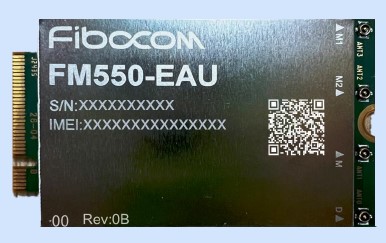
The FM550-EAU is a 5G Sub-6 GHz M.2 cellular module built for broadband equipment such as FWA devices, CPE, enterprise routers, hotspots and industrial gateways. It supports 3GPP Release 16, operates on 5G SA and NSA networks, and provides LTE Cat 20 and WCDMA fallback for wider deployment flexibility.
Its platform combines an S5300 chipset on a 4 nm process, a single-core Cortex-A55 at 1.5 GHz, PCIe Gen3 for high-speed host connectivity, and L1 multi-constellation GNSS support for positioning. The 30 × 52 × 2.3 mm M.2 format helps simplify integration into designs that need compact multi-gigabit cellular connectivity across EMEA, APAC and Australia.
Range features
A high level overview of what this range offers
- 3GPP Release 16 with SA and NSA: Supports deployment on standalone and non-standalone 5G networks.
- Up to 5CC NR carrier aggregation: Allows multiple component carriers to be combined where supported by the network.
- Peak NR SA rate of 4.67 Gbps downlink and 1.25 Gbps uplink: Supports data-intensive broadband applications under suitable network conditions.
- Peak NR EN-DC rate of 6.47 Gbps downlink: Uses combined 5G NR and LTE resources in compatible NSA networks.
- S5300 chipset with 4 nm process: Provides the cellular and processing platform within the M.2 module.
- PCIe Gen3 host interface: Provides a data path suited to multi-gigabit cellular connectivity.
- Four-antenna architecture with downlink and uplink MIMO: Supports spatial diversity and higher throughput on the specified bands.
- LTE Cat 20 and WCDMA fallback: Maintains connectivity where 5G service is unavailable.
- L1 multi-constellation GNSS: Supports GPS, GLONASS, BeiDou and Galileo positioning.
- FOTA and multi-platform drivers: Supports remote firmware maintenance and integration with Windows, Linux and Android hosts.
- 30 × 52 mm M.2 package: Fits equipment designed around the established M.2 cellular module format.
- VoLTE, SMS and audio support: Accommodates voice and messaging functions where enabled by the network and device design.
What’s in this range?
All the variants in the range and a comparison of what they offer
| Specification | Value |
|---|---|
Product/variant | FM550-EAU |
Module family | FM550 |
Air interface | 5G NR Sub-6 GHz |
3GPP standard | Release 16 |
Deployment region | EMEA, APAC and Australia |
Package | M.2 |
Dimensions | 30.0 × 52.0 × 2.3 mm |
Network modes | 5G SA and NSA, including EN-DC |
Cellular fallback | LTE Cat 20 and WCDMA |
Chipset and process | S5300, 4 nm |
Processor | Single-core Cortex-A55, 1.5 GHz |
Cellular antenna connections | 4 |
Operating voltage | 3.135 to 4.4 V; 3.8 V typical |
Operating temperature | -25°C to +75°C |
5G NR bands | n1, n3, n5, n7, n8, n20, n26, n28, n38, n40, n41, n66, n67, n71, n75, n76, n77 and n78 |
LTE FDD bands | B1, B3, B5, B7, B8, B20, B26, B28, B32, B66, B67 and B71 |
LTE TDD bands | B38, B40, B41, B42, B43 and B48 |
LTE LAA band | B46 |
WCDMA bands | B1, B3, B5 and B8 |
5G NR carrier aggregation | Typical 2CC NR CA within 200 MHz; up to 5CC NR CA |
SA carrier aggregation | Up to NR 5CC within 200 MHz |
NSA carrier aggregation | Up to NR 2CC + LTE 5CC |
NR downlink MIMO | 4 × 4 on n1, n3, n7, n38, n40, n41, n66, n71, n75, n76, n77 and n78 |
NR uplink MIMO | 2 × 2 on n1, n3, n38, n40, n41, n77 and n78 |
LTE FDD downlink MIMO | 4 × 4 on B1, B3, B7, B32 and B66 |
LTE TDD downlink MIMO | 4 × 4 on B38, B40, B41, B42, B43 and B48 |
Peak NR SA data rate | 4.67 Gbps downlink / 1.25 Gbps uplink |
Peak NR EN-DC data rate | 6.47 Gbps downlink / 730 Mbps uplink |
Peak LTE data rate | 2 Gbps downlink / 211 Mbps uplink |
Peak WCDMA data rate | 42 Mbps downlink / 5.76 Mbps uplink |
Voice | VoLTE |
SMS | Yes |
Audio | Yes |
Firmware update | FOTA supported |
OS drivers | Windows, Linux and Android |
FWA software compatibility | Linux, OpenWRT, RDK-B and prplOS |
GNSS | L1 GPS, GLONASS, BeiDou and Galileo |
USB | USB 2.0 |
PCIe | PCIe Gen3 |
UART | Yes |
SPI | Yes |
GPIO | Yes |
UIM/UICC | UIM supported; removable UICC supported |
Interfaces not supported | I²C, SDIO, I²S, MIPI and RGMII |
Regulatory and conformity listings | CE, RCM, RoHS, HF, REACH, UKCA and GCF |
GCF listing | FM550-EAU-01; reference 12842; certified 28 March 2025 |
FAQs
for FM550 5G Sub6 GHz M.2 module
Yes. It supports 5G SA as well as NSA operation through EN-DC, allowing it to work with both standalone 5G core networks and deployments that combine 5G NR with LTE.
The stated peak rates are 4.67 Gbps downlink and 1.25 Gbps uplink in NR SA mode. In NR EN-DC mode, the stated peak is 6.47 Gbps downlink and 730 Mbps uplink. Actual throughput depends on carrier aggregation, spectrum allocation, signal conditions, network configuration, antennas and the host interface.
PCIe Gen3 is the relevant host interface where cellular throughput is a primary design requirement. USB 2.0 is also available, but its interface capacity is below the module’s stated multi-gigabit cellular peak rates.
The FM550-EAU variant is intended for EMEA, APAC and Australia. Engineers should confirm the required 5G NR, LTE and WCDMA bands against the intended countries and network operators before finalising the design.
The module provides four cellular antenna connections. Its MIMO support varies by band, including 4 × 4 downlink MIMO on selected NR and LTE bands and 2 × 2 uplink MIMO on selected NR bands.
Yes. It supports L1 reception from GPS, GLONASS, BeiDou and Galileo. Antenna placement, RF losses, enclosure materials and interference from cellular or digital circuitry should be considered during the host design.
The FM550-EAU supports LTE Cat 20 and WCDMA fallback. Its stated peak LTE rate is 2 Gbps downlink and 211 Mbps uplink, while WCDMA supports up to 42 Mbps downlink and 5.76 Mbps uplink.
VoLTE, SMS and audio functions are supported. Their availability in a finished product also depends on firmware configuration, network services, operator provisioning and the host audio design.
The operating voltage range is 3.135 to 4.4 V, with 3.8 V stated as typical. The specified operating temperature range is -25°C to +75°C, so power integrity and thermal design should be assessed under the intended traffic load and enclosure conditions.
PCIe Gen3, USB 2.0, UART, SPI, GPIO and UIM are supported. I²C, SDIO, I²S, MIPI and RGMII are not included, so the host platform should not depend on those interfaces for module integration.