FE50MSxR 650 nm DC-50 MBd 50 m SMI POF Transceiver
- Technology
- Fibre optic transceivers
- Partner
- Firecomms
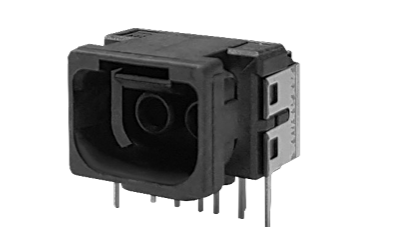
The FE50MSxR is an integrated optoelectronic transceiver designed for short-range communication over plastic optical fibre (POF). It contains both a 650 nm RCLED (resonant cavity LED) transmitter and a monolithic photodiode receiver within a single SMI duplex module, enabling full-duplex data transfer at rates up to 50 MBd (approximately 50 Mbit/s). This module is ideal for engineers developing industrial automation networks, motor control systems, or sensor interconnects that demand reliable, noise-immune links.
By using light to transfer data, it provides inherent immunity to electromagnetic interference (EMI) and galvanic isolation, making it well-suited for harsh or high-voltage environments. The transceiver’s I/O interfaces are TTL-compatible (with both inverting and non-inverting logic versions available), simplifying direct connection to microcontrollers, UARTs or other digital circuits. With a wide operating temperature range and a through-hole SMI connector, the FE50MSxR series is easy to integrate and ensures dependable performance in industrial, automotive, or medical applications where copper solutions fall short.
Range features
A high level overview of what this range offers
- DC to 50 MBd data rate – Supports digital communication up to ~50 Mbit/s for a range of serial protocols and custom interfaces
- Visible 650 nm red LED – Uses a high-efficiency RCLED transmitter that provides a clearly visible light output for easy fibre troubleshooting and alignment
- Monolithic photodiode receiver – Integrated photodiode + amplifier design offers high EMI/EMC immunity for reliable operation in electrically noisy environments
- Supports POF and PCS fibre – Optimised for standard 1 mm Plastic Optical Fibre and compatible with 200 µm Plastic Clad Silica fibre, giving flexibility in fiber type and reach
- Up to 50 m link distance – Enables short-distance optical links (typ. 50 m with 1 mm POF) suitable for in-building or machine-to-machine connections
- Dual 5 V or 3.3 V supply – Operates from either 5 V or 3.3 V DC power (±10% tolerance), allowing easy integration into both legacy 5 V systems and modern 3.3 V designs
- TTL logic interface – Transmitter and receiver use TTL-compatible signals, simplifying direct interfacing with microcontrollers, DSPs or TTL serial ports (no extra driver circuitry needed)
- Inverting & non-inverting options – Available in two logic polarities (FE50MSIR for inverted output, FE50MSNR for non-inverted) to match different system logic conventions
- Industrial temperature range – Rated for -40 °C to +85 °C operation, ensuring consistent performance in harsh industrial or outdoor conditions
- Robust SMI connector housing – Standard SMI snap-in fibre connector provides secure, low-loss fibre attachment in a compact form factor (through-hole mounting for PCB stability)
- Safety and compliance – Eye-safe LED emitter (Class 1) with a flame-retardant UL 94 V-0 housing and full RoHS compliance for use in regulated industries
Downloads
for FE50MSxR 650 nm DC-50 MBd 50 m SMI POF Transceiver
What’s in this range?
All the variants in the range and a comparison of what they offer
| Specification | FE50MSIR (Inverting) | FE50MSNR (Non-Inverting) |
|---|---|---|
Optical wavelength | 650 nm (visible red LED) | 650 nm (visible red LED) |
Data rate | DC to 50 MBd (≈50 Mbit/s) | DC to 50 MBd (≈50 Mbit/s) |
Maximum link distance | ~50 m with 1 mm POF @ 50 MBd | ~50 m with 1 mm POF @ 50 MBd |
Fibre compatibility | 1 mm POF or 200 µm PCS fibre | 1 mm POF or 200 µm PCS fibre |
Logic output polarity | Inverted TTL (active-low) | Non-inverted TTL (active-high) |
Supply voltage | 3.3 V or 5.0 V DC (±10%) | 3.3 V or 5.0 V DC (±10%) |
Interface | TTL digital I/O, through-hole pins | TTL digital I/O, through-hole pins |
Connector format | SMI duplex optical port (snap-in) | SMI duplex optical port (snap-in) |
Operating temperature | -40 °C to +85 °C (industrial range) | -40 °C to +85 °C (industrial range) |
Module housing | UL 94 V-0 rated plastic, RoHS compliant (black casing) | UL 94 V-0 rated plastic, RoHS compliant (black casing) |
FAQs
for FE50MSxR 650 nm DC-50 MBd 50 m SMI POF Transceiver
The two versions only differ in their digital logic polarity. FE50MSIR provides an inverting TTL output (active-low signalling), meaning a presence of light on the fiber yields a low logic output. FE50MSNR provides a non-inverting TTL output (active-high), where light on the fiber corresponds to a high logic output. This allows you to choose the module that matches your system’s logic requirements without additional inverters in your circuit.
The FE50MSxR is designed for standard 1 mm core plastic optical fibre (POF), and it can reliably communicate over distances of about 50 metres using POF at the full 50 MBd data rate. It also supports 200 µm plastic-clad silica (PCS) fibre, though practical distance may vary with that fiber type. Using high-quality fibre and connectors will ensure you achieve the maximum distance and signal quality. Keep in mind that very tight bends or poor terminations in the fibre can reduce the effective range.
Yes. The module supports data rates from DC (static signals) up to 50 MBd, which is roughly equivalent to 50 Mbit/s for NRZ encoded data. This covers a variety of medium-speed digital communication needs. In practice, it can handle protocols like UART/serial communications, 10 Mbps Ethernet (e.g. 10Base-FL over POF), certain fieldbus networks, and other custom or standard protocols that operate in the tens-of-megabits range. It is not meant for 100 Mb or gigabit-range data rates, but it excels at providing a reliable link for low-to-mid speed data in challenging environments.
Yes. The transceiver can run from either a 5 V or 3.3 V DC supply, and its I/O pins are TTL logic level compatible. This means it will interface correctly with classic 5 V TTL circuits and with 3.3 V CMOS logic inputs/outputs. There’s no level shifting required – you simply power the module at the voltage your system uses (within the ±10% tolerance range) and the device will handle the logic levels accordingly. This dual-supply flexibility makes it easy to drop into both legacy 5 V systems and modern 3.3 V designs.
No additional analog driver or receiver circuitry is needed. The FE50MSxR modules have built-in driving electronics for the LED and an integrated receiver amplifier for the photodiode. You can connect the transmitter input pin directly to a microcontroller’s digital output or other TTL signal source, and connect the receiver’s output pin to a digital input on your controller or device. Just be sure to provide a stable power supply (with proper decoupling capacitors) to the module. Other than that, the transceiver is essentially plug-and-play from an electrical standpoint, greatly simplifying the design of an optical link.
Generally, yes – the device is eye-safe under normal use. The FE50MSxR uses a 650 nm LED emitter (not a high-powered laser diode). The optical power coupled into the fibre is low and the light is highly dispersed, which means it falls under Class 1 eye safety in typical operation when the fibre is connected. As a precaution, you should avoid staring directly into the transmitter’s port or the end of a lit fibre at close range, since it is a bright light source. But under standard operating conditions with fibre in place, it’s not harmful to the eyes.
This transceiver uses the SMI (Standard Mechanical Interface) connector format, which is a compact snap-in connector commonly used for POF. The module has a duplex SMI port – one for the transmit fibre and one for the receive fibre. To connect, you terminate your plastic optical fibre with a matching SMI plug (sometimes called an SMI connector tip). Inserting the plug into the module is tool-free: you push it in until it clicks and locks. The SMI design ensures the fibre is precisely aligned and secured in the transceiver, providing low-loss coupling and a reliable connection that won’t shake loose in industrial environments.
Absolutely. In fact, a key advantage of optical links is their immunity to electromagnetic interference. The FE50MSxR transceiver is well suited for environments with lots of electrical noise – such as near motors, drive inverters, welders, or radio transmitters – because the data is transmitted as light rather than as an electrical signal. The module’s integrated receiver is designed with high EMI immunity as well, so it resists interference that might otherwise induce errors. Combined with its -40…+85 °C temperature rating and durable construction, it is an excellent choice for industrial factory floors, automotive systems, or outdoor installations where copper wiring might suffer from noise, ground loops or lightning surge issues.
The FE50MSxR is used wherever a reliable, medium-speed data link is needed without electrical interference or where isolation is a benefit. Typical applications include industrial automation and control networks (PLC-to-PLC communications, sensor and actuator links), medical equipment interconnects (where isolation protects patients and sensitive electronics), automotive or transportation systems (for example, communications within electric vehicles or train systems where EMI is prevalent), and any scenario where you have two devices exchanging data over tens of metres and want the robustness of fibre optics. Essentially, it replaces short-run copper links with a safer, noise-proof optical link at speeds sufficient for many control, monitoring, and data acquisition tasks.