GyroSil® Polarisation Maintaining 1550 nm Optical Fibre for Gyroscopes
- Technology
- Speciality fibre
- Partner
- Lightera (formerly OFS)
GyroSil 1550 is a polarisation-maintaining optical fibre developed for high-precision fibre optic gyroscopes and other interferometric sensing systems. Its 80 µm reduced cladding diameter enables very compact coil winding compared with standard telecom fibre, helping designers reduce sensor size without sacrificing optical performance. The fibre is optimised for 1550 nm operation and delivers low attenuation, making it suitable for long sensing coils with minimal signal decay.
Dual acrylate coating options of 135 µm or 155 µm provide flexibility between compact packing density and mechanical protection. Strong polarisation-maintaining behaviour is supported by low H-parameter and short beat length values, helping stabilise sensor output. The fibre is proof-tested to 100 kpsi for durability during handling and integration. An extended-temperature version is also available for demanding aerospace and defence environments. Overall, GyroSil 1550 is engineered to support reliable, compact, and accurate inertial navigation system designs.
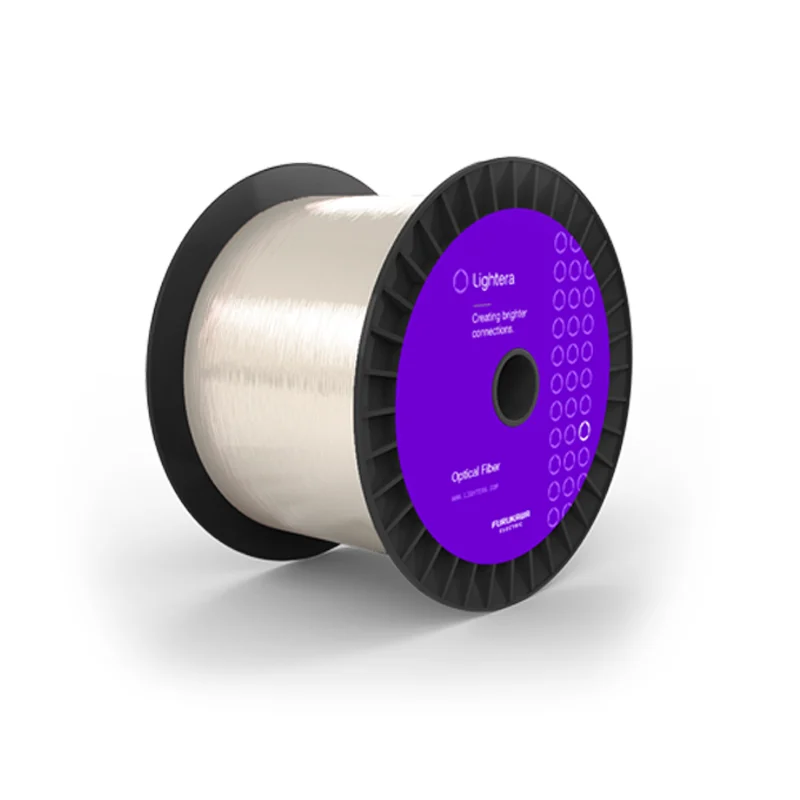
GyroSil 1550 is a polarisation-maintaining (PM) optical fibre optimised for fibre optic gyroscopes (FOGs) and other precision rotation-sensing applications. Its reduced 80 µm cladding diameter supports compact coil architectures where installation space is limited, while dual acrylate coating variants allow a practical balance between coil density and robustness.
Designed for 1550 nm operation, the fibre combines low attenuation, strong birefringence, and reliable mechanical performance for demanding aerospace, defence, and navigation systems.
Range features
A high level overview of what this range offers
- Polarisation-maintaining design: Preserves the light polarisation state for stable and accurate gyroscope measurements
- 80 µm reduced cladding: Enables tighter coil winding and more compact sensor designs
- Bend-insensitive performance: Maintains low attenuation in small-diameter fibre coils
- Dual acrylate coating options: Available in 155 µm or 135 µm coating diameters to suit different packaging needs
- Optimised for 1550 nm: Supports low-loss transmission at the standard FOG operating wavelength
- High birefringence characteristics: Low H-parameter and short beat length support strong polarisation retention
- 100 kpsi proof test: Provides excellent tensile strength and handling durability
- Extended temperature option: GyroSil 1550-135B supports operation from –55 °C to +85 °C
- Radiation-resistant core concept: Pure silica core supports improved resilience, with rad-hard variants available for harsher environments
Downloads
for GyroSil® Polarisation Maintaining 1550 nm Optical Fibre for Gyroscopes
What’s in this range?
All the variants in the range and a comparison of what they offer
| Specification | GyroSil 1550-155 (80/155) | GyroSil 1550-135 (80/135) | GyroSil 1550-135B (80/135, ext. temp) |
|---|---|---|---|
Cladding diameter | 80 ± 1 µm | 80 ± 1 µm | 80 ± 1 µm |
Coating diameter | 155 ± 5 µm | 135 ± 5 µm | 135 ± 5 µm |
Core concentricity error | < 0.5 µm | < 0.5 µm | < 0.5 µm |
Fibre type | Polarisation-maintaining | Polarisation-maintaining | Polarisation-maintaining |
Centre operating wavelength | 1550 nm | 1550 nm | 1550 nm |
Cutoff wavelength | < 1500 nm | < 1500 nm | < 1500 nm |
Mode field diameter @ 1550 nm | 6.4 ± 0.5 µm | 6.4 ± 0.5 µm | 6.4 ± 0.5 µm |
Attenuation @ 1550 nm | < 1.0 dB/km | < 1.0 dB/km | < 1.0 dB/km |
H-Parameter (1/m) | < 2 × 10^−5 | < 2 × 10^−5 | < 2 × 10^−5 |
Beat length @ 1550 nm | < 3.5 mm | < 3.5 mm | < 3.5 mm |
Operating temperature | Not specified | Not specified | –55 °C to +85 °C |
Proof test level | 100 kpsi | 100 kpsi | 100 kpsi |
Orderable part number | 27322 | 35589 | 89957 |
FAQs
for GyroSil® Polarisation Maintaining 1550 nm Optical Fibre for Gyroscopes
Fibre optic gyroscopes depend on interference between light waves travelling in opposite directions around a coil. If the fibre allows random polarisation changes, the signal can suffer added noise, drift, and phase instability. A polarisation-maintaining fibre like GyroSil 1550 helps preserve a stable polarisation state, supporting cleaner interference signals and more accurate rotation sensing.
GyroSil 1550 is engineered for sensing rather than telecom transmission. It uses an 80 µm cladding diameter instead of the more common 125 µm size, allowing much tighter coil winding in compact gyroscope assemblies. It is also a polarisation-maintaining fibre, includes dual acrylate coating options, and is proof-tested to 100 kpsi for demanding handling and integration conditions.
Both versions share the same 80 µm cladding and optical design, but they differ in outer coating diameter. The 155 µm version offers slightly greater mechanical protection, while the 135 µm version reduces total fibre diameter for denser winding or tighter packaging. This gives designers flexibility based on space constraints and handling priorities.
GyroSil 1550 is designed for small-diameter coil applications typical of fibre optic gyroscopes. While a specific minimum bend radius is not stated here, the reduced cladding and bend-tolerant design support very compact winding with low attenuation. In practical FOG coil geometries, the fibre is intended to maintain strong performance without significant signal degradation.
These are key indicators of polarisation-maintaining performance. A very low H-parameter means minimal coupling between polarisation axes, while a short beat length indicates strong birefringence. Together, these values show that GyroSil 1550 is designed to preserve the input polarisation state effectively over long fibre lengths, which is essential in precision gyroscope coils.
The fibre uses a pure silica core, which supports improved resistance to radiation-induced attenuation compared with some conventional designs. For moderate radiation exposure, this can be beneficial in aerospace environments. For more demanding space or high-radiation use cases, a dedicated rad-hard GyroSil variant is available.
The standard variants do not list a specific operating temperature in the provided specification table. However, the GyroSil 1550-135B extended-temperature version is specified for operation from –55 °C to +85 °C, making it suitable for harsher aerospace and defence environments.
Yes, it can be fusion spliced, but PM-to-PM splicing should use suitable alignment equipment to preserve the fibre’s polarisation-maintaining behaviour. Splicing to standard non-PM fibre is physically possible, though the PM function is not retained beyond that point. Because GyroSil 1550 uses an 80 µm cladding, compatible preparation and splicing tools should be used.