Thyro Family (SCR power controller products)
- Technology
- Thyristor power controllers
- Partner
- Advanced Energy
Thyro Family SCR power controllers regulate electrical power in industrial heating, melting, drying, forming and rectifier processes. The range includes Thyro-S, Thyro-A, Thyro-A+, Thyro-PX, Thyro-PX DC, Thyro-XD and the distributed Thyro-PX Modular Solution. This breadth allows engineers to match the controller to the load type, phase arrangement, current rating, control accuracy and firing method. Typical applications include electric furnaces, heat tracing, extruders, infrared drying, glass and ceramic processing, crystal growth, semiconductor thermal processes and hydrogen electrolysis. Depending on the series, functions can include load monitoring, configurable analogue I/O, process-data recording, mains load optimisation and transformer soft starting. Industrial communication options include EtherNet/IP, EtherCAT, PROFIBUS, PROFINET and Modbus TCP/IP, with selected models also supporting local USB configuration and touch displays. Integrated semiconductor fuses are provided on the principal controller series, while approvals, ratings and accessory compatibility must be checked against the selected voltage, current and phase configuration.
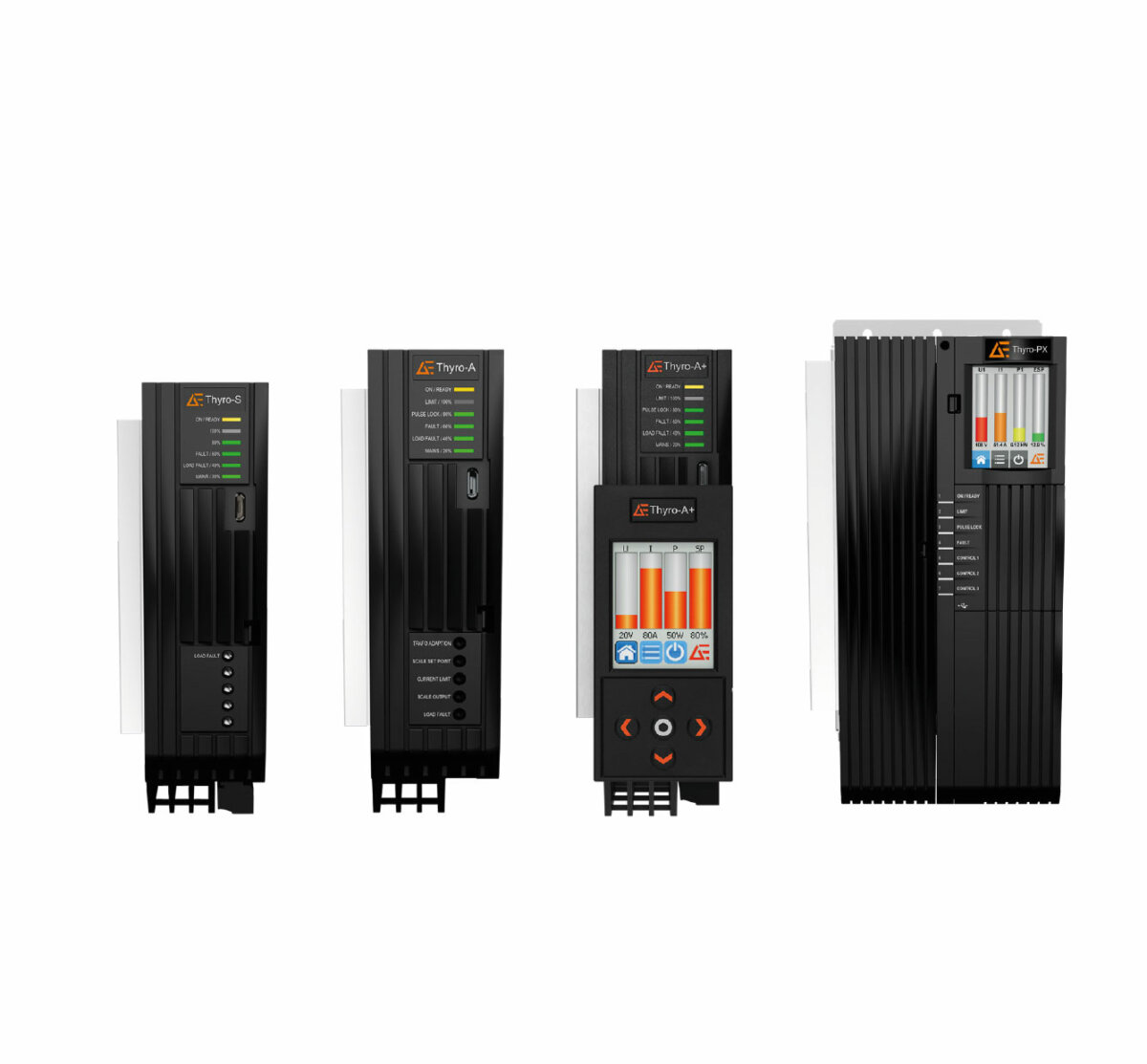
The Thyro Family brings together digital thyristor switches, SCR power controllers, DC rectifiers and modular high-current systems for industrial power control. It covers simple switching duties, precision closed-loop regulation and distributed water-cooled architectures for demanding AC and DC processes.
Across the range, engineers can select the required current class, phase configuration, firing mode, control accuracy and communications interface for resistive, transformer and temperature-dependent loads. This makes the family suitable for applications such as furnaces, dryers, extruders, heat tracing, glass processing, semiconductor thermal tools and hydrogen-related rectifier systems.
Range features
A high level overview of what this range offers
- Seven controller and rectifier platforms – Supports general heating, high-accuracy thermal control, DC rectification and distributed high-current systems.
- Current ratings from 8 to 5000 A – Allows selection for compact heater circuits through to large industrial furnaces.
- AC ratings up to 1000 V – Extends controller selection to higher-voltage Thyro-PX installations.
- Single-, two- and three-phase formats – Matches single-phase loads and several three-phase circuit arrangements.
- TAKT, VAR, QTM, VT and VSC operating modes – Provides firing methods for resistive, transformer and temperature-dependent loads.
- Voltage, current and power control options – Supports closed-loop regulation based on the electrical variable that matters to the process.
- Configurable analogue and digital interfaces – Simplifies connection to process controllers, PLCs and plant automation systems.
- Industrial Ethernet and fieldbus options – Supports integration with common factory communication networks.
- Process displays and PC tools – Assist commissioning, parameter adjustment, diagnosis and operating-data review.
- Mains load optimisation for multiple controllers – Can coordinate up to 32 controllers in supported TAKT-mode systems.
- Load monitoring and configurable alarms – Helps identify heater, load-circuit and operating faults where the selected model provides these functions.
- Water-cooled modular architecture – Supports separated control and power sections in high-current AC and DC systems.
Downloads
for Thyro Family (SCR power controller products)
What’s in this range?
All the variants in the range and a comparison of what they offer
| Specification | Thyro-S | Thyro-A | Thyro-A+ | Thyro-PX | Thyro-PX DC | Thyro-XD | Thyro-PX Modular Solution |
|---|---|---|---|---|---|---|---|
Product type | Digital thyristor switch | Digital SCR power controller | Digital SCR power controller | Digital SCR power controller | Digital SCR rectifier | High-accuracy digital SCR power controller | Distributed SCR controller and power-stack system |
Phase configuration | 1, 2 or 3 phase | 1, 2 or 3 phase | 1, 2 or 3 phase | 1, 2 or 3 phase | Three-phase controlled rectifier | Single phase | 1, 2 or 3 phase; AC and DC configurations |
Current rating | 8 to 350 A | 8 to 1500 A | 16 to 650 A | 16 to 5000 A | Up to 1800 A DC | 30 A | 4000 A per water-cooled stack; higher currents through parallel connections |
AC voltage rating | 230 to 500 V, configuration dependent | 230 to 500 V, configuration dependent | 230 to 500 V; other ratings by request | 230 to 500 V and 690 to 1000 V, each with stated tolerance ranges | 230 to 500 V standard; 690 V configurations by request | 24 to 500 V AC +10% | Up to 690 V AC +10% |
DC rating | — | — | — | — | 650 V DC bus; 960 V version identified as in preparation | — | Up to 900 V DC system design |
Frequency | 47 to 63 Hz | 47 to 63 Hz | 45 to 65 Hz | 45 to 65 Hz | Fan supply 50/60 Hz; stack mains frequency depends on the configured system | 45 to 65 Hz | 45 to 65 Hz |
Control accuracy | Switching controller | ±3% voltage; current measurement depends on option | ±1.5% voltage and ±1.5% current | ±0.5% voltage or current; ±1% power | Better than ±1% voltage or current; better than ±2% power | ±0.25% voltage or current; ±0.5% power for phase-angle setpoints down to 5% | ±0.5% voltage or current; ±1% power |
Operating modes | On/off switching; TAKT terminology used for full-wave switching arrangements | TAKT, VAR, QTM and optional VT; modes depend on phase version | TAKT, VAR, QTM, VT and SWITCH; modes depend on phase version | TAKT, VAR, VSC, soft start and soft down | VAR phase-angle firing with 0 to 100% setpoint | TAKT, VAR and variable full-wave VT | TAKT, VAR, VSC, soft start and soft down |
Control types | Switching by logical input or automation interface | Voltage, voltage squared, current, current squared and power, depending on variant | Voltage, voltage squared, current, current squared and power, depending on variant | Voltage, voltage squared, current, current squared, power or open-loop operation | Voltage, current and power regulation | Voltage, voltage squared, current, current squared, power or open-loop operation | Voltage, voltage squared, current, current squared, power or open-loop operation |
Load compatibility | Resistive and transformer loads | Resistive and transformer loads; selected versions support warm-to-cold resistance ratios up to 6 | Resistive and transformer loads; warm-to-cold resistance ratios up to 6 | Resistive, transformer and temperature-dependent loads with ratios up to 20 using MOSI starting | Electrolysers, water purification, DC heaters and crystal-growing supplies | Lamp heating, resistive and transformer loads; ratios up to 20 using MOSI starting | Resistive, transformer, furnace, arc-furnace and electrolyser applications |
Setpoint interfaces | 0 to 24 V logical input and optional digital bus control | 0/4 to 20 mA, 0/1 to 5 V, 0/2 to 10 V and digital control | Two configurable analogue setpoints plus digital and accessory inputs | Up to three configurable analogue inputs plus digital and optional I/O cards | 0/4 to 20 mA, 0/1 to 5 V and 0/2 to 10 V | 0/4 to 20 mA, 0/1 to 5 V and 0/2 to 10 V | Up to three configurable analogue inputs plus optional I/O cards |
Network options | EtherNet/IP, PROFIBUS, PROFINET and Modbus TCP/IP through a bus module | EtherNet/IP, PROFIBUS, PROFINET and Modbus TCP/IP through a bus module | EtherNet/IP, EtherCAT, PROFIBUS, PROFINET and Modbus TCP/IP | EtherNet/IP, EtherCAT, PROFIBUS, PROFINET and Modbus TCP/IP | EtherNet/IP, EtherCAT, PROFIBUS, PROFINET and Modbus TCP/IP | EtherNet/IP, EtherCAT, PROFIBUS, PROFINET and Modbus TCP/IP through the applicable bus module | EtherNet/IP, EtherCAT, PROFIBUS, PROFINET and Modbus TCP/IP |
Local configuration | Status LEDs and Micro-USB | Status LEDs and Micro-USB | Optional display, SD card and Micro-USB | 2.8 in touch display, SD card, RS-232 and USB | Optional 2.8 in touch display, SD card and Micro-USB | Optional touch display, SD card and Micro-USB | Touch display, SD card and PC configuration tool |
Fuse and monitoring provisions | Integrated semiconductor fuse; load monitoring on selected variant | Integrated semiconductor fuse; load monitoring on RL and RLP variants | Integrated semiconductor fuse and load-circuit monitoring | Integrated semiconductor fuse and load/self-monitoring | Semiconductor fuse for each thyristor with fuse-monitoring switch | Integrated semiconductor fuse, load-resistance measurement and configurable fault relays | Protection depends on the selected stack; thermal monitoring and interface isolation options are available |
Product compliance | CE; UL 508 and Canadian C22.2 No. 14 coverage depends on rating | CE; UL 508 and Canadian C22.2 No. 14 coverage depends on rating | CE; UL 508 and Canadian C22.2 No. 14 coverage depends on rating | CE; UL listing or recognition depends on voltage and current configuration | Configuration-dependent | CE marked | CE-marked controller; system compliance depends on the completed assembly |
FAQs
for Thyro Family (SCR power controller products)
Choose Thyro-S when the application primarily needs repeatable on/off switching rather than continuously regulated voltage, current or power. Thyro-A adds TAKT, VAR and QTM operation with ratings from 8 to 1500 A, making it suitable for a broad range of conventional heating systems. Thyro-A+ adds higher measurement accuracy, an optional display and more flexible commissioning, while the current range extends to 650 A. Thyro-PX is intended for more demanding systems requiring up to 5000 A, up to 1000 V, multi-zone control or VSC operation. Thyro-XD is the specialised 30 A choice where compact construction, resistance-change detection and ±0.5% power accuracy are important.
The firing mode should be selected from the electrical behaviour of the load, the acceptable harmonic content and the process response required. TAKT applies complete mains cycles and is commonly used with resistive loads where slower power modulation is acceptable. VAR controls each sinusoidal half-wave and is useful for transformer loads, rapid ramps and loads whose resistance changes considerably with temperature. QTM provides fast half-wave package control for suitable resistive loads, while VT combines or varies full-wave behaviour to address dynamic thermal processes. Thyro-PX VSC operation can reduce the disadvantages associated with conventional phase-angle control in compatible transformer and variable-resistance applications.
Accuracy varies materially between the series and should be matched to the stability required by the process. Thyro-A provides ±3% voltage accuracy and ±1.5% current accuracy, while Thyro-A+ improves both voltage and current control to approximately ±1.5%. Thyro-PX provides ±0.5% voltage or current control and ±1% power control. Thyro-XD narrows this further to ±0.25% for voltage or current and ±0.5% for power, subject to the stated phase-angle setpoint condition. For processes such as rapid thermal annealing or lamp heating, this difference affects how quickly the system can detect and compensate for changes in load resistance or incoming voltage.
Digital integration is available through EtherNet/IP, EtherCAT, PROFIBUS, PROFINET and Modbus TCP/IP, although the interface arrangement depends on the selected controller. Thyro-S and Thyro-A normally use a shared bus module, which can connect up to eight compatible power controllers under one module. Thyro-A+, Thyro-PX, Thyro-PX DC and Thyro-XD offer broader interface and accessory arrangements, including configurable analogue I/O and local USB access. The analogue setpoint ranges commonly include 0/4 to 20 mA, 0/1 to 5 V and 0/2 to 10 V. Engineers should confirm the network module, controller firmware and required process-data mapping before finalising the automation architecture.
The choice depends on the heater connection, whether a neutral conductor is present and how much independent phase control is required. Two-phase controllers can regulate a three-phase economic circuit using a delta load or a star-connected load without neutral, reducing the number of controlled power paths. A three-phase controller is appropriate where the circuit uses a neutral, open delta or another arrangement requiring control of all three phases. Thyro-S, Thyro-A, Thyro-A+ and Thyro-PX are available in one-, two- and three-phase forms, while Thyro-XD is currently a single-phase 30 A unit. The exact circuit topology must be checked against the model code before ordering or preparing the panel wiring.
Mains load optimisation coordinates the switching of several controllers so that their power demand is distributed rather than applied simultaneously. The dASM arrangement can coordinate groups of up to 32 supported controllers, with up to eight controllers connected to each bus module. This function is intended for TAKT full-wave switching systems and can help limit mains loading, flicker and coincident demand peaks. Thyro-PX also provides digital mains-load optimisation and power monitoring within its broader control architecture. In practice, the designer must consider the number of zones, response time, communication layout and load duty cycles before deciding whether local controller coordination or a wider plant-level power-management strategy is appropriate.
Rated current assumes the environmental and cooling conditions defined for the selected model, so panel thermal design cannot be based on current alone. Several air-cooled variants reach rated current at up to 35°C with forced cooling or 45°C with passive convection, with derating required above the stated limits. The modular water-cooled stack supports up to 690 V AC and approximately 4000 A per stack, but its capability depends on thyristor selection, coolant temperature, flow rate and plumbing arrangement. Each water-cooled thyristor requires up to 10 litres per minute, and the thermal switches open at 85°C. Clearance, semiconductor fusing, conductor sizing, protective earthing and safe isolation must therefore be designed for the complete assembled system.