Advanced Bus Module – SCR and Pyrometer Integration
- Technology
- SCR power controllers
- Partner
- Advanced Energy
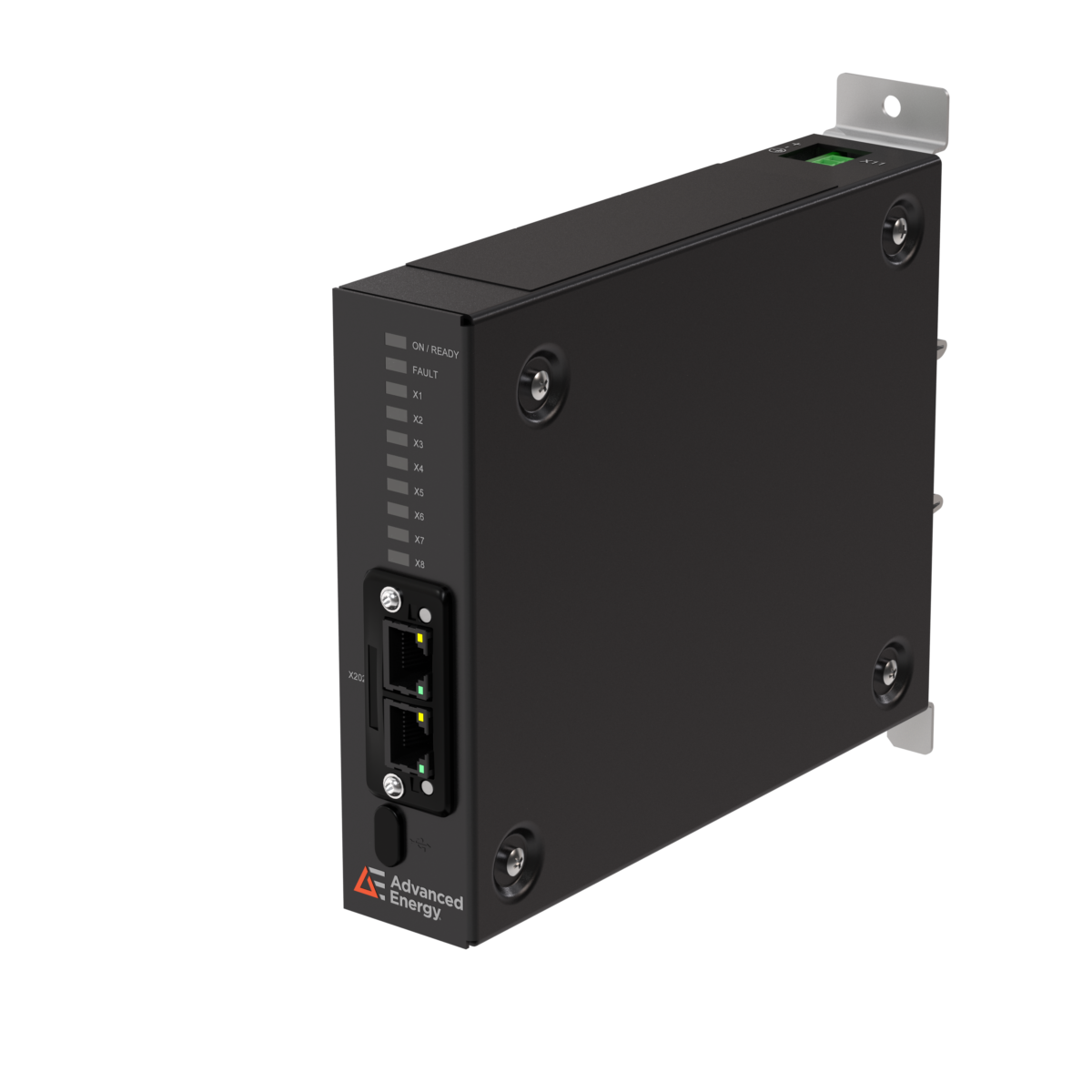
The Advanced Bus Module (ABM) is an add-on bus module designed to enhance Thyro-XD series SCR power controllers in demanding industrial processes. It acts as a central hub that connects up to eight SCR controllers and integrates feedback from one or more Impac® pyrometers for real-time temperature control. By enabling fast EtherCAT communication (and other protocols via optional interface cards), the ABM lets your power control system communicate with plant PLCs or automation networks at high speed. This module’s small footprint means it can be easily mounted alongside the controllers without consuming much panel space. In operation, it can coordinate a network of controllers – and with its optional dASM grid-synchronisation mode, it can manage up to 32 SCR units in unison for balanced power loading. The result is a more responsive and precise heating control system that is simpler to integrate. Industries from semiconductor manufacturing and glass production to metal heat treatment benefit from the ABM’s ability to tightly couple power control with accurate temperature measurement, leading to improved consistency, efficiency, and reliability in thermal processes.
Range features
A high level overview of what this range offers
- SCR–pyrometer integration – Provides direct temperature feedback from Impac pyrometers to SCR controllers for precise closed-loop control
- High-speed EtherCAT® communication – Delivers fast, low-latency data exchange with automation systems, improving response times and control accuracy
- Compact design – Minimal footprint module that mounts easily on DIN rail, saving panel space and simplifying installation with Thyro-XD controllers
- dASM grid optimisation mode – Optional synchronisation feature coordinates up to 32 SCR units (in full-wave operation) to balance load peaks and reduce stress on the power grid
- Multi-protocol flexibility – Supports EtherCAT, EtherNet/IP®, Profibus®, Profinet®, and Modbus TCP via plug-in Anybus interface cards, ensuring easy integration into various industrial networks
- Unified monitoring & access – Integrated USB interface for PC connection allows full parameter access to all connected SCR controllers using Thyro-Tool Pro software, simplifying configuration and diagnostics
Downloads
for Advanced Bus Module - SCR and Pyrometer Integration
What’s in this range?
All the variants in the range and a comparison of what they offer
| Part Number | Module Name | Description | EtherCAT Switches | dASM Support | Application Compatibility |
|---|---|---|---|---|---|
2000190022 | Advanced Bus Module S | Standard Advanced Bus Module with integrated EtherCAT® switching capability for high-speed communication | Yes | No | Thyro-XD SCR Power Controller and compatible Thyro systems |
2000190031 | Advanced Bus Module D | Standard Advanced Bus Module with dASM (digital load optimization) functionality, no EtherCAT switches | No | Yes | Thyro-XD SCR Power Controller and advanced load-controlled applications |
2000190030 | Advanced Bus Module N | Standard Advanced Bus Module without EtherCAT switches and without dASM (basic configuration) | No | No | Thyro-XD SCR Power Controller and general-purpose communication setups |
FAQs
for Advanced Bus Module – SCR and Pyrometer Integration
A single ABM can connect and manage up to eight Thyro-XD SCR power controllers in a network. All those controllers communicate through the module as one system. Additionally, if you enable the ABM’s special dASM mode, multiple ABMs can work in unison to synchronise up to 32 SCR controllers in full-wave operation for large-scale coordinated control.
The dASM (distributed Adaptive Synchronisation Mode) is an optional operating mode of the ABM that optimises how multiple SCR controllers draw power from the mains. In dASM mode, the ABM staggers or synchronises the firing of up to 32 SCR units to avoid them all switching at the same instant. This helps balance the load on the power grid, reducing peak currents and potential electrical stress, which can be especially beneficial in installations with many heaters or high power levels.
The Advanced Bus Module is available in three versions to suit different needs:
- ABM “S” includes built-in EtherCAT switch ports for daisy-chaining into an EtherCAT network.
- ABM “D” is equipped with the dASM synchronisation feature (for grid/load optimisation) but does not have the EtherCAT switch hardware.
- ABM “N” is the standard variant without EtherCAT switches and without dASM.
All three versions provide the core functionality of linking Thyro-XD controllers and pyrometers; the main differences are whether EtherCAT networking and/or dASM capability is included.
The ABM itself natively supports EtherCAT® (ultra-fast fieldbus communication, and by using optional Anybus plug-in interface cards it can support EtherNet/IP®, Profibus®, Profinet®, or Modbus TCP/IP protocols. In practice, you would choose the appropriate Anybus module for the network you intend to use. For example, if your facility uses an Allen-Bradley PLC system, you might install the EtherNet/IP interface card; for a Siemens or similar system, a Profibus or Profinet card can be used. This flexibility means the ABM can integrate into virtually any common industrial control network.
Bringing an Impac infrared pyrometer into the control loop allows the SCR power controller to adjust heating based on actual measured temperature rather than just preset power levels. The ABM facilitates this by directly feeding the pyrometer’s temperature readings into the Thyro-XD controller network. The benefit is much tighter temperature control – the system can automatically compensate for disturbances or material changes in real time. This results in more uniform product quality, avoidance of overheating, and improved energy efficiency because the heating output is continuously tuned to reach and hold the desired temperature precisely.
The ABM is specifically designed to work with Advanced Energy Thyro-XD SCR power controllers. It uses the Thyro-XD’s digital interface to consolidate communications and sensor feedback. Older Thyro series controllers (such as Thyro-A or Thyro-S) use different bus modules (for example, the BasicBus Module) and would not use the Advanced Bus Module. If you have Thyro-XD units in your system, the ABM is the correct module to integrate networking and pyrometer feedback. For other SCR controller models, you would use the corresponding communication module intended for those units.
The Advanced Bus Module is a standalone unit that typically mounts on a DIN rail in your control cabinet, adjacent to the SCR power controllers. It connects to the Thyro-XD controllers via a dedicated communication port or bus cable (so that multiple controllers link in series to the one module). Pyrometers (temperature sensors) are wired into the ABM’s sensor inputs or communication ports. On the other side, the ABM has an interface slot for an Anybus fieldbus card or an EtherCAT port (depending on the version), which you connect to your plant’s network or PLC. In summary, installation involves mounting the module, connecting power (24 V supply), linking the Thyro-XD controllers and any pyrometers to it, and then attaching the chosen fieldbus interface to your control network.
The ABM is powered by a 24 V DC supply. It draws approximately 1.2 A under normal conditions, but to support all features and connected devices, it can require up to 6.0 A at full load. In practical terms, you should budget about 24 V at 6 A (around 144 W) available for the ABM, especially if you have many controllers and modules connected. Ensure your 24 V power supply can deliver this current comfortably to avoid voltage drop. The module has built-in protections, but a stable and adequately rated DC supply will guarantee reliable operation.
Configuration and monitoring are done using a PC-based software tool called Thyro-Tool Pro. The ABM has a USB port that you can connect directly to a laptop or PC. Using Thyro-Tool Pro, an engineer can access all the connected SCR power controllers from that single connection point – viewing parameters, adjusting settings, and monitoring real-time performance metrics for each controller or the system as a whole. This is extremely convenient, as it means you don’t need to connect to each controller individually; the ABM acts as a communications gateway. The software provides a graphical interface for commissioning, diagnostics, data logging (trending), and firmware updates if needed, simplifying maintenance and fine-tuning of the heating system.