Light Shaping Diffuser Directional Turning Film
- Technology
- Light shaping diffusers
- Partner
- Luminit
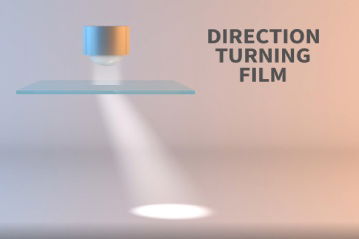
Luminit’s directional turning film (DTF) consists of linear non-symmetric microprisms that deflect a nearly collimated light source by 20°. The direction turning film can be combined with a light shaping diffuser of any angle to simultaneously shape and deflect the beam.
The DTF is ideal for recessed LED lighting such as uplighters, stair lighting, and swimming pool lighting.
Range features
A high level overview of what this range offers
Advantages of directional turning film
- Better wall washing for recessed luminaires
- Reduction of glare and more intensive floor lighting for path/ staircase lighting
- Improved floor lighting for swimming pools
- Cost savings through simple integration without modifications to the luminaire
What’s in this range?
All the variants in the range and a comparison of what they offer
Turning angle (standard) | 20° |
Substrate | Polycarbonate 0.010“ |
Transmission spectral range | 400nm to 1500nm |
Temperature range | -30°C to 80°C @ 240 hours |
Humidity | > 95% ± 5 % RH @ 24 hours |
Yellow index – UVA/UVB (900 Kjm^2) | Δa = -2,98; Δb = 10,27 |
FAQs
for Light Shaping Diffuser Directional Turning Film
Luminit’s DTF (Direction Turning Film) is a non-symmetrical linear micro-prismatic that imparts a 20-degree shift in the angle of a semi-collimated light source. The DTF works well with LED light sources that utilize secondary optics. Some applications include recessed can lights to allow for more wall washing, pathway/stair lighting to reduce glare and increase ground illumination and pool lighting to increase illumination of the bottom.
Direction Turning Films can be combined with Light Shaping Diffusers to shape and homogenize the beam in addition to changing direction. The beam can be shaped in a circular or elliptical pattern dependent on the diffuser angle chosen. These light bending films enable off-axis placement of the incoming beam when direct line of sight is impractical. Applications include LED lighting, avionics displays, traffic signs/displays and LCD backlights. They are also used to change the light beam direction to light a wall, walkway or other lighting target.
Luminit offers BTDF data that is convertible to a variety of formats on their website.
The diffusivity has a natural “sigmoidal” (i.e., “S” curve) response to drive signal strength.
You can achieve a range of angles from 1° FWHM in the clear state to 70° FWHM in the fully diffused state.
The EVD unit has an 81% transmission efficiency in the “on” state and 78% in the “off” state measured at 550 nm at 28°C. Anti-reflection coated glass laminates are available on a special-order basis to improve transmission.
There are currently two different types of DTF products, one is a 20° bend-off axis material for visible or white light and the other is a 10° bend-off axis for 810 nm (IR) LEDs.
Yes, Luminit’s Direction Turning Film is often used to redirect light to a desired location
Yes, you can layer multiple sheets of DTF to increase the angle of redirection; however, there will be significant transmission loss.
Luminit’s display Brightness Film (DBF) is a light management film that increases the brightness of LCD displays. DBF is a prismatic structure with either a 1, 2, 3.5, 10 or 20-degree diffuser on the other side of the film. DBF is also available without the diffuser.
Birefringence is the optical property of a material having a refractive index that depends on the polarization and propagation direction of light. In LCD screens, birefringence can create unwanted optical artifacts such as Newton’s rings and more. The high transmission efficiency of Luminit diffusers as well as the ability to homogenize a light source can preserve polarization and eliminate birefringence.
Automotive lighting engineers incorporate the diffusers into taillights and running lights to homogenize the output of LEDs as well as control the beam angle. If you’ve seen a recent model Dodge Durango while driving at night, you’ve seen Luminit diffusers in action. Luminit’s light bending diffusion films are also used in automotive interior lighting, cluster panels, LCD displays, welcome mat lighting and more.
Yes, Luminit’s lighting diffuser film is approved by AMECA as meeting the three-year weathering test of SAE J576 for plastics used in optical lenses and reflectors on motor vehicles.