MP3010M-EV camera module
- Partner
- Tamron
The MP3010M-EV is a compact Full HD camera module with a 10× motorised zoom, designed for demanding vision applications in industry and security. It uses a high-sensitivity Sony STARVIS sensor to deliver clear colour images in very low light and supports day/night operation with an IR-cut filter. The module outputs up to 1080p at 60 fps and supports multiple interfaces including LVDS, micro HDMI, analogue composite, and USB Video Class for plug-and-play streaming.
Built-in electronic image stabilisation helps reduce the effects of vibration and motion, making it well suited to drones, robots, and mobile platforms. VISCA control over TTL serial, with compatibility for RS-232 and RS-485, enables remote adjustment of zoom, focus, iris, and other camera settings. Its compact 33 × 43 × 59 mm form factor and weight of about 70 g make it ideal for space-constrained and weight-sensitive designs. The module is also NDAA compliant, making it suitable for projects with strict sourcing requirements.
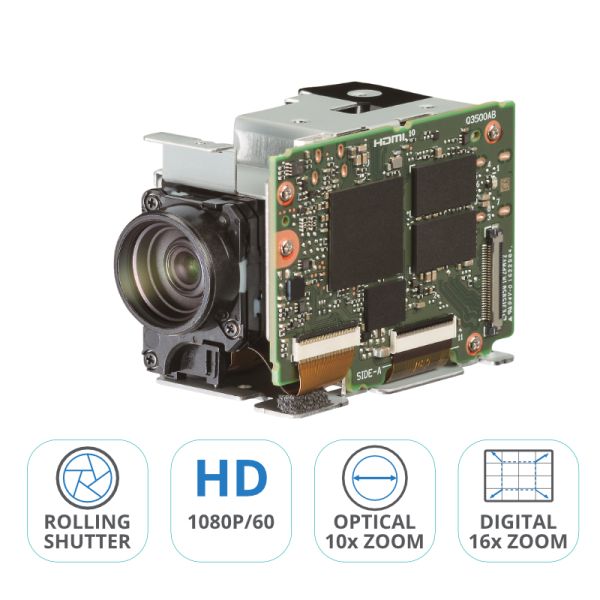
The MP3010M-EV is engineered for professional embedded imaging where compact size, optical zoom, and reliable low-light performance are essential. It combines a Sony STARVIS sensor, 10× motorised zoom, and electronic image stabilisation in a lightweight module that is easy to integrate into robotics, surveillance, transport, industrial inspection, and UAV platforms.
Its backward-compatible mechanical design helps simplify upgrades from earlier MP1010 and MP1110 series modules, while support for LVDS, micro HDMI, analogue CVBS, and VISCA control gives system designers flexibility across both modern and legacy environments.
Range features
A high level overview of what this range offers
- Backward-compatible upgrade path – Designed with the same physical format and connector concept as earlier MP1010/MP1110 series modules, helping reduce redesign work.
- Excellent low-light imaging – Sony STARVIS sensor technology provides strong sensitivity for clearer images in dim scenes.
- True day/night capability – Automatic IR-cut filter switching enables colour imaging by day and infrared-friendly monochrome operation at night.
- Multiple video outputs – Supports LVDS, micro HDMI, and analogue CVBS for integration into digital and legacy systems.
- Full HD high frame rate output – Delivers up to 1080p at 60 fps for smooth, detailed video capture.
- Electronic image stabilisation – Helps minimise visible shake and vibration on drones, vehicles, and other moving platforms.
- Remote VISCA control – Enables control of zoom, focus, iris, and camera settings over TTL serial, RS-232, or RS-485 compatible setups.
- 10× optical zoom lens – Covers wide to telephoto views in one compact module for flexible framing.
- Ultra-compact and lightweight – Approx. 33 × 43 × 59 mm and about 70 g, ideal for space- and weight-sensitive systems.
- NDAA compliant – Suitable for regulated projects requiring trusted component sourcing.
What’s in this range?
All the variants in the range and a comparison of what they offer
Specification | MP3010M-EV |
Image Sensor | 1/3″ Sony CMOS with STARVIS back-illuminated technology |
Effective Pixels | 1920 × 1080 or 1280 × 720 |
HD Video Formats | 1080p at 60, 59.94, 50, 30, 29.97, 25 fps; 720p at 60, 59.94, 50, 30, 29.97, 25 fps |
SD Video Format | NTSC/PAL |
Minimum Illumination | 0.1 lx colour; 0.025 lx B&W |
S/N Ratio | More than 50 dB |
Gain Control | Auto / Manual |
Shutter Speed | 1/1 s to 1/10,000 s |
Lens | 10× optical zoom, f = 3.3–33 mm, F/1.8–3.4 |
Digital Zoom | Up to 16× |
Focus Modes | Auto / Manual / One-push / AF sensitivity |
Minimum Object Distance | Visible light: 10 mm wide to 800 mm tele; 850 nm: 10 mm wide to 1200 mm tele |
Horizontal Field of View | 59.2° wide to 6.7° tele |
Day/Night | On / Off with ICR switching |
Electronic Image Stabilisation | Off / On |
Horizontal Resolution | Centre: 800 TV lines typical |
HD Video Output | LVDS digital Y/Pb/Pr 4:2:2; HDMI Type D micro |
SD Video Output | CVBS 1.0 V p-p, 75 Ω |
Camera Control | VISCA |
Power Requirement | DC 8–12 V ±10% |
Power Consumption | Approx. 2.5 W typical; approx. 4.4 W during zoom and focus operation |
Operating Temperature | -5 °C to +60 °C |
Storage Temperature | -40 °C to +60 °C |
Operating Humidity | 20% to 80% RH, non-condensing |
Dimensions | 33 × 43 × 59 mm |
Weight | About 70 g |
FAQs
for MP3010M-EV camera module
The module uses a Sony STARVIS sensor for strong low-light performance and can capture colour video at approximately 0.1 lx. For darker scenes, its day/night function switches the IR-cut filter to support near-infrared use and black-and-white imaging down to around 0.025 lx.
The MP3010M-EV supports LVDS for digital HD output, micro HDMI (Type D) for direct HD connection, and analogue CVBS for NTSC/PAL systems. It is also described as supporting UVC over USB for plug-and-play streaming to a PC.
Camera control is handled through the VISCA protocol. The module supports serial control via TTL and can be integrated with RS-232 or RS-485 compatible systems, allowing remote adjustment of zoom, focus, iris, exposure, and other settings.
Yes. It is designed as a practical upgrade path for earlier MP1010 and MP1110 series modules, with a closely matched form factor and compatible mounting and interface expectations that help minimise hardware redesign.
The MP3010M-EV uses electronic image stabilisation rather than optical vibration compensation. It digitally compensates for small movements and vibration to help produce a steadier image in mobile or high-vibration applications.
NDAA compliance indicates that the module is intended for projects that must avoid restricted components under U.S. procurement rules such as Section 889. This makes it a suitable option for government, defence, and security-related applications with supply chain restrictions.
Typical uses include drones, robots, industrial inspection systems, surveillance and security platforms, transportation monitoring, and other embedded vision applications that need compact size, optical zoom, and dependable low-light imaging.