Gears (Servo drives)
Precision gear stages for controlled motion and torque transfer
Servo drive gears provide the mechanical foundation for precise, motorised movement. They translate motor output into controlled, repeatable motion, helping imaging platforms achieve the accuracy, torque and responsiveness needed for demanding positioning applications.
Unlike a complete pan and tilt positioner, a servo drive gear is a component within the wider motion system. It works alongside motors, encoders and control electronics to deliver accurate movement with minimal backlash and reliable torque transmission.
For engineers, the right gear stage depends on factors such as gear ratio, torque and load requirements, backlash, efficiency and positioning accuracy. Selecting the right combination ensures the wider imaging system performs consistently and predictably.
Do you want to know more about this technology? Try out our new Chatbot!
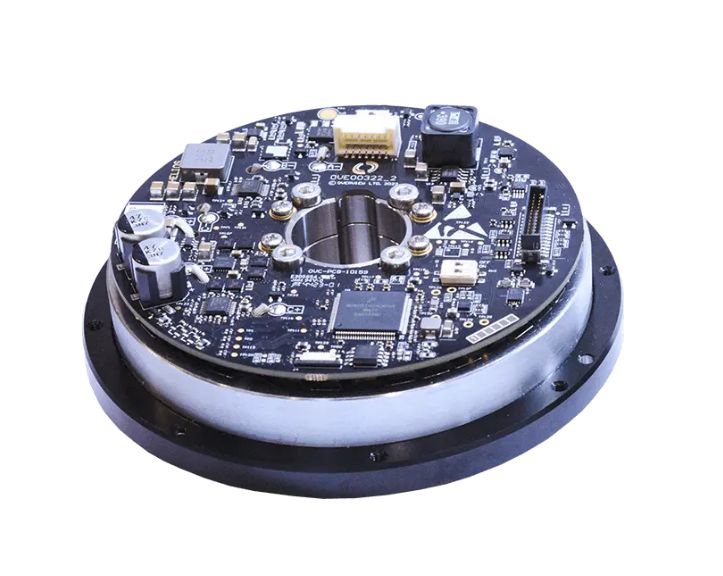
Why our portfolio is right for you
Our servo drive gear solutions are designed for applications where controlled, accurate and repeatable movement is essential. They provide the mechanical precision needed for camera positioning, machine vision, robotics and other automated imaging systems.
We offer a range of servo drive options to suit different combinations of speed, torque, load and positioning requirements. Whether you are building a custom camera positioning system or integrating precision motion into an existing platform, our solutions give you the flexibility to select the mechanical architecture that best fits your application.
Our in-house engineering expertise can also support you beyond component selection, helping you consider gear ratios, payloads, positioning accuracy and system integration from the outset. The result is a motion system that is designed to work reliably as a complete assembly — not just a collection of individual components.
Key selection factors
-
Backlash and positioning accuracy: Low backlash is important when precise, repeatable movement is required. The gear stage should be selected with the accuracy requirements of the complete system in mind.
-
Gear type and architecture: Different gear technologies offer different advantages. Harmonic drives can provide high precision and low backlash, while planetary and worm gears offer alternative combinations of torque capacity, efficiency and cost.
-
Load capacity and torque transmission: The gear stage must be able to handle the required payload and torque throughout its operating range. Considering peak as well as continuous loads helps avoid premature wear or loss of performance.
-
Integration complexity: Unlike a complete pan and tilt positioner, a servo drive gear needs to be integrated into the wider mechanical and control architecture. Motor, encoder, mounting and control requirements all need to be considered together.
-
Efficiency and thermal behaviour: Gear efficiency affects both power consumption and heat generation. This can be particularly important in compact or enclosed systems where thermal management is limited.
-
Application-specific requirements: The operating environment and duty cycle can influence the choice of materials, sealing, lubrication and gear architecture. Precision applications may prioritise minimal mechanical play, while industrial environments may place greater emphasis on durability and environmental protection.
Technical overview
Within camera positioning systems, servo drive gears convert rotational motor input into controlled angular or linear movement. They are typically integrated into pan and tilt assemblies, robotic mechanisms or custom motion platforms where accurate and repeatable positioning is required.
Different gear architectures offer different performance characteristics. Worm, planetary and harmonic drives, for example, each provide different balances of precision, efficiency, torque capacity, size and backlash. The most suitable option depends on the movement profile and mechanical requirements of the application.
Servo drive gears form part of a larger positioning system rather than operating as a standalone solution. They need to be matched with the appropriate motor, encoder, mechanical structure and control system to achieve the required level of performance.
Their characteristics can have a direct impact on the responsiveness, stability and positioning accuracy of the finished system. This becomes particularly important in applications such as precision imaging, machine vision and automated inspection, where even small amounts of mechanical play can affect the final result.
Integration notes
Servo drive gears are integrated with motors, encoders and control electronics to create a complete motion system. Mechanical alignment is particularly important: accurate mounting and correct load distribution help ensure smooth operation, reduce wear and maintain positioning performance over time.
The gear stage also needs to be matched to the motor and control system. In closed-loop applications, encoder feedback and appropriate control tuning help the system respond accurately to commanded movements. Backlash and mechanical tolerances should be accounted for during both mechanical design and software development.
Unlike a complete pan and tilt positioner, the gear stage does not provide the full structural and control package. This gives engineers greater flexibility when developing a bespoke positioning system, but also means that integration and component selection become a more important part of the design process.
Compared with a tripod, which provides fixed, passive support, servo-driven systems introduce active, programmable movement and therefore require the mechanical, electrical and control elements to work together as one system.
FAQ’s
They are used to transmit and control motion in motorised positioning systems. Applications include pan tilt mechanisms, tracking systems, and automated inspection setups. They enable precise and repeatable movement.
The key difference is system level: • Servo drive gears: components within a motion system • Pan tilt positioners: complete positioning units Servo gears require additional integration to function as a full system.
Common types include: • Worm gears for high torque and self-locking behaviour • Planetary gears for efficiency and compactness • Harmonic drives for high precision and low backlash Each type suits different applications.
Backlash affects positioning accuracy and repeatability. High backlash can lead to errors in camera orientation. Minimising backlash is critical in precision imaging systems.
Yes, they require integration with motors, encoders, and control systems. This increases design complexity compared to complete positioning systems. Proper engineering is needed to achieve optimal performance.
The gear must handle the required torque without excessive wear or deformation. Incorrect selection can lead to failure or reduced accuracy. Load analysis is an essential part of system design.
Yes, but they must be designed or protected for environmental conditions. Factors such as dust, moisture, and temperature can affect performance. Proper sealing and materials are important.
Typical issues include: • Ignoring backlash requirements • Underestimating load and torque • Overlooking integration complexity These can lead to system performance problems if not addressed early.