NanoScan Series
- Technology
- High voltage amplifiers and piezo drivers
- Partner
- Prior Scientific
The Prior Scientific NanoScan Series is a range of high-performance piezoelectric nanopositioning systems designed to provide extremely fast, precise and repeatable movement for advanced microscopy applications.
NanoScan systems are designed for applications where conventional motorised positioning is not fast or precise enough. By using piezoelectric actuation and high-resolution capacitive feedback, the systems provide exceptionally fine positioning and rapid step-and-settle performance.
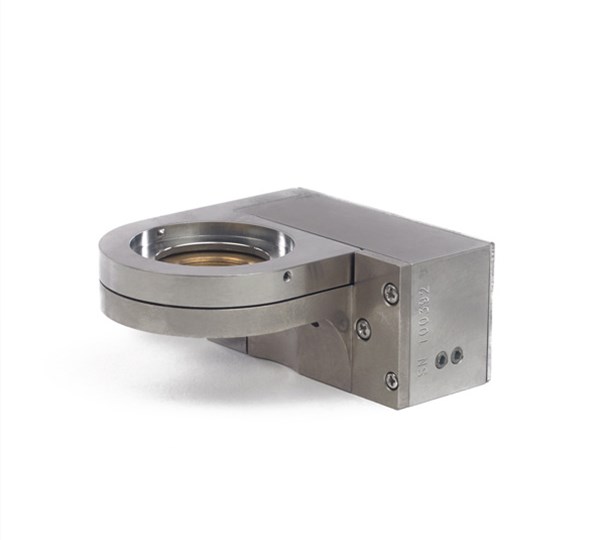
The range includes objective scanners and sample scanners, allowing the microscope objective or specimen to be moved with nanometre-scale precision. NanoScan systems can be integrated with Prior motorised stages and are also compatible with a range of common microscope configurations using the appropriate adapter hardware.
This makes NanoScan particularly well suited to applications requiring rapid Z-stack acquisition, precision focus control, 3D imaging and high-speed microscopy.
Precision Z positioning at exceptional speed
High-resolution microscopy increasingly requires more than simply moving a sample from one XY position to another. Applications such as 3D imaging, optical sectioning and volumetric acquisition require the microscope’s focal plane to move rapidly and accurately through the sample. NanoScan addresses this requirement using piezo-driven nanopositioning.
Rather than relying on conventional motor-driven mechanisms, the piezo actuator provides extremely small, rapid movements. Integrated capacitive sensors provide closed-loop feedback, allowing the controller to monitor the actual position and correct for movement errors.
Prior specifically describes the NanoScan OP400 as providing its fastest step-and-settle performance among its objective positioners, while the SP range is designed to provide high-performance piezo-driven sample positioning.
Range features
A high level overview of what this range offers
- Piezoelectric nanopositioning NanoScan uses piezoelectric actuation to provide extremely small and rapid positioning movements.
This makes it possible to perform high-resolution focus changes and Z-stack acquisition substantially faster than conventional mechanically driven positioning systems.
- Closed-loop capacitive feedback Integrated capacitive feedback sensors continuously monitor position.
This closed-loop architecture helps NanoScan achieve high positioning accuracy and repeatability, making it suitable for demanding quantitative microscopy applications.
- Exceptional step-and-settle performance Fast movement is only useful if the system can settle quickly enough for the microscope to acquire an image.
NanoScan is designed around rapid step-and-settle performance, helping minimise the time spent waiting for vibration and positioning errors to decay between images.
- Rapid Z-stack acquisition One of the key applications for NanoScan is high-speed Z-stack imaging.
The scanner can rapidly move through successive focal planes, enabling faster acquisition of 3D image stacks while maintaining precise control of the focal position.
- Objective or sample scanning Prior provides both objective-scanning and sample-scanning configurations.
This gives system designers flexibility to select the positioning architecture that best suits the microscope, sample and optical configuration.
- High positioning accuracy and resolution NanoScan is intended for applications where small positioning errors can affect image quality or quantitative measurements.
The combination of piezo actuation and capacitive feedback provides the fine positioning capability required for advanced optical microscopy.
- Integration with automated microscopy NanoScan can be incorporated into larger automated microscopy systems, including systems using Prior motorised stages.
This enables fast Z movement to be combined with automated XY positioning, creating a complete platform for automated 3D and multi-position imaging.
- Flexible microscope integration The NanoScan range is designed to work with Prior motorised stages and can be integrated with many common microscope platforms using appropriate adapter plates.
This makes it suitable for both new microscope builds and upgrades to existing automated imaging systems.
What’s in this range?
All the variants in the range and a comparison of what they offer
| Model | Type | Primary function | Typical integration |
|---|---|---|---|
OP200 | Objective scanner | High-speed precision objective positioning | Upright microscope systems |
OP400 | Objective scanner | High-speed objective positioning with increased load capability | Upright microscope systems |
OP800 | Objective scanner | High-speed objective positioning for higher-load applications | Upright microscope systems |
SP NanoScan Series | Sample scanner | Piezo-driven precision sample positioning | Prior motorised stages and compatible microscopes |
SP systems | Piezo sample scanner | Rapid Z movement and Z-stack acquisition | Automated microscopy platforms |