MDBT42T Series, Bluetooth 5.4, LGA module; nRF52805 based
- Technology
- Bluetooth modules
- Partner
- Raytac
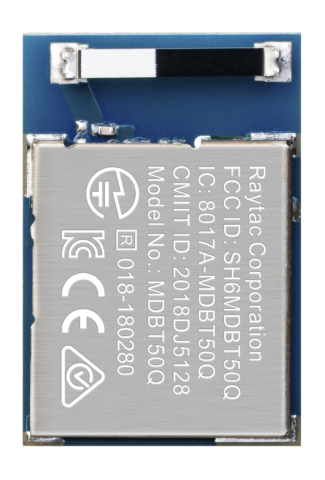
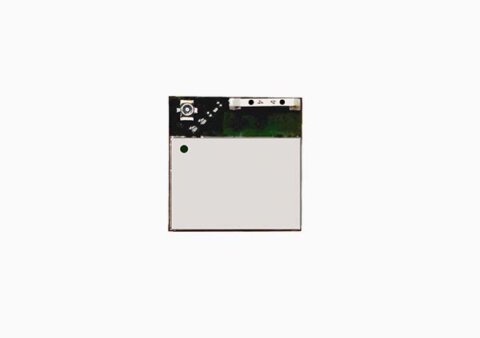
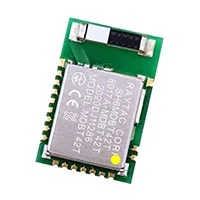
Raytac’s MDBT42T module series is a compact Bluetooth Low Energy module family designed for straightforward wireless integration in embedded systems. Pre-loaded with Raytac AT command firmware and operating in the Peripheral/Slave role, it provides a practical route to adding Bluetooth connectivity without the need for a full custom software build. Based on the Nordic nRF52805 SoC, the series is also recognised as a Nordic-recommended third-party module.
The module supports Bluetooth 5.4, 5.2, 5.1 and 5.0, making it a strong fit for low-power wireless applications that require reliable connectivity, compact size and simplified integration. Global approvals including FCC, IC, CE, TELEC (MIC), KC, SRRC and NCC help reduce certification effort for international designs, while RoHS and REACH compliance supports use in modern product development and regulated markets.
At hardware level, the module integrates a 32-bit ARM Cortex-M4F processor, 192 kB Flash and 24 kB RAM in a compact 7.2 x 11.2 x 2.05 mm footprint. It provides 10 GPIOs, a UART interface, an MTU of up to 247 bytes and an integrated chip antenna, giving developers a balanced platform for space-constrained Bluetooth designs. For applications requiring Central/Master functionality, the module is designed to operate alongside Raytac’s MDBT42Q-ATM and MDBT42Q-PATM modules.
Range features
A high level overview of what this range offers
- Device name configuration
- 1 Mbps / 2 Mbps on-air data rate
- 5-level TX power control
- Adjustable advertising and connection intervals
- Advertising enable/disable with status LED patterns
- 7 UART baud rates, with hardware interface & flow control enable/disable
- 8 programmable GPIOs with power-down & GPIO wake-up
- DC-DC or LDO power mode selection
- Internal or external 32.768 kHz oscillator
- Hardware & software reset and factory default recovery
- Serial number & MAC address set/retrieve
- Battery ADC monitoring
- Max MTU 247 bytes, payload up to 244 bytes
What’s in this range?
All the variants in the range and a comparison of what they offer
| Specification | MDBT42T-192K | MDBT42T-P192K | MDBT42TV-192K | MDBT42TV-P192K |
|---|---|---|---|---|
SoC | Nordic nRF52805 | Nordic nRF52805 | Nordic nRF52805 | Nordic nRF52805 |
Bluetooth qualification | BT5.4 / BT5.3 / BT5.2 / BT5.1 / BT5 | BT5.4 / BT5.3 / BT5.2 / BT5.1 / BT5 | BT5.4 / BT5.3 / BT5.2 / BT5.1 / BT5 | BT5.4 / BT5.3 / BT5.2 / BT5.1 / BT5 |
CPU | 32-bit ARM Cortex-M4 | 32-bit ARM Cortex-M4 | 32-bit ARM Cortex-M4 | 32-bit ARM Cortex-M4 |
Flash / RAM | 192 KB / 24 KB | 192 KB / 24 KB | 192 KB / 24 KB | 192 KB / 24 KB |
GPIO | 10 | 10 | 10 | 10 |
Antenna | Chip antenna | PCB antenna | Chip antenna | PCB antenna |
Interfaces | SPI, UART, I2C, PWM | SPI, UART, I2C, PWM | SPI, UART, I2C, PWM | SPI, UART, I2C, PWM |
ADC | 2-channel, 12-bit, 200 KSPS | 2-channel, 12-bit, 200 KSPS | 2-channel, 12-bit, 200 KSPS | 2-channel, 12-bit, 200 KSPS |
Programmable TX power | +4 dBm to -20 dBm | +4 dBm to -20 dBm | +4 dBm to -20 dBm | +4 dBm to -20 dBm |
Supply voltage | 1.7 V to 3.6 V | 1.7 V to 3.6 V | 1.7 V to 3.6 V | 1.7 V to 3.6 V |
On-chip DC/DC buck converter | Yes | Yes | Yes | Yes |
Dimensions | 7.2 × 11.2 × 2.05 mm | 7.2 × 11.2 × 1.8 mm | 5.8 × 8.3 × 1.3 mm | 5.8 × 8.3 × 1.3 mm |
Form factor | Compact | Compact | Tiny | Tiny |
Certifications shown in product header | FCC, IC, CE, Telec (MIC), KC, SRRC, NCC | FCC, IC, CE, Telec (MIC), KC, SRRC, NCC | FCC, IC, CE, UKCA, Telec (MIC), KC, SRRC, NCC | FCC, IC, CE, UKCA, Telec (MIC), KC, SRRC, NCC |
Regional pre-certification listed in specs section | FCC, IC, CE, Telec, KC, SRRC, NCC, RCM, UKCA | FCC, IC, CE, Telec, KC, SRRC, NCC, RCM, UKCA | FCC, IC, CE, Telec, KC, SRRC, NCC, RCM, UKCA | FCC, IC, CE, Telec, KC, SRRC, NCC, RCM, UKCA |
RoHS / REACH compliant | Yes | Yes | Yes | Yes |
FAQs
for MDBT42T Series, Bluetooth 5.4, LGA module; nRF52805 based
The MDBT42T-AT is designed as a Bluetooth Low Energy peripheral module with pre-loaded AT command firmware. It is intended for devices that need BLE connectivity controlled over UART, such as sensors, small controllers and simple wireless nodes, without requiring developers to implement the Bluetooth stack themselves.
The module is certified for Bluetooth 5.4, 5.2, 5.1 and 5, providing compatibility with modern Bluetooth LE hosts and enabling features such as higher throughput and improved robustness compared with earlier revisions.
The module communicates with a host via a UART interface. The host sends and receives AT commands and status messages over this serial link, with seven selectable baud rates and optional hardware flow control to match a wide range of host platforms.
Internally, the MDBT42T-AT integrates an nRF52805-based SoC with a 32-bit Cortex-M4F CPU, 192 kB of flash memory and 24 kB of RAM. These resources support the AT firmware as well as user-specific behaviour such as GPIO control and configuration storage.
Yes. The module supports DC-to-DC and LDO power modes, a power-down mode for very low current consumption and wake-up via GPIO. Combined with Bluetooth LE operation and adjustable advertising and connection intervals, this makes it suitable for battery-powered designs.
The MDBT42T-AT provides 10 GPIO pins, with 8 of them configurable via AT commands. These pins can be used for typical functions such as driving LEDs, reading buttons, controlling external circuitry or sensing logic-level signals.
The module supports an MTU size of up to 247 bytes, allowing a data payload of up to 244 bytes per packet. This helps improve effective throughput and reduce protocol overhead for applications needing to transfer larger chunks of data.
The module is certified to the Bluetooth 5.x specification and holds a range of regulatory approvals including FCC, IC, CE, Telec (MIC), KC, SRRC and NCC, as well as RoHS and REACH environmental compliance. These approvals help streamline product certification and market access.
Yes. Within the same module family there are central-role modules such as MDBT42Q-ATM and MDBT42Q-PATM. The MDBT42T-AT is intended for peripheral role, and can be used in combination with these central modules to create complete Bluetooth LE systems.
Dedicated documents are available, including a detailed specification, a footprint and design guide with layout and reflow information, and a RoHS & REACH report. These resources support PCB layout, mechanical integration, soldering process setup and compliance documentation.