FG160 5G Sub6 GHz SMD module
- Technology
- 5G modules
- Partner
- Fibocom
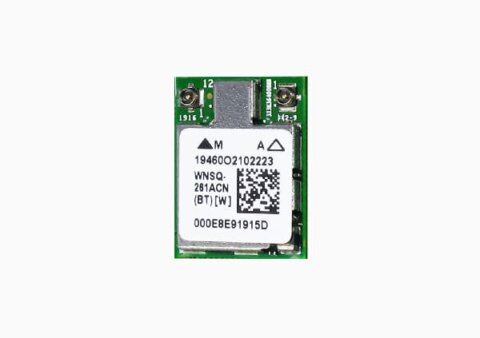
The FG160 5G Sub-6 GHz LGA module range is designed for embedded gateways and connected equipment that require high cellular data rates. It supports standalone and non-standalone 5G architectures, NR carrier aggregation and LTE Cat 19 fallback, with WCDMA also available on the FG160-EAU. Three regional variants cover Asia excluding China, Europe and Australia, North America, and India. The soldered LGA package suits CPE, MiFi, set-top boxes, industrial PCs, outdoor units and other space-conscious embedded designs. Multi-constellation GNSS, Windows, Linux and Android drivers, and a broad interface set support integration with different host platforms. Typical applications include fixed wireless access, industrial monitoring, remote medical equipment, UAV platforms, gateways and VR or AR systems. Variant selection should be based on the required regional frequency bands, network operator requirements and approval status.
Range features
A high level overview of what this range offers
- 3GPP Release 16 with SA and NSA operation – Supports both standalone 5G networks and deployments using LTE infrastructure.
- Three regional variants – Allows the radio configuration to be matched to deployment regions and network bands.
- NR carrier aggregation and FDD/TDD ENDC – Supports flexible use of available 5G and LTE spectrum.
- Mode-specific 5G data rates – Delivers up to 2,470 Mbps downlink and 900 Mbps uplink in NR SA, or 3,470 Mbps downlink and 555 Mbps uplink in NR ENDC.
- LTE Cat 19 fallback – Provides up to 1,600 Mbps downlink and 211 Mbps uplink where 5G service is unavailable.
- Downlink 4 × 4 and selected uplink 2 × 2 NR MIMO – Supports multi-antenna operation on the bands listed for each regional model.
- Multi-constellation GNSS – Supports GPS, GLONASS, Galileo, BeiDou and QZSS positioning.
- USB, PCIe and embedded peripheral interfaces – Provides several options for host communication and peripheral integration.
- FOTA and optional voice services – Supports remote firmware updates, optional VoLTE and VoNR, and SMS over IMS.
- OpenCPU capability – Can support integrated FWA software designs and reduce reliance on a separate external processor, depending on the system architecture.
- FG150 compatibility – Can simplify migration planning between compatible module generations.
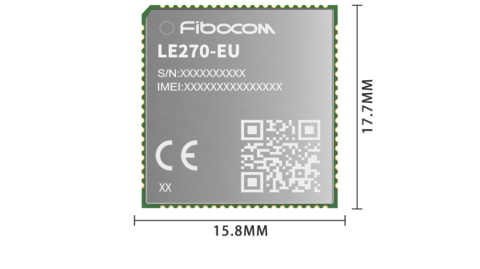
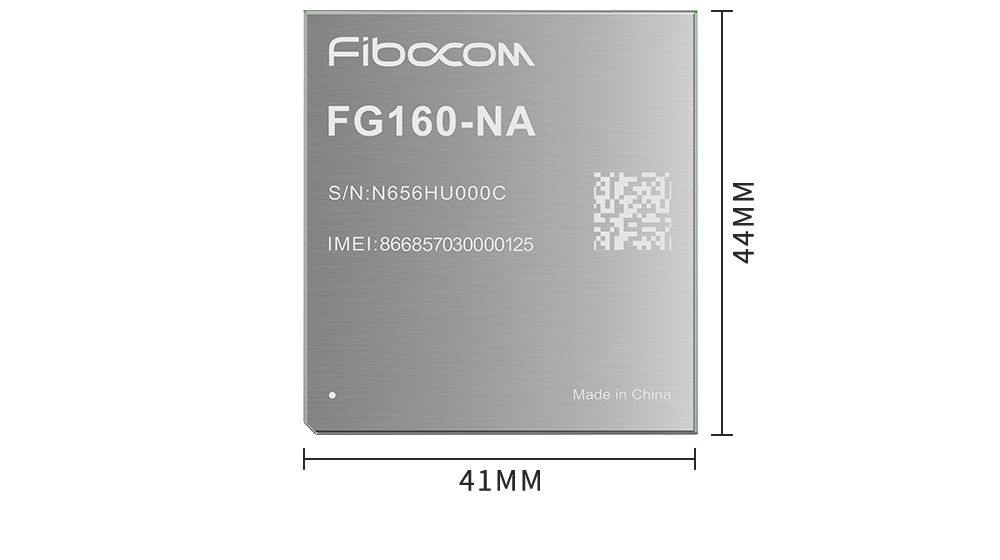
- 41.0 × 44.0 × 2.75 mm LGA package – Supports direct PCB assembly in compact embedded products.
What’s in this range?
All the variants in the range and a comparison of what they offer
| Specification | FG160-EAU | FG160-NA | FG160-IN |
|---|---|---|---|
Product model | FG160-EAU | FG160-NA | FG160-IN |
Region | Asia excluding China, Europe and Australia | North America | India |
Air interface | 5G Sub-6 GHz, LTE and WCDMA | 5G Sub-6 GHz and LTE | 5G Sub-6 GHz and LTE |
3GPP release | Release 16 | Release 16 | Release 16 |
Modem platform | Snapdragon X62 | Snapdragon X62 | Snapdragon X62 |
Package | LGA | LGA | LGA |
Dimensions | 41.0 × 44.0 × 2.75 mm | 41.0 × 44.0 × 2.75 mm | 41.0 × 44.0 × 2.75 mm |
Network mode | NSA and SA | NSA and SA | NSA and SA |
Operating voltage | 3.3 to 4.4 V; 3.8 V typical | 3.3 to 4.4 V; 3.8 V typical | 3.3 to 4.4 V; 3.8 V typical |
Operating temperature | −30°C to +75°C | −30°C to +75°C | −30°C to +75°C |
Antenna configuration | 4/6/8 plus 1 GNSS | 4/6/8 plus 1 GNSS | 4/6/8 plus 1 GNSS |
5G NR bands | EAU-0x/1x: n1/3/5/7/8/20/28/38/40/41/75/76/77/78/79 | n2/5/7/12/14/25/30/41/48/66/71/77/78 | n1/3/5/8/28/40/41/78 |
LTE FDD bands | EAU-0x/1x: B1/3/5/7/8/20/28/32 | B2/4/5/7/12/13/29/30/66/71 | B1/3/5/8 |
LTE TDD bands | EAU-0x/1x: B38/40/41/42/43 | B41/46 LAA/48 | B40/41 |
WCDMA bands | B1/5/8 | Not supported | Not supported |
NR MIMO | DL 4 × 4: n1/3/5/7/20/28/38/40/41/66/75/76/77/78/79 | DL 4 × 4: n2/5/7/12/14/25/30/41/48/66/70/71/77/78 | DL 4 × 4: n78 |
LTE MIMO | DL 4 × 4: B1/3/5/7/8/20/28/32/38/40/41/42/43/66 | DL 4 × 4: B2/4/5/7/12/13/30/41/48/66/71 | — |
NR SA data rate | 2,470 Mbps DL / 900 Mbps UL | 2,470 Mbps DL / 900 Mbps UL | 2,470 Mbps DL / 900 Mbps UL |
NR ENDC data rate | 3,470 Mbps DL / 555 Mbps UL | 3,470 Mbps DL / 555 Mbps UL | 3,470 Mbps DL / 555 Mbps UL |
LTE data rate | 1,600 Mbps DL / 211 Mbps UL | 1,600 Mbps DL / 211 Mbps UL | 1,600 Mbps DL / 211 Mbps UL |
WCDMA data rate | 42 Mbps DL / 5.76 Mbps UL | Not supported | Not supported |
Voice | Optional VoLTE and VoNR | Optional VoLTE and VoNR | Optional VoLTE and VoNR |
SMS | SMS over IP using IMS | SMS over IP using IMS | SMS over IP using IMS |
Digital audio | Yes | Yes | Yes |
FOTA | Yes | Yes | Yes |
Operating-system drivers | Windows, Linux and Android | Windows, Linux and Android | Windows, Linux and Android |
GNSS | GPS, GLONASS, Galileo, BeiDou and QZSS | GPS, GLONASS, Galileo, BeiDou and QZSS | GPS, GLONASS, Galileo, BeiDou and QZSS |
USB | USB 3.1/3.0 and USB 2.0 | USB 3.1/3.0 and USB 2.0 | USB 3.1/3.0 and USB 2.0 |
PCIe | PCIe 4.0/3.0 | PCIe 4.0/3.0 | PCIe 4.0/3.0 |
Other interfaces | UART, SPI, GPIO, I²C, SDIO, UIM, I²S and MIPI | UART, SPI, GPIO, I²C, SDIO, UIM, I²S and MIPI | UART, SPI, GPIO, I²C, SDIO, UIM, I²S and MIPI |
Regulatory listings | CE, RCM, REACH, RoHS and Anatel | FCC and IC | — |
Operator or industry listings | GCF* | PTCRB and GCF | — |
OpenCPU | Yes | Yes | Yes |
FG150 compatibility | Compatible | Compatible | Compatible |
Note | Entries marked with an asterisk should be confirmed for the selected SKU and deployment region. | Entries marked with an asterisk should be confirmed for the selected SKU and deployment region. | Entries marked with an asterisk should be confirmed for the selected SKU and deployment region. |
FAQs
for FG160 5G Sub6 GHz SMD module
The principal differences are their supported 5G NR and LTE frequency bands, regional coverage and listed approvals. FG160-EAU also supports WCDMA, while the North American and Indian variants are limited to 5G NR and LTE fallback.
In standalone mode, the range supports up to 2,470 Mbps downlink and 900 Mbps uplink. In NR ENDC operation, the maximum figures are 3,470 Mbps downlink and 555 Mbps uplink, so the highest downlink and uplink values do not occur in the same network mode.
Yes. It supports both NSA and SA operation. NSA allows 5G NR to operate with LTE network infrastructure, while LTE Cat 19 provides fallback where 5G coverage is unavailable.
The range supports USB 3.1/3.0 and USB 2.0, PCIe 4.0/3.0, UART, SPI, GPIO, I²C, SDIO, UIM, I²S and MIPI. RGMII is not supported, so Ethernet requirements must be addressed at system level.
The range supports configurations described as 4, 6 or 8 cellular antenna paths plus one GNSS path. The final antenna design must account for the selected regional bands and the MIMO combinations required by the application.
Integrated positioning supports GPS, GLONASS, Galileo, BeiDou and QZSS. A dedicated GNSS antenna path is included in the stated antenna configuration.
No. OpenCPU allows application software to use processing resources within the module and can reduce the need for a separate processor in some FWA designs. Wi-Fi 6E, 160 MHz channel bandwidth and 4096-QAM relate to implementation-specific FWA configurations rather than an integrated Wi-Fi radio interface in the cellular module.
The ranges are described as compatible, which can support migration between product generations. Engineers should still verify the complete pin assignment, power requirements, firmware, antenna design and regional approvals before treating the modules as interchangeable.
Confirm the network bands used by the target operator, the required fallback technology, approval status, antenna configuration and local regulatory requirements. Approval entries carrying an asterisk should be verified for the exact SKU and deployment market.