FG132 5G RedCap mPCIe module
- Technology
- 5G modules
- Partner
- Fibocom
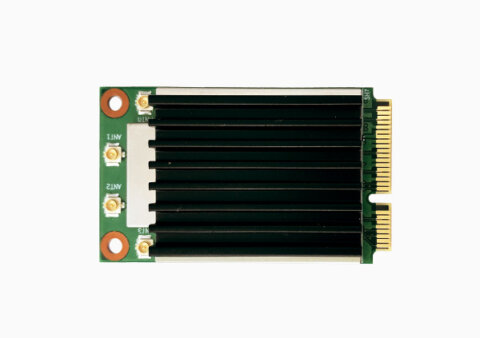
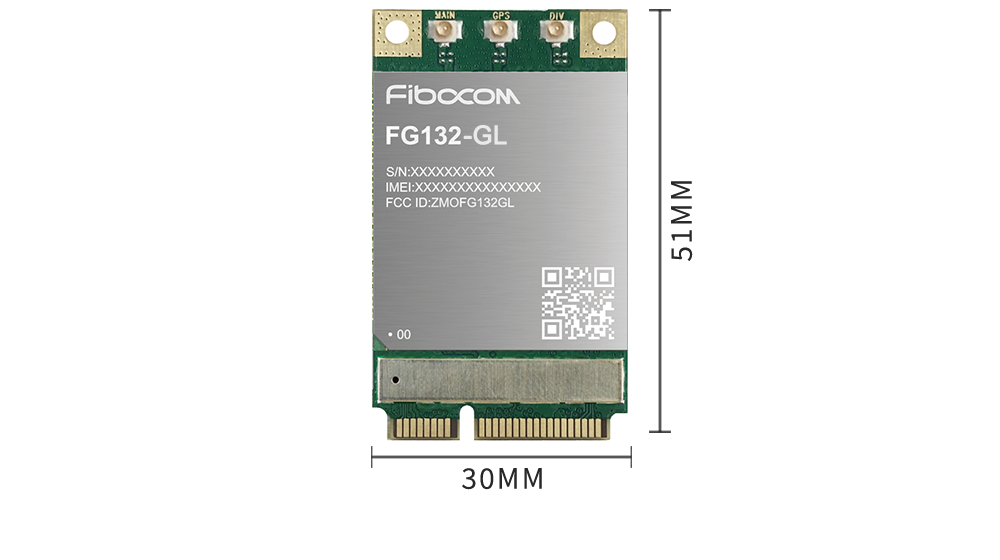
The FG132 5G RedCap Mini PCIe module is designed for equipment that needs more bandwidth than LPWA technologies without requiring a full eMBB-class 5G module. It supports 3GPP Release 17 RedCap, 5G Standalone operation and backward compatibility with 4G LTE networks. Peak data rates reach up to 223 Mbps downlink and 123 Mbps uplink on 5G RedCap, with LTE performance up to 195 Mbps downlink and 75 Mbps uplink under the stated 256QAM conditions. The range includes a global FG132 MiniPCIe-GL version and an FG132 MiniPCIe-CN version for China. Its Mini PCIe form factor supports integration into industrial routers, industrial PCs, IP cameras, IoT gateways and fixed wireless access terminals. Available interfaces include USB 2.0, two UARTs, GPIO and PCM for practical host and peripheral connectivity. Additional functions such as GNSS, SMS, voice and DFOTA expand deployment flexibility. Support for private 5G networks and network slicing also makes the module suitable for managed industrial and enterprise cellular applications.
Range features
A high level overview of what this range offers
- 3GPP Release 17 RedCap – Provides mid-rate cellular connectivity using reduced-capability 5G technology.
- 5G SA and 4G compatibility – Supports migration to Standalone 5G while retaining LTE connectivity.
- Up to 223 Mbps downlink and 123 Mbps uplink on 5G – Supports applications such as industrial routing, video transmission and fixed wireless access.
- Global and China variants – Allows the frequency-band configuration to be selected for the intended deployment region.
- Standard Mini PCIe layout – Supports integration into compatible host equipment and existing card-based designs.
- USB 2.0, dual UART, GPIO and PCM – Provides practical interfaces for host communication, control and audio integration.
- GNSS, SMS and voice support – Adds positioning, messaging and voice capabilities where required by the application.
- DFOTA support – Enables differential firmware updates for remotely deployed equipment.
- Windows, Linux and Android drivers – Supports development across commonly used embedded and computing platforms.
- Normal and extended temperature ranges – Covers operation from -35°C to +75°C, with an extended range of -40°C to +85°C.
What’s in this range?
All the variants in the range and a comparison of what they offer
| Specification | FG132 MiniPCIe-GL | FG132 MiniPCIe-CN |
|---|---|---|
Region | Global | China |
Air interface | 5G RedCap | 5G RedCap |
3GPP release | Release 17 | Release 17 |
Form factor | Mini PCIe | Mini PCIe |
Dimensions | 51.0 × 30.0 × 3.4 mm | 51.0 × 30.0 × 3.4 mm |
Operating voltage | 3.3 to 4.3 V DC; 3.8 V typical | 3.3 to 4.3 V DC; 3.8 V typical |
Operating temperature | -35°C to +75°C | -35°C to +75°C |
Extended temperature | -40°C to +85°C | -40°C to +85°C |
Network operation | 5G NR SA with 4G compatibility | 5G NR SA with 4G compatibility |
5G NR SA bands | n1/n2/n3/n5/n7/n8/n12/n13/n14/n18/n20/n25/n26/n28/n30/n38/n40/n41/n48/n66/n70/n71/n77/n78 | n1/n3/n5/n8/n28/n40/n41/n78/n79 |
LTE bands | B1/B2/B3/B4/B5/B7/B8/B12/B13/B14/B17/B18/B19/B20/B25/B26/B28/B30/B34/B38/B39/B40/B41/B42/B43/B48/B66/B71 | B1/B3/B5/B8/B34/B38/B39/B40/B41 |
LTE HPUE bands | B38/B40/B41/B42/B43 | B38/B41 |
Maximum 5G SA Sub-6 data rate with 256QAM | 223 Mbps downlink / 123 Mbps uplink | 223 Mbps downlink / 123 Mbps uplink |
Maximum LTE data rate with 256QAM | 195 Mbps downlink / 75 Mbps uplink | 195 Mbps downlink / 75 Mbps uplink |
Firmware update | DFOTA | DFOTA |
Operating-system drivers | Windows, Linux and Android | Windows, Linux and Android |
GNSS | Yes | Yes |
SMS | Yes | Yes |
Voice | Yes | Yes |
SIM interface | 1 | 1 |
USB | 1 × USB 2.0 | 1 × USB 2.0 |
UART | 2 | 2 |
GPIO | Yes | Yes |
PCM | Yes | Yes |
Regulatory and environmental listings | CE, FCC, RoHS, HF, TSCA, RCM and REACH | CCC, SRRC, NAL and RoHS |
Operator programmes | T-Mobile, Verizon and AT&T* | Not listed |
Industry certifications | GCF and PTCRB | Not listed |
FAQs
for FG132 5G RedCap mPCIe module
The range contains the FG132 MiniPCIe-GL for global deployments and the FG132 MiniPCIe-CN for China. Their mechanical, data-rate and interface specifications are the same, but their cellular bands and certification listings differ.
Yes. It operates on 5G NR Standalone networks using 3GPP Release 17 RedCap technology and is backward compatible with 4G LTE networks. It does not list 5G Non-Standalone operation.
Under the listed 256QAM conditions, the module supports up to 223 Mbps downlink and 123 Mbps uplink on 5G SA Sub-6. The listed LTE rates are up to 195 Mbps downlink and 75 Mbps uplink. Actual throughput depends on the network, signal conditions, band configuration and host design.
No. Mini PCIe describes the card form factor and pin layout, while the specification lists the PCIe interface as unavailable. Host designs should use the available USB 2.0 and UART interfaces rather than assume a PCIe data path.
The stated operating range is -35°C to +75°C. An extended range of -40°C to +85°C is also specified, so thermal testing should cover the intended enclosure, airflow, duty cycle and radio operating conditions.
Drivers are listed for Windows, Linux and Android. The exact driver version, kernel compatibility and host configuration should be confirmed during the integration phase.
Yes. DFOTA is supported, allowing differential firmware packages to be delivered to deployed modules. Update recovery, power-loss handling and deployment controls should be validated as part of the system software design.
GNSS, SMS and voice are listed for both regional variants. The required antennas, audio path, network services and software configuration must be considered at host-system level.
Yes. The range supports 5G SA operation and is designed to address private-network and network-slicing requirements. Compatibility still depends on the private network’s bands, core configuration, SIM provisioning and enabled service features.
Check the required 5G and LTE bands, local regulatory approvals, operator acceptance, SIM arrangement and deployment region. Operator entries marked with an asterisk should be confirmed for the required network and project schedule before final design-in.