AC Ratio Transformers
- Technology
- Radio frequency
- Partner
- Advanced Energy
AC ratio transformers are specialised AC calibration devices that serve as inductive voltage dividers for precision measurement and metrology. They are designed for engineers and technicians who need to verify or calibrate AC voltage and current ratio accuracy in critical equipment. The range includes multi-decade ratio transformers, fixed 1:1 isolation transformers, and integrated ratio transformer calibrator systems, each suited to different calibration roles. By providing stable and highly linear ratio outputs across frequencies from standard 50/60 Hz mains up to the kHz range, these devices help maintain traceable accuracy in electrical testing setups. Typical applications span calibration laboratories, standards institutes, and specialised industries where ensuring the correct ratio in transformers, bridge circuits, or sensors is paramount. Built with robust construction and fine-tuned engineering, AC ratio transformers deliver long-term stability and reliable performance in demanding environments.
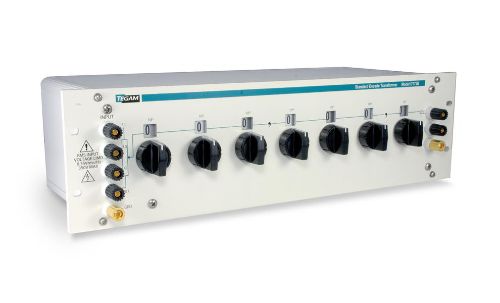
This range of AC ratio transformers supports high-accuracy AC calibration wherever a stable and traceable ratio standard is required. It covers three core solution types: adjustable AC ratio decade transformers for fine ratio setting, fixed AC ratio isolation transformers for precise 1:1 coupling and signal inversion, and automated AC ratio transformer calibrator systems for streamlined laboratory workflows.
Designed for metrology labs, standards facilities, and demanding industrial environments, these instruments provide excellent linearity, long-term stability, and dependable performance across a broad frequency range. They are well suited to transformer testing, bridge measurements, sensor verification, and other precision AC ratio applications.
Range features
A high level overview of what this range offers
- 0.00009% accuracy and 0.1 ppm resolution – Enables extremely precise ratio control for demanding calibration tasks.
- Wide frequency coverage – Supports applications from 50 Hz mains frequency up to 20 kHz, depending on model.
- Adjustable multi-decade ratio capability – Seven-decade designs provide flexible ratio selection from near-zero to slightly above 1:1.
- Precision 1:1 isolation performance – Fixed-ratio isolation models provide accurate coupling, with optional 0.5 ratio via centre tap.
- High input impedance – Helps minimise circuit loading and preserve measurement integrity in sensitive setups.
- Integrated calibration system option – The 1372 series combines a precision reference transformer with computer-based control for improved efficiency.
- Stable, rugged construction – Engineered for long-term reliability and repeatable performance in laboratory and industrial use.
- Traceable quality and USA manufacturing – Built to high standards for users who require dependable metrology-grade equipment.
Downloads
for AC Ratio Transformers
What’s in this range?
All the variants in the range and a comparison of what they offer
Specification | Decade Ratio Transformer | Isolation Transformer | Calibrator System |
Accuracy (Linearity) | 0.00009% | 0.005% | 0.00009% |
Frequency range | 50 Hz to 20 kHz | 50 Hz to 10 kHz | 50 Hz to 20 kHz |
Ratio range | –0.0111111 to +1.1111110 | 1:1 or 1:0.5 (centre-tap) | 0.0 to +1.0 |
Resolution | 1 × 10^–7 (0.1 ppm) | N/A | 1 × 10^–7 (0.1 ppm) |
FAQs
for AC Ratio Transformers
An AC ratio transformer is a high-precision inductive device, often used as an inductive voltage divider, that produces an output AC signal in a defined ratio to the input. It uses precision transformer windings and selected taps or decade switches to divide AC voltage with excellent stability and accuracy. Rather than generating or amplifying a signal, it precisely scales an existing AC input so engineers can compare, verify, and calibrate instruments against a known ratio standard.
These devices achieve high accuracy through precision inductive design, stable winding geometry, and excellent linearity over their operating range. Compared with resistive methods, they can offer very low phase error and strong ratio stability across frequency. In multi-decade models, carefully engineered switching arrangements help preserve accuracy while changing settings. The result is a metrology-grade ratio standard suitable for traceable calibration work.
Typical applications include calibration laboratories, national metrology institutes, transformer test setups, AC bridge circuits, resolver and transducer testing, and other environments where a precise AC voltage or current ratio must be established or verified. They are used to calibrate electrical measurement instruments, validate ratio accuracy in transformers and sensors, and support specialised research and industrial measurement tasks.
A decade ratio transformer is an adjustable ratio standard with multiple selectable taps or decade switches, allowing very fine ratio setting across a broad range. It is ideal for simulation and precision calibration. An AC ratio isolation transformer is normally a fixed-ratio device, typically 1:1, sometimes with a centre tap for 0.5 ratio output. Its role is to provide accurate isolation, phase inversion, or balanced output in AC measurement circuits while minimising loading effects.
The 1372 series provides a more automated calibration workflow by combining a precision ratio transformer reference with computer-based control and data handling. This allows users to step through ratio points, run repeatable procedures, and capture calibration results with less manual intervention. It improves efficiency, reduces the chance of operator error, and supports more consistent documentation in laboratory environments.
Yes. These high-precision AC ratio transformers are typically supplied with calibration data and certificates traceable to recognised national standards. This supports confidence in the stated performance and helps users meet internal quality and accreditation requirements.
Yes. Although they are designed for long-term stability, periodic recalibration is recommended to confirm that performance remains within specification over time. Maintenance needs are generally low because these are largely passive devices, but good handling practices, protection from humidity and shock, and proper care of mechanical switches are important for preserving accuracy.
The 1372A is a complete calibrator package that includes the precision AC ratio reference transformer. The 1372B provides the same calibration and automation functionality but is supplied without the reference transformer. This gives users the option to use an existing standard if they already have one.
Choose a decade ratio transformer if you need adjustable high-resolution ratio settings for simulation and calibration. Choose an AC ratio isolation transformer if your priority is accurate 1:1 isolation, signal inversion, or balanced output in a measurement circuit. Choose the 1372 series calibrator if you need an integrated, automated solution for frequent calibration work and improved workflow efficiency.
Related product ranges
QT2021 Series MCXO Crystal Oscillators
The Q-Tech QT2021 MCXO range, where precision meets innovation in crystal oscillators. These microcomputer compensated crystal oscillators (MCXOs) represent the pinnacle of timing technology, utilising high-stability overtone SC-cut crystals combined with sophisticated microprocessor-controlled compensation.
RF coaxial cables for high frequency
Radbons RF coaxial cables offer a blend of performance, reliability, and versatility, making them a preferred choice in many demanding industries.