AcoustiSens® Simplex DAS Tight Buffered Cable Single Mode Bend Insensitive Fibre
- Technology
- Fibre optic cables, connectors and assemblies
- Partner
- Lightera (formerly OFS)
The C87945 AcoustiSens® simplex DAS fibre cable is purpose-built for distributed acoustic sensing systems that require improved sensitivity to vibration and acoustic events. It uses an enhanced single-mode optical fibre based on ITU-T G.657.A1 geometry to significantly increase Rayleigh backscatter while maintaining low attenuation. This improves signal-to-noise ratio and helps detect weaker events over longer distances than conventional fibres. Its bend-insensitive construction supports reliable routing in tighter installation spaces without introducing significant bending loss.
The cable is built as a tight-buffered simplex design with aramid yarn strength members and a durable PVC outer jacket for practical handling in laboratory and prototype deployments. It is splice-compatible with standard G.657.A1 and G.652.D fibres, making integration into existing fibre routes straightforward. The DAS operating wavelength range of 1538-1554 nm supports interoperability with standard interrogator platforms. As a prototype lab-use cable, it is especially suited for evaluations in pipeline monitoring, transport infrastructure sensing, perimeter security, and other critical infrastructure applications.
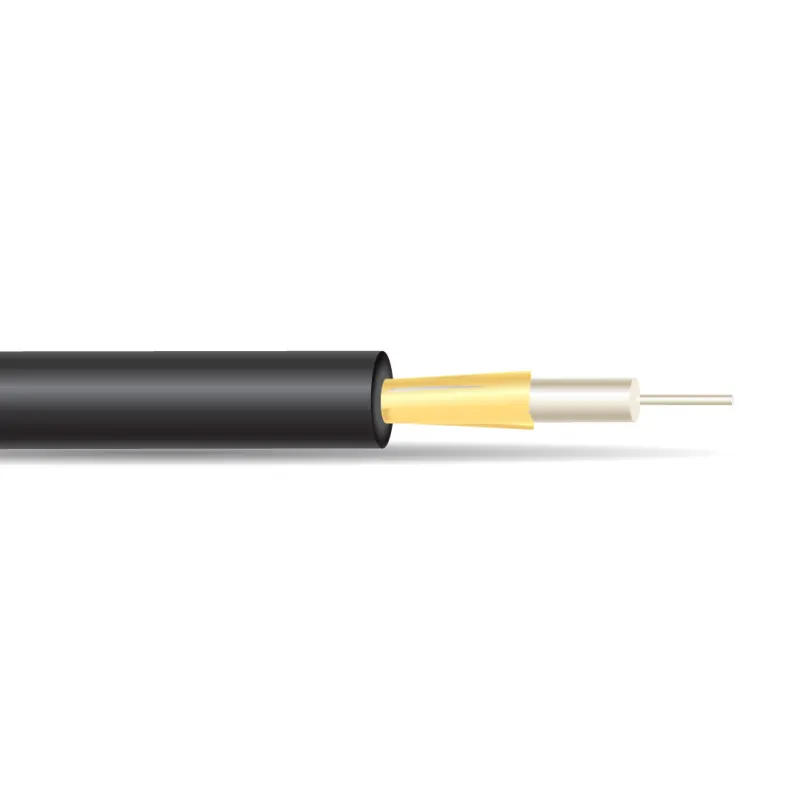
The AcoustiSens simplex DAS fibre cable is engineered for distributed acoustic sensing fibre applications where stronger backscatter and better event detection are critical. By combining a bend-insensitive single-mode fibre design with enhanced Rayleigh response, this vibration sensing fibre optic cable helps DAS users improve acoustic sensitivity without changing interrogator hardware.
Built around a specialised G.657.A1 optical fibre platform, this tight-buffered fibre optic cable is designed as a practical drop-in option for testing, evaluation, and prototype sensing deployments. It is especially valuable where detecting weaker vibrations, extending monitoring reach, or increasing installation flexibility can improve overall DAS system performance.
Range features
A high level overview of what this range offers
- 10-15 dB higher Rayleigh backscatter – Increases returned optical signal strength for much higher vibration sensitivity and improved acoustic detection.
- 1538-1554 nm DAS operating range – Supports common interrogator laser wavelengths for straightforward interoperability with standard DAS equipment.
- Minimal added attenuation – Maintains low optical loss while improving backscatter, helping preserve signal quality over distance.
- Bend-insensitive fibre design – Reduces bend-related loss and supports routing around tighter corners and coils.
- Splice-compatible with G.657.A1 and G.652.D fibres – Integrates easily into existing fibre routes using standard splicing methods.
- Drop-in replacement performance upgrade – Improves sensing capability without requiring new interrogators or added optical amplification.
- Greater sensing reach and deployment flexibility – Higher SNR can support longer monitoring distances or increased offset from the asset being monitored.
- Detection of weaker vibration events – Helps identify subtle acoustic activity that conventional telecom fibre may miss.
- Rugged tight-buffered simplex construction – Uses a 500 µm buffered fibre, aramid yarn strength members, and a 2.2 mm PVC jacket for practical handling in lab and prototype field work.
What’s in this range?
All the variants in the range and a comparison of what they offer
Specification | Value |
Base Fiber Type | G.657 AcoustiSens Wideband I (GS86545) bend-insensitive, similar to ITU G.657.A1 |
Fiber Cladding Diameter | 125 µm |
Fiber Coating Diameter | 200 µm |
Cable Buffer Diameter | 500 µm |
Cable Buffer Material | Hytrel® |
Strength Member Material | Aramid yarn |
Outer Jacket Diameter | 2.2 mm |
Outer Jacket Material / Colour | PVC, black |
Attenuation @ 1310 nm | ≤ 1.5 dB/km |
Attenuation @ 1550 nm | For reference only |
Operating Wavelength Range (DAS) | 1538-1554 nm |
Fiber Proof Test | 100 kpsi |
Max Installation Load | 87 N |
Max Operating Load | 29 N |
Min Bend Radius (installation) | 35 mm |
Min Bend Radius (operating) | 25 mm |
Operating Temperature | -20 to +80 °C |
Storage Temperature | -20 to +80 °C |
Note | Prototype design – target specifications not guaranteed |
FAQs
for AcoustiSens® Simplex DAS Tight Buffered Cable Single Mode Bend Insensitive Fibre
Distributed acoustic sensing uses fibre optic cable as a continuous sensor to detect vibrations and acoustic events along its length. The C87945 cable is designed specifically for DAS and uses enhanced Rayleigh backscatter to improve the sensitivity and accuracy of event detection. This helps operators monitor assets such as pipelines, railways, and perimeters with stronger vibration response and better real-time event visibility.
The AcoustiSens fibre is engineered to generate significantly more Rayleigh backscatter than standard telecom single-mode fibre while adding very little attenuation. In practical DAS use, that means a much stronger returned sensing signal and improved signal-to-noise ratio. It behaves like a standard single-mode fibre for handling and integration, but delivers much greater sensitivity to vibration and sound.
No. A key benefit of this cable is its drop-in compatibility with standard DAS interrogators. It works across a 1538-1554 nm operating range and is intended to be used with existing interrogation equipment without requiring optical amplifiers, hardware changes, or special system modifications.
Yes. The fibre is splice-compatible with standard G.657.A1 and G.652.D optical fibres, so it can be fusion spliced or connected into existing fibre routes using normal methods. This simplifies integration into established sensing lines or hybrid network sections.
Users can expect substantially improved sensing performance compared with standard single-mode fibre, especially in applications where weak vibration signals are difficult to detect. Higher Rayleigh backscatter improves signal-to-noise ratio, which can support detection of weaker events, better operation in noisier conditions, and potentially longer monitoring reach depending on the DAS setup and installation conditions.
This product is currently presented as a prototype intended mainly for laboratory evaluation and proof-of-concept work. While it has a durable tight-buffered construction and a broad operating temperature range, it is better suited to testing and prototype deployments than long-term outdoor installation. For permanent field use, a more rugged production cable design may be preferable.
This cable is especially useful where detection of faint or distant acoustic events is important. Typical applications include pipeline leak and intrusion monitoring, railway and highway sensing, perimeter and border security, and structural health monitoring. In these scenarios, the improved signal-to-noise ratio can help reveal events that standard sensing fibre may not detect as clearly.