IR Quad Detector Acquisition system
- Technologie
- Infrarot-Photodetektoren
- Partner
- IR Materials
The QDAS 4-Channel Infrared Detector Acquisition System is a specialised solution for multi-sensor infrared data acquisition. Designed to interface with up to four lead-salt IR detectors (PbS/PbSe) at once, it provides a convenient way to collect synchronised signals from multiple infrared sensors.
The unit is entirely USB-powered and includes built-in transimpedance amplifiers and a 16-bit analogue-to-digital converter, so engineers can plug it into a PC and start capturing data without any external power supplies or complex setup. An included Windows application allows real-time viewing of each detector’s output, offering digital filtering and data logging features that streamline analysis.
This system is particularly useful in gas sensing and environmental monitoring applications, where several IR detectors with different optical filters might be used to identify various gases simultaneously. Optional add-ons like a thermoelectric cooler controller board and a pulsed MEMS IR emitter board extend its versatility, enabling stable operation with cooled detectors and synchronised source modulation. Compact and straightforward to deploy, the QDAS platform helps researchers and product developers obtain precise, multi-channel infrared measurements with minimal effort.
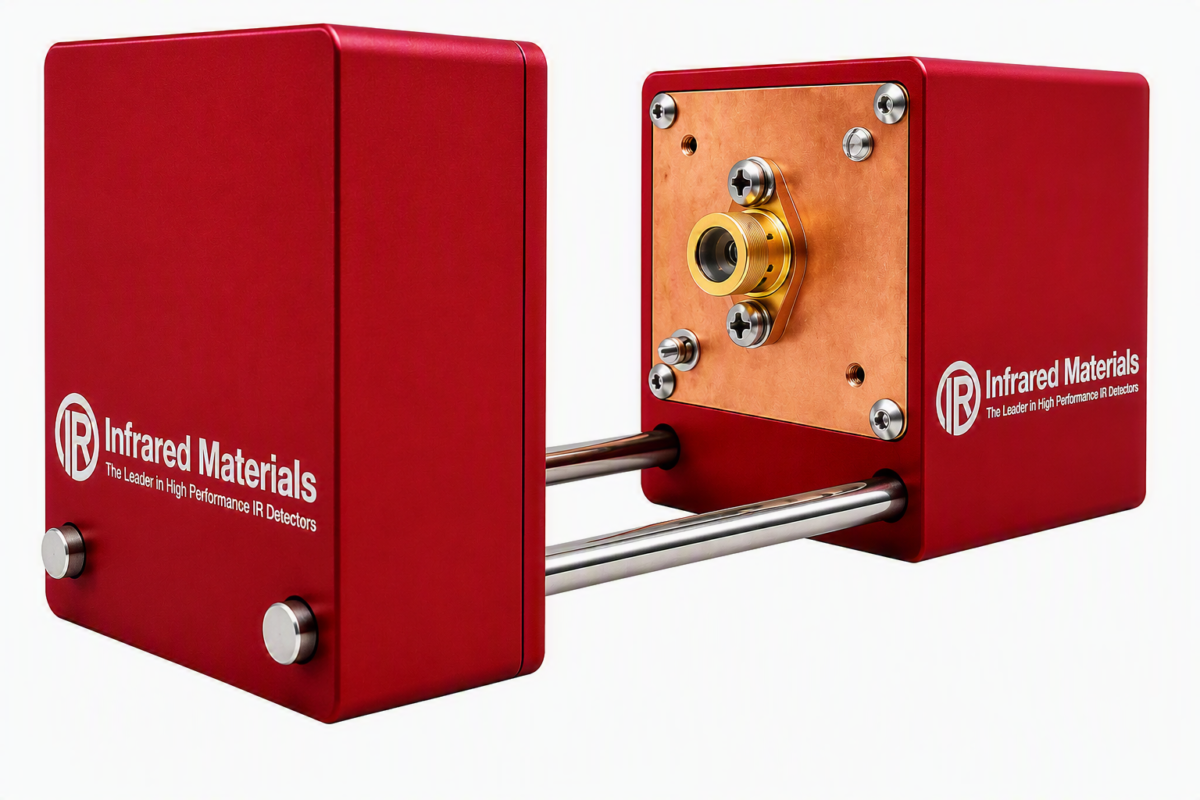
The QDAS is built for engineers and researchers who need reliable, synchronised acquisition from multiple infrared detectors in one compact platform. By combining four detector inputs, low-noise analogue conditioning, 16-bit digitisation, and USB connectivity, it simplifies the setup of multi-channel IR measurement systems for laboratory and OEM development work.
Typical use cases include gas sensing, environmental monitoring, and any application where several PbS or PbSe detectors are used with different filters, positions, or channels to compare infrared responses in parallel.
Eigenschaften
- 1-4 channel simultaneous acquisition: Capture synchronised data from up to four PbS or PbSe infrared detectors in one system.
- USB-powered operation: Runs directly from a standard USB connection with no external power supply required.
- Optimised for pulsed IR sources: Designed for modulated source operation from 5 Hz to 150 Hz, making it ideal for chopped or MEMS-based emitters.
- Low-noise transimpedance amplification: Built-in AC-coupled amplifiers support photoconductive detector signals with selectable 100 kΩ or 1 MΩ gain.
- 16-bit ADC resolution: High-resolution conversion delivers precise digital measurement detail across all channels.
- External TTL trigger input: Enables accurate synchronisation with external triggers, choppers, or timing sources.
- Auto-calibration support: Software-guided timing adjustment helps capture detector peak response accurately.
- Compact modular hardware: Small two-board stack design saves space and supports optional expansion modules.
- Integrated Windows software: View live signals, apply FIR/IIR filtering, log data, and export measurements to CSV.
- Stored device settings: On-board memory retains configuration and calibration parameters between sessions.
Multi-detector measurement Use multiple IR detectors in parallel for comparative or multi-parameter sensing tasks.
Easy PC integration Connect over USB, launch the Windows software, and begin acquisition without complex bench setup.
Expandable platform Add optional TEC control or a pulsed emitter board for more advanced infrared system designs.
Downloads
für IR Quad Detector Acquisition system
Verfügbare Modellvariationen
Alle verfügbaren Varianten und ein Vergleich ihrer Spezifikationen
Specification | Value |
Detector channels | 1 to 4 (simultaneous data acquisition) |
Supported detectors | Lead Sulfide (PbS) or Lead Selenide (PbSe) infrared sensors |
Input type | AC-coupled transimpedance amplifier (gain 100 kΩ or 1 MΩ) |
Pulse frequency range | 5 Hz to 150 Hz |
A/D conversion | 16-bit resolution (4:1 multiplexed input) |
Trigger input | TTL compatible, for external synchronisation |
Interface & Power | USB 5 V (powered via USB; no external PSU required) |
Form factor | Two-board stack, approx. 1.8 in × 1.8 in (≈46 mm square) |
Software compatibility | Windows XP or later (provided .NET control software) |
Optional accessories | QDAS-PLE pulsed IR emitter board; QDAS-TEC cooler controller board |
FAQs
für IR Quad Detector Acquisition system
The QDAS is designed for lead-salt infrared photodetectors, specifically PbS and PbSe devices. It provides the required biasing and amplification for these photoconductive detectors, allowing direct integration in typical use cases. Other detector technologies may require custom interfacing or additional validation.
Yes. The system is optimised for modulated infrared signals and uses AC-coupled amplifiers, so it measures signal changes rather than a steady DC level. In practice, this means a chopped or pulsed IR source is required for stable measurement.
The QDAS uses an on-board 16-bit ADC with a 4:1 multiplexed input. Each detector channel is sampled in rapid succession, providing effectively near-simultaneous acquisition for applications operating within the intended pulse frequency range.
The standard QDAS configuration supports pulse or modulation frequencies from 5 Hz to 150 Hz. This range is well suited to common infrared gas sensing and chopped-source measurement setups.
The included Windows software provides real-time signal display, FIR/IIR digital filtering, data logging, and CSV export. It also allows users to adjust settings such as gain, channel naming, and sampling-related parameters through a graphical interface.
Yes. An optional QDAS-TEC add-on board is available for thermoelectrically cooled PbS or PbSe detectors. This module adds cooler control functionality for applications that need improved detector stability or sensitivity.