256-Element-PbS- und -PbSe-Array-Detektoren
- Technologie
- Infrarot-Photodetektoren
- Partner
- IR Materials
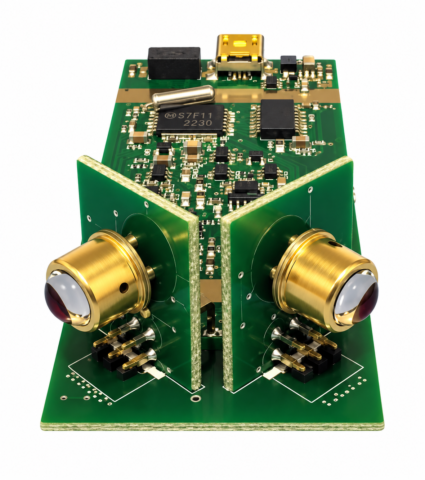
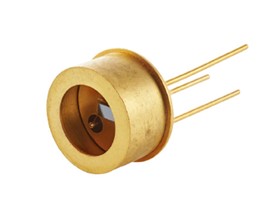
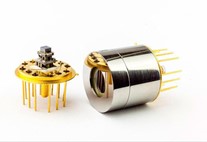
Diese photoleitenden Infrarot-Detector Arrays mit 256 Elementen bieten eine leistungsstarke Zeilensensorlösung für industrielle und wissenschaftliche Anwendungen. Sie sind in zwei Materialvarianten verfügbar: PbS für den SWIR-Bereich von 1,2–3,3 µm und PbSe für den MWIR-Bereich von 1,2–5,5 µm. So können Anwender den passenden Detektor für das jeweilige Zielspektrum wählen. Jedes Array ist in einem kompakten, gehäuselosen 84-Pin-Chip-Carrier mit IR-transparentem Fenster und integriertem thermoelektrischem Kühler untergebracht, der den Detektor bei etwa –20 °C stabilisiert. Die Kühlung reduziert das Dunkelrauschen und verbessert Empfindlichkeit sowie Messstabilität – besonders wichtig für die Spektroskopie und die Detektion schwacher Signale. Ein integrierter Multiplexer und eine 16-Bit-Analog-Digital-Wandlung ermöglichen das schnelle Auslesen aller 256 Kanäle mit Bildraten von bis zu etwa 1700 fps bei den kürzesten Integrationszeiten. Die Unterstützung externer Trigger und die Echtzeit-Dunkelstromkorrektur tragen zu präzisen, wiederholbaren Messungen bei. Optional sind eine USB-2.0-Controllerplatine und ein Software Development Kit erhältlich, um Evaluierung und Systemintegration zu vereinfachen.
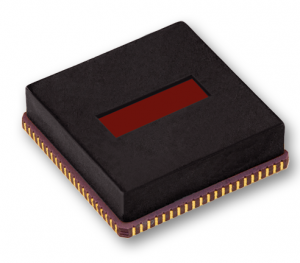
Diese Detector Arrays sind für die schnelle mehrkanalige Infraroterfassung in der Spektroskopie, industriellen Überwachung und Zeilenscan-Bildgebung ausgelegt. Erhältlich als PbS- oder PbSe-Version, ermöglichen sie Entwicklern, das Detektormaterial auf den benötigten Wellenlängenbereich abzustimmen und zugleich von integrierter thermoelektrischer Kühlung, kompakter Bauform und direkter digitaler Ausgabe zu profitieren.
Die Kombination aus linearem 256-Pixel-Format, Hochgeschwindigkeitserfassung und stabilem, rauscharmem Betrieb macht diese Produktreihe ideal für anspruchsvolle Messsysteme, bei denen Empfindlichkeit, Wiederholbarkeit und eine unkomplizierte Integration entscheidend sind.
Eigenschaften
- Lineares 256-Pixel-Array: Erfasst in einer einzigen Belichtung eine vollständige Zeile von Infrarotdaten für Multipunkt-Erfassung, Spektroskopie und Zeilenscan-Bildgebung.
- Materialoptionen PbS und PbSe: Wählen Sie PbS für die SWIR-Detektion von 1,2–3,3 µm oder PbSe für die MWIR-Detektion von 1,2–5,5 µm.
- Integrierte thermoelektrische Kühlung: Der integrierte TEC-Betrieb bei etwa –20 °C reduziert Dunkelrauschen und verbessert die Signalstabilität.
- Integrierter Multiplexer und 16-Bit-ADC: Liefert digitale Ausgänge aller 256 Kanäle und vereinfacht zugleich die Integration in die Elektronik.
- Hochgeschwindigkeitsleistung: Unterstützt Bildraten von bis zu etwa 1700 fps bei minimaler Integrationszeit.
- Externer Trigger und Dunkelstromkorrektur: Ermöglicht synchronisierte Erfassung und dauerhaft konsistente Messgenauigkeit.
- Flexible Pixelgeometrie: Standardmäßig rechteckige Pixel, optional auch quadratische oder längliche Pixelformate zur Optimierung von Sichtfeld oder spektraler Auflösung.
PbS-Variante: A-LC5T-256R
- Spektralbereich: 1,2–3,3 µm
- Spitzenempfindlichkeit: ca. 2,4–2,5 µm
- Höhere Spitzendetektivität
- Sehr gut geeignet für SWIR-Erfassung und Spektroskopie im Bereich von 1–3 µm
PbSe-Variante: B-LC5T-256R
- Spektralbereich: 1,2–5,5 µm
- Maximale Empfindlichkeit: ca. 4,1–4,3 µm
- Schnellere Ansprechzeit
- Ideal für Anwendungen, die eine erweiterte Empfindlichkeit im MWIR-Bereich von 3–5 µm erfordern
Verfügbare Modellvariationen
Alle verfügbaren Varianten und ein Vergleich ihrer Spezifikationen
Parameter | PbS-Variante (A-LC5T-256R) | PbSe-Variante (B-LC5T-256R) |
Detektormaterial | PbS (Bleisulfid) | PbSe (Bleiselenid) |
Spektraler Empfindlichkeitsbereich (λ) | 1,2–3,3 µm | 1,2–5,5 µm |
Wellenlänge der maximalen Empfindlichkeit | ~2,4–2,5 µm | ~4,1–4,3 µm |
Aktive Elemente (Pixel) | 256 × 1 (lineares Array) | 256 × 1 (lineares Array) |
Pixelgröße (H × B) | 0,040 × 0,450 mm (Standard) | 0,040 × 0,450 mm (Standard) |
Optionale Pixelgrößen | 0,040 × 0,040 mm oder 0,040 × 4,50 mm | 0,040 × 0,040 mm oder 0,040 × 4,50 mm |
Pixelabstand (Mitte zu Mitte) | 0,050 mm | 0,050 mm |
Arraylänge | 12,85 mm | 12,85 mm |
Pixel-Funktionsrate |
|
|
Sichtfeld (FOV) |
|
|
Thermoelektrischer Kühler | 1-stufiges TEC, 5 V bei 2 A (≈10 W) | 1-stufiges TEC, 5 V bei 2 A (≈10 W) |
Temperaturstabilität | ± 5 mK (Regelung im geschlossenen Regelkreis) | ± 5 mK (Regelung im geschlossenen Regelkreis) |
Nominelle Detektortemperatur | –20 °C (typischer Betriebspunkt) | –20 °C (typischer Betriebspunkt) |
Umgebungstemperatur im Betrieb | –50 °C bis +75 °C | –50 °C bis +85 °C |
Lagertemperaturbereich | –50 °C bis +75 °C | –50 °C bis +85 °C |
Max. einfallende Bestrahlungsstärke | ~1 × 10^-3 W/cm² | ~1 × 10^-3 W/cm² |
Pixelwiderstand (typisch) | 10–11 MΩ bei +25 °C; 50–60 MΩ bei –20 °C | 10–11 MΩ bei +25 °C; 50–60 MΩ bei –20 °C |
Detektivität D* (bei +25 °C) | ≥ 1,0 × 10^11 cm·Hz^1/2/W | ≥ 1,8 × 10^10 cm·Hz^1/2/W |
Empfindlichkeit (Peak, V/W) | 2,5 × 10^6 (min); 5,0 × 10^6 (typ) | 2,5 × 10^5 (min); 4,0 × 10^5 (typ) |
Ansprechgleichmäßigkeit | ± 15 % des Mittelwerts | ± 15 % des Mittelwerts |
Quanteneffizienz (QE) | ~ 2 % | ~ 2 % |
Ansprechzeit (τ) | ~250 µs (typ. bei +25 °C); bis zu 1,6 ms (max. bei –20 °C) | ~2 µs (typ. bei +25 °C); bis zu 20 µs (max. bei –20 °C) |
Integrationszeitbereich | 4 µs bis 210 ms (einstellbare Schrittweite 3,2 µs) | 4 µs bis 210 ms (einstellbare Schrittweite 3,2 µs) |
Max. Bildrate | ~1700 fps (bei min. Integrationszeit) | ~1700 fps (bei min. Integrationszeit) |
Auslesung & Steuerung | 256-Kanal-DC-Integrierender Multiplexer; Global Shutter mit Pixel-Offset-Korrektur | 256-Kanal-DC-Integrierender Multiplexer; Global Shutter mit Pixel-Offset-Korrektur |
Integrierte Elektronik | 32-Bit-MCU (80 MHz) + 16-Bit-ADC; internes EEPROM | 32-Bit-MCU (80 MHz) + 16-Bit-ADC; internes EEPROM |
Kommunikationsschnittstelle | USB 2.0 (Ethernet/SPI/RS485 in Entwicklung) | USB 2.0 (Ethernet/SPI/RS485 in Entwicklung) |
Stromversorgung (Steuerplatine) | 15 V DC, ca. 1,6 A | 15 V DC, ca. 1,6 A |
Konformität | RoHS & REACH | RoHS & REACH |
Hinweise
- Das Sichtfeld ist objektivabhängig; mit geeigneter Optik und der Array-Länge sind mehr als 40° erreichbar.
- Die maximale Vollbildrate wird bei der minimalen Integrationszeit erreicht.
- Das Auslesen eines kleineren Pixelfensters kann die Bildrate weiter erhöhen, wenn eine höhere Geschwindigkeit erforderlich ist.
FAQs
für 256-Element-PbS- und -PbSe-Array-Detektoren
Die wesentlichen Unterschiede liegen im Spektralbereich und in der Leistungscharakteristik. Die PbS-Version arbeitet von etwa 1,2 µm bis 3,3 µm mit einer maximalen Empfindlichkeit bei rund 2,5 µm, während die PbSe-Version den Bereich von etwa 1,2 µm bis 5,5 µm abdeckt und ihre maximale Empfindlichkeit bei rund 4,2 µm erreicht. Grundsätzlich bietet PbS eine höhere Spitzen-Detektivität, während PbSe deutlich schnellere Ansprechzeiten und eine bessere Eignung für die erweiterte MWIR-Detektion bietet.
Der integrierte thermoelektrische Kühler reduziert das thermische Rauschen und den Dunkelstrom in den photoleitenden Pixeln, indem er den Detektor bei etwa –20 °C betreibt. Dadurch verbessern sich Signal-Rausch-Verhältnis, Empfindlichkeit und Langzeitstabilität der Messung. Die präzise Temperaturregelung hilft außerdem, eine Kalibrierdrift bei wechselnden Umgebungsbedingungen zu minimieren.
Das Array verfügt über integrierte Elektronik zur Signalintegration und 16-Bit-Digitalisierung aller 256 Pixel. Auf die Daten können Anwender über die USB-2.0-Schnittstelle oder mit einer optionalen Controller-Platine und einem Entwicklungskit zugreifen. So lassen sich Integrationszeiten einstellen, Erfassungen triggern und kalibrierte Pixeldaten streamen, ohne eine kundenspezifische analoge Frontend-Elektronik entwickeln zu müssen.
Die maximale Vollbildrate liegt bei etwa 1700 Bildern pro Sekunde, wenn die kürzeste Integrationszeit von rund 4 µs verwendet wird. Wird die Integrationszeit erhöht, um schwächere Signale zu erfassen, sinkt die erreichbare Bildrate. Bei Bedarf kann das Auslesen nur eines Teilbereichs der Pixel die Bildrate weiter erhöhen.
Ja, trotz seiner linearen 256 × 1-Sensorstruktur kann es für die Bildgebung eingesetzt werden. In Push-Broom- oder Zeilenscan-Systemen kann das Array ein zweidimensionales Bild Zeile für Zeile aufbauen, während sich der Sensor oder das Zielobjekt bewegt. Es eignet sich außerdem hervorragend für die Spektroskopie, bei der jedes Pixel in einem spektrographiebasierten System einer anderen Wellenlänge entsprechen kann.
Ja. Die Standardausführung verfügt über ein 0,5-mm-Siliziumfenster mit einer langwellendurchlässigen Antireflexbeschichtung, die die ungefähre Einschaltwellenlänge von 1,2 µm festlegt. Alternative Fenstermaterialien oder kundenspezifische optische Filter sind auf Anfrage erhältlich, um die spektrale Empfindlichkeit an spezifische Anwendungsanforderungen anzupassen.
Diese Arrays kommen in der IR-Spektroskopie, Gasanalyse, Spektrophotometrie, industriellen Prozessüberwachung, Qualitätskontrolle, thermischen Profilierung und in Zeilenscan-Bildgebungssystemen zum Einsatz. Besonders wertvoll sind sie überall dort, wo mehrere Infrarot-Messpunkte oder Wellenlängen schnell und gleichzeitig erfasst werden müssen.