Impac series pyrometers for special materials
- Technology
- Pyrometers
- Partner
- Advanced Energy
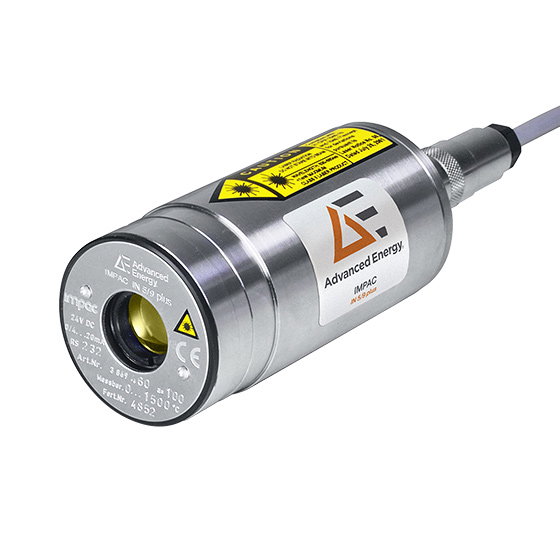
The Impac series pyrometers offer a specialised solution for industries that need exact temperature control of unique or difficult materials. These infrared pyrometers are engineered for non-contact measurement on surfaces such as semiconductor wafers (e.g. sapphire or silicon), molten aluminium, ceramics, plastics, and other materials with unusual emissivity or transparency. By utilising specific infrared wavelength bands and advanced optics, each Impac model addresses a particular application – from monitoring LED sapphire wafer temperatures to measuring plastic film or glass surfaces in production. The pyrometers provide consistent, accurate readings where conventional thermometers would be inaccurate or impractical. Industrial engineers integrate these sensors into processes like electronics fabrication, glass manufacturing, and metal heat treatment to ensure quality and optimise process control. With digital interfaces and robust design, the Impac series seamlessly fits into modern manufacturing lines, offering reliable performance even in harsh conditions or rapid temperature changes.
Range features
A high level overview of what this range offers
- Wavelength-Optimised Sensors – Each pyrometer uses a tailored infrared spectral range to accurately measure specific materials that would be difficult to gauge with standard IR thermometers. This specialization enables reliable temperature readings on low-emissivity or transparent surfaces.
- Dual-Mode (Two-Color) Technology – Certain models employ a two-wavelength ratio pyrometer method, which largely cancels out errors from unknown emissivity or partial obstructions. This feature ensures accurate measurements even if the target is obscured by dust, smoke, or changing surface properties.
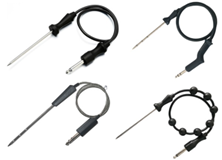
- Fiber Optic Design – High-temperature models include fiber-optic sensor heads that can tolerate extreme ambient heat (up to ~250 °C) and electromagnetic interference. The fiber-optic setup allows measurement in confined or harsh environments (e.g. induction furnaces) while keeping electronics safe and stable.
- High Speed & Precision – Impac pyrometers offer very fast response times (down to 1–2 ms for some models) and high optical resolution. This enables capture of rapid temperature transients and precise targeting of small objects, which is critical for fast processes and detailed quality control.
- Analog & Digital Outputs – All instruments provide a linear analog output (0/4–20 mA) plus RS232/RS485 digital communication. This simplifies integration into PLCs, controllers, or PC software, allowing real-time temperature feedback for automated process control and data logging.
- Adjustable Parameters – Users can adjust emissivity settings, focus, exposure time, and subrange on most models, either via onboard interface or software. These controls let engineers fine-tune the pyrometer for different applications or materials, maximizing accuracy under varying conditions.
- Laser Aiming and Sight Options – Built-in laser pointers or through-lens viewfinders help align the sensor precisely on the target spot. This ensures the pyrometer is measuring the intended area (even very small or distant targets), improving measurement reliability.
- Durable Industrial Build – The Impac series features rugged housings (often IP65-rated) and high-quality optics suitable for industrial use. They withstand hot, dusty, and continuous-operation environments, offering long-term stability with minimal maintenance.
Downloads
for Impac series pyrometers for special materials
What’s in this range?
All the variants in the range and a comparison of what they offer
| Model / Series | IN 5/9 Series (Sapphire) | IPE 140 Series (Mid-IR) | IS 12-Al (Aluminium) | IS/IGA 50-LO Series (Fiber Optic) | ISR 6 Advanced (Ratio) |
|---|---|---|---|---|---|
Temperature Range (°C) | 0 to 1500 °C | 5 to 1200 °C | 350 to 1050 °C | 250 to 3500 °C | 600 to 3000 °C |
Spectral Response | 8.0 – 9.7 µm (long-wave IR) | 3.0 – 5.0 µm (mid-IR) | ~0.8 µm (near IR) | 0.7 – 1.8 µm* (short IR) | Two-color at 0.9 µm & 1.05 µm |
Optical Configuration | Fixed optics (various lenses) | Focusable optics (4 options) | Fixed/focus optics (built-in display) | Fiber optic cable with interchangeable heads | Focusable optics (optional line-scan lens) |
Response Time (t90) | 180 ms | 1.5 ms (min) | < 1.5 ms (fast) | ~5–10 ms (fast, adjustable) | 2 ms (high-speed) |
Special Application | Sapphire wafers & crystal growth | Metals, ceramics, graphite (medium temps) | Molten and heated aluminium processes | High-temp metals in furnaces, induction heating | Forging, welding, fluctuating emissivity targets |
Note: IS 50-LO plus uses ~0.7–1.1 µm; IGA 50-LO plus uses ~1.5–1.8 µm detectors (short wavelength IR).
FAQs
for Impac series pyrometers for special materials
Standard IR thermometers are often calibrated for general-purpose use and may struggle with materials that are reflective, transparent, or have unusual emissivity. The Impac series is purpose-built with specific detectors and wavelength filters tuned to particular materials. For example, some models operate at wavelengths that sapphire or quartz absorb well, allowing accurate wafer temperature readings. This specialization means each Impac pyrometer can measure challenging surfaces (like glass, plastics, or shiny metals) with much greater accuracy and consistency than a generic pyrometer.
Low-emissivity metals (such as aluminium or silicon wafers) reflect a lot of ambient energy, making temperature measurement difficult. Impac pyrometers designed for these materials use very short infrared wavelengths (around 0.8 µm or similar), where metals emit more radiation and are easier to measure. Additionally, these models often have features like adjustable emissivity settings and, in some cases, two-color ratio measurement. The ratio method is particularly useful: by comparing signals at two wavelengths, the ISR 6 Advanced pyrometer can largely ignore changes in emissivity or surface finish, providing stable temperature readings even on shiny or oxidising metal surfaces.
A two-color pyrometer measures infrared radiation at two adjacent wavelengths instead of one. The ISR 6 Advanced does this and computes the ratio of the two signals to determine temperature. The advantage is that if something partially blocks the view (dust, smoke) or if the target’s emissivity changes with temperature, both wavelengths are affected similarly and the ratio remains constant for a given temperature. This makes ratio pyrometers ideal for harsh conditions like foundries, forging furnaces, or processes with fluctuating emissivity or dirty atmospheres. You would choose the ISR 6 Advanced when you need reliable readings in such challenging conditions or when measuring very small, very hot targets quickly (it can respond in 2 ms).
Yes. All Impac series pyrometers provide standard output signals for easy integration. They have a linear analog output (usually 0 to 20 mA or 4 to 20 mA) which can feed directly into a PLC, temperature controller, or analog input module for real-time control. Additionally, they offer digital communication interfaces (RS-232 or RS-485 serial, and some models support USB adapters) enabling more complex data exchange. This means you can remotely read temperatures, set parameters, or log data using a computer or SCADA system. In practice, engineers often use the analog output for fast feedback control loops (e.g. furnace heating) and the digital link for calibration, diagnostics, or detailed logging via the provided InfraWin software.
The Impac special materials pyrometers find use across a range of high-tech and industrial processes. To name a few: semiconductor fabrication (measuring wafer or sapphire crystal temperatures in MOCVD, epitaxy, or annealing ovens), glass production (monitoring glass surface temperature in furnaces or during cooling), plastic film and textile manufacturing (non-contact temperature control of webs and films that conventional sensors can’t touch), and metal heat treatment (like ensuring correct temperature of aluminium billets, or controlling induction heating via fiber-optic pyrometers). Each model is tailored to one of these scenarios, delivering accurate measurements that help maintain quality and efficiency in that specific process.
The spot size depends on the optics of each model. Many Impac pyrometers offer focusable optics or a choice of lenses to achieve the smallest possible measurement spot at a given distance. For example, the IPE 140 series can focus down to a spot around 0.9 mm at close range, which is excellent for small parts. Others, like the IN 5 series, might have fixed optics defined by a field-of-view ratio (e.g. 60:1 meaning a 1 cm spot at 60 cm distance). The ISR 6 Advanced can achieve about a 0.6 mm spot with a high-quality lens. In summary, these pyrometers can target very small areas – often around 1 mm or even less – provided you select the appropriate lens and distance. This capability is crucial when measuring tiny components or precise points on a larger object.
They are designed for long-term stability and minimal maintenance. Upon installation, it’s important to set the correct emissivity for your material and ensure the optics are kept clean (since dust or condensation on the lens can affect readings). In normal operation, the solid-state detectors and digital linearization maintain accuracy over time. It is recommended to periodically verify calibration (for example, annually or as required by your quality standards) using a blackbody source or reference, especially if used in critical processes. However, users often find that these pyrometers hold their calibration well. Other than occasional lens cleaning and verifying alignment, there is no special maintenance needed. Robust housings and, for fiber-optic models, the separation of optics from electronics also help protect the measurement integrity in industrial conditions.