Impac series pyrometers for glass surfaces
- Technology
- Pyrometers
- Partner
- Advanced Energy
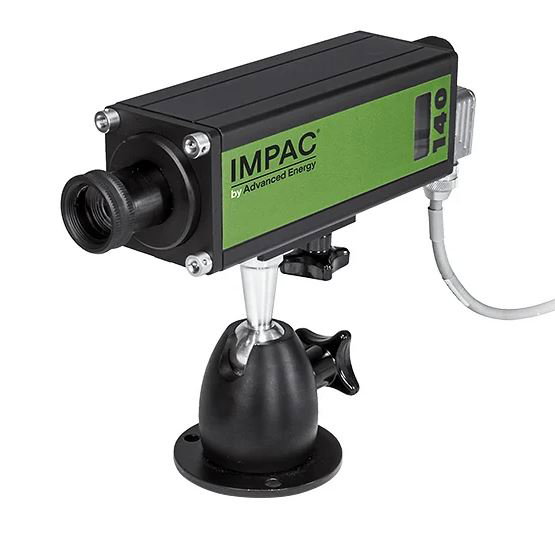
Impac series infrared pyrometers provide a reliable solution for measuring temperature on glass surfaces in industrial environments. These non-contact sensors are purpose-built for the glass industry, ensuring accurate readings where standard thermometers often struggle. The series includes a variety of models optimised for different glass-making processes – from monitoring large flat glass sheets and solar panel glass to measuring molten glass in furnaces. Each pyrometer in the range operates at specific infrared wavelengths that penetrate glass issues like transparency and reflection, allowing engineers to capture true surface temperatures. The devices offer fast response times and robust construction, helping maintain quality and process control in applications like float glass manufacturing, container glass production, glass bending, and technical glass fabrication. With options such as built-in laser aiming, fibre optic sensing for high-heat areas, and modular multi-sensor setups, these pyrometers are engineered to integrate seamlessly into production lines and deliver dependable temperature data around the clock.
Range features
A high level overview of what this range offers
Impac series pyrometers offer specialized features and benefits tailored for glass temperature measurement:
- Dedicated glass measurement wavelengths – Ensure accurate surface temperature readings on thin or molten glass by minimising interference from glass transparency
- Wide temperature range up to 2500 °C – Suitable for all stages of glass manufacturing, from cooler annealing processes to high-temperature furnace zones
- Laser aiming and small spot optics – Simplifies alignment on small or moving glass targets, enabling precise measurements of objects as small as ~1 mm
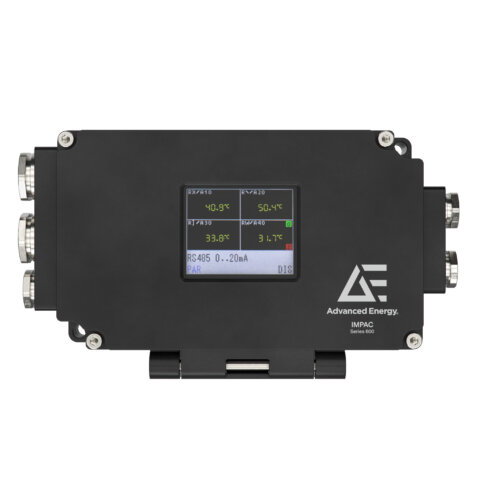
- Modular multi-sensor design – Supports up to 8 interchangeable sensor heads on one system, offering flexible multi-point monitoring and easy maintenance without complex recalibration
- High-speed response options – Captures rapid temperature changes in production (as fast as 10 ms in high-speed models), allowing real-time monitoring of fast processes
- Fibre optic pyrometer model – Fibre-coupled design (no electronics at the measuring head) tolerates ambient temperatures up to 250 °C, eliminating the need for cooling in furnace and forehearth areas
- Rugged, industrial build (IP65) – Durable stainless steel and sealed housings ensure reliable operation in harsh glass production environments with dust, heat, and vibration
Downloads
for Impac series pyrometers for glass surfaces
What’s in this range?
All the variants in the range and a comparison of what they offer
| Specification | Impac IN 5/5 plus Series | Impac 600 Series | Impac IN 6/78 Series | Impac IS 50-LO/GL Series |
|---|---|---|---|---|
Temperature Range (°C) | 100 to 2500 | –40 to 2500 | 150 to 1100 | 600 to 1800 |
Spectral Range (µm) | 5.14 | 0.7–14 (varies by head) | 7.8 | 0.8–1.1 |
Measurement Uncertainty | ±0.6% or ±2 °C | ±0.5% or ±0.8 °C | ±0.7% or ±3.5 °C | ±0.3% of reading + 1 °C |
Output / Interface | 4–20 mA; RS-232/RS-485 | 4–20 mA (1–2×); optional RS-232/485, Profinet | 4–20 mA; RS-485 | 4–20 mA (two-wire loop) |
Alignment Aid | Laser targeting | None | None | None |
FAQs
for Impac series pyrometers for glass surfaces
Glass is a challenging material for temperature measurement because it can be semitransparent and reflective at certain infrared wavelengths. General-purpose IR pyrometers might either see through the glass or pick up background furnace radiation, leading to inaccurate readings. Impac pyrometers use specific infrared wavelength bands (around 5 µm or the unique 7.8 µm for thin glass) where hot glass emits strongly and is opaque, ensuring the sensor measures the actual surface temperature. In short, these specialised pyrometers are tuned to the optical properties of glass, providing much more reliable temperature data than a standard IR thermometer would on glass materials.
A wide range of glass production processes use Impac pyrometers for critical temperature monitoring. In float and flat glass manufacturing, they measure the glass ribbon’s temperature to control cooling and annealing. In container glass (bottles, jars) production, pyrometers monitor mold and glass surface temperatures to ensure proper forming and eliminate stresses. They are also used in glass tempering and bending lines, bulb and glass fibre production, solar panel glass fabrication, and any process where maintaining precise glass temperature is essential. Even in glass furnace operations, these pyrometers (especially the fibre optic models) measure molten glass and refractory temperatures to help optimise furnace performance.
For ultra-thin glass sheets and coated glass, the series includes models with special capabilities. The Impac IN 6/78 pyrometer, for example, operates at a 7.8 µm wavelength which is ideal for measuring extremely thin glass (less than 1 mm thick) that would otherwise be partly transparent at other wavelengths. Additionally, these pyrometers allow the user to adjust emissivity values (and in some cases, even compensate for glass transmittance) so that coatings or varying glass emissivity can be accounted for. By tuning the emissivity setting to the specific glass type or coating, the pyrometer can deliver accurate readings for thin or treated glass that standard settings might not accurately capture.
Yes. The Impac IS 50-LO/GL series is specifically designed for measuring high temperatures of molten glass in furnaces, forehearths, and glass tanks. It uses a fibre optic probe that can withstand very high ambient heat – up to 250 °C at the measurement point – so it can be mounted looking into a furnace or forehearth without needing water cooling. The optical head observes the molten glass, while the sensitive electronics are safely located further away, connected by a fibre optic cable. This arrangement lets you accurately monitor molten glass temperatures (typically in the range of ~600 to 1800 °C) continuously, which is vital for controlling the melt and glass quality.
Impac pyrometers offer very fast response times, suitable for dynamic production processes. Standard models have response times on the order of tens of milliseconds (often around 80 ms), which is sufficient for most glass manufacturing needs. Moreover, high-speed versions are available in the series – for instance, the “-H” suffix models can capture temperature changes in as little as 10 ms. This means even rapid fluctuations, such as those occurring when a hot glass gob is formed or when a sheet moves under a cooling jet, can be tracked in real time. The fast response helps ensure process controls can react quickly to keep temperatures within the desired range.
Integration of Impac pyrometers into industrial systems is straightforward. All models provide a standard analogue 4–20 mA output, which is commonly used to feed temperature readings into PLCs, controllers, or analog input cards. In addition, they feature digital communication interfaces: most have an RS-232 or RS-485 serial port, allowing direct communication with a PC or network for logging and configuration. The modular Impac 600 series even supports modern industrial communication protocols (with optional add-ons for Profinet or other fieldbus interfaces), enabling direct integration into factory automation networks. With these options, you can both read measurements in real time and remotely adjust settings or calibrations via software, ensuring the pyrometers fit easily into automated control and monitoring systems.
In general, the Impac pyrometers are designed for industrial use and do not require special cooling in standard conditions. Most units can operate in ambient temperatures up to about 70 °C without cooling, thanks to their robust design. Installation typically involves mounting the sensor with a clear line of sight to the target glass surface (often using a mounting bracket or flange). In dusty or hot environments, you can use optional accessories like air purge collars or cooling jackets, but often this isn’t necessary for glass applications. The IS 50-LO/GL fibre optic model is a special case designed for extreme heat: it allows the optical head to work in areas up to 250 °C, so that one doesn’t need to cool the head even when peering into a furnace. It’s important to follow the manufacturer’s guidelines for distance and focus to achieve the specified spot size – and ensure the lens or optics are kept clean (an air purge helps with this) for consistent, accurate measurements.
These pyrometers can focus on surprisingly small target spots when equipped with the appropriate optics. For example, the Impac IN 5/5-L plus variant can measure a spot as small as roughly 1.1 mm in diameter at a defined distance, due to its high optical resolution (about 100:1). In practical terms, this means you could measure the temperature of a tiny feature or a small section on a larger glass sheet – such as a thin glass filament or a small glass bead – with good accuracy. Other models in the series have optics with focal options to measure small areas as well; for instance, the IN 6/78 can target thin glass strips with a few millimetres of spot size. It’s important to choose the right lens and distance to get the desired spot size. Overall, the series allows precision targeting for both broad surfaces and fine details, ensuring even small or critical points on a glass product can be temperature-checked.