FTIR Rocket – FTIR Spectrometer
- Technology
- Spectrometers
- Partner
- ARCoptix
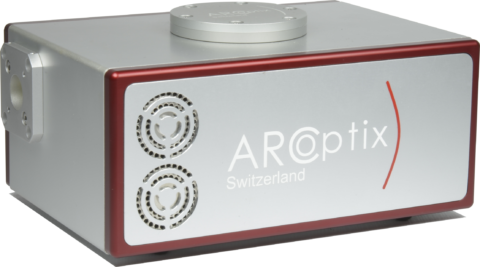
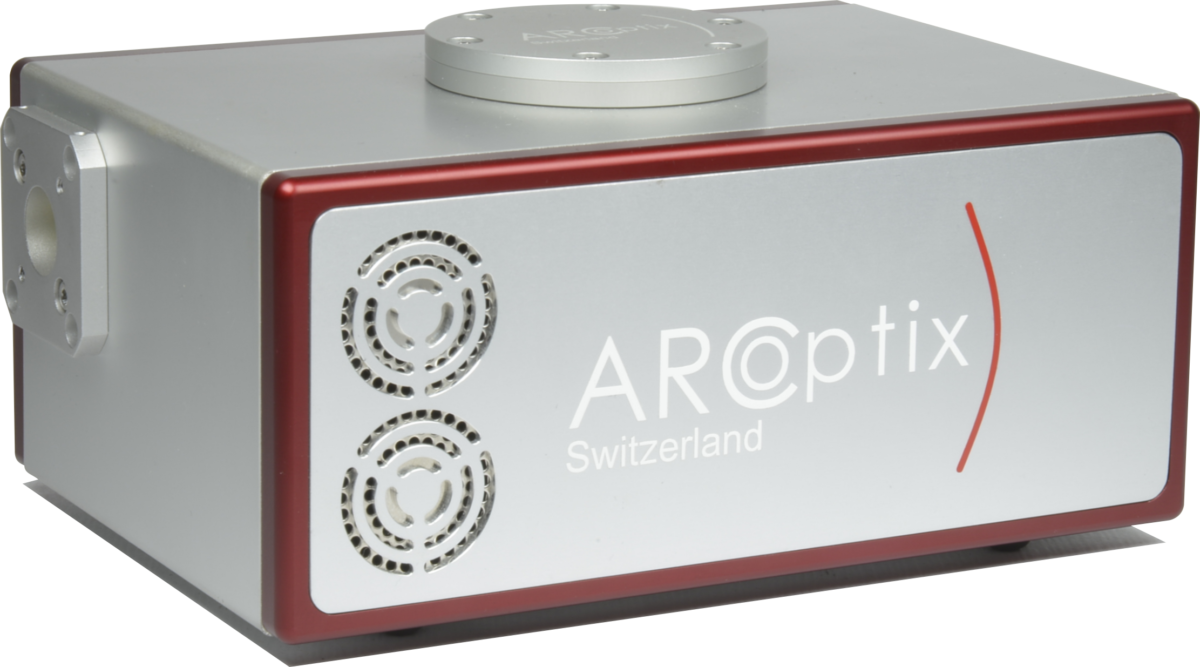
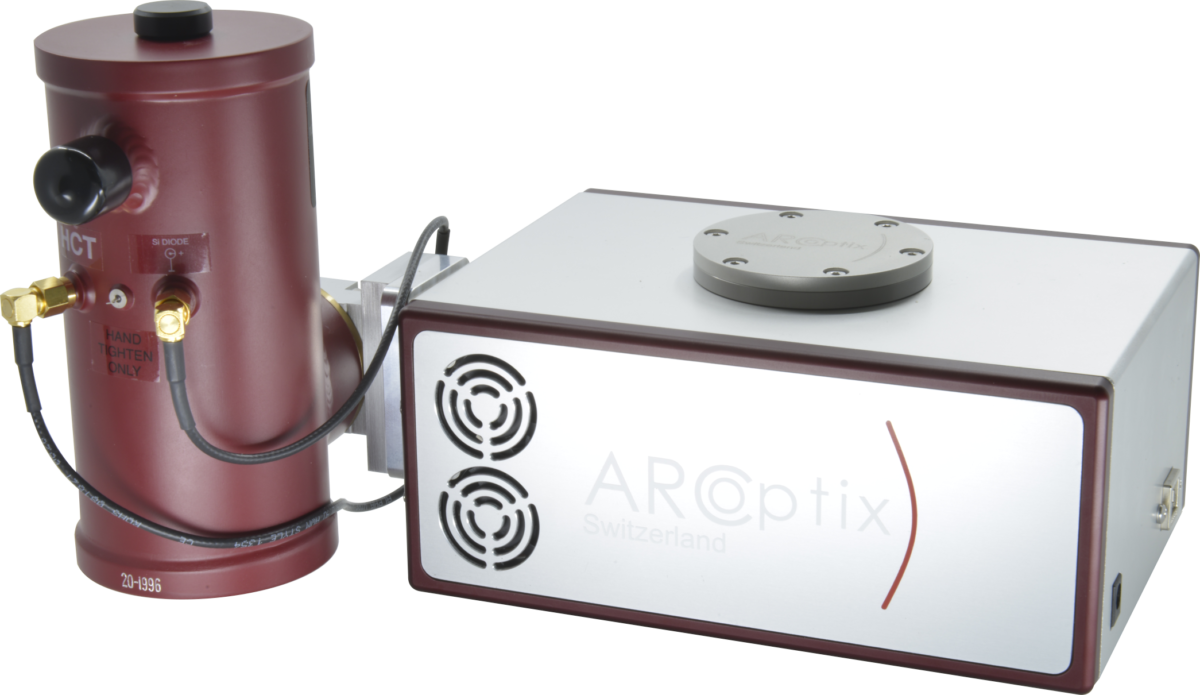
The FTIR Rocket is a miniature mid-infrared spectrometer designed for engineers and scientists who need laboratory-grade spectral analysis in a compact unit. It can operate either in free-space mode or via a removable SMA905 fibre-coupler, providing flexibility for both benchtop experiments and remote sensing setups. Multiple versions are available to cover different spectral ranges from 2 µm up to 16 µm, using high-performance Mercury-Cadmium-Telluride (MCT) detectors – in thermoelectrically cooled or liquid nitrogen cooled configurations – and a pyroelectric option for broad-range coverage. All models achieve a baseline resolution of 4 cm⁻¹ (with optional upgrades to 1 cm⁻¹ and even 0.5 cm⁻¹ for finer detail), allowing the resolution of subtle spectral features. A permanently aligned interferometer with dual corner-cube mirrors and a stabilised solid-state reference laser ensure consistent calibration and excellent wavelength accuracy without the need for manual realignment. Thanks to its high stability in both wavelength and intensity, the FTIR Rocket yields highly repeatable spectra, making it well-suited for quantitative analysis and chemometric applications. The instrument connects via USB and comes with user-friendly Windows software and a developer API, enabling quick integration into custom measurement systems. Typical applications range from infrared laser and LED characterization (it can even analyse pulsed IR lasers with >10 kHz repetition) to material identification, gas absorption spectroscopy, and on-line process monitoring across industries like environmental sensing, pharmaceuticals, and petrochemicals.
Range features
A high level overview of what this range offers
- Compact footprint – Small, lightweight design (about 18 × 16 × 8 cm) fits easily into lab setups or portable systems
- Fibre or free-space input – Removable SMA905 fibre adapter allows both direct beam measurements and flexible fibre-optic sampling in hard-to-reach or in-situ locations
- High spectral resolution – Resolves fine spectral details with 4 cm⁻¹ standard resolution (upgradeable to 1 cm⁻¹ or 0.5 cm⁻¹) for detailed IR peak analysis
- Choice of detectors – Available with thermoelectrically cooled MCT detectors for high sensitivity without cryogenics, an LN₂-cooled MCT for ultra-high sensitivity at extended ranges, or a pyroelectric DLATGS detector for broad spectral coverage
- Permanently aligned interferometer – Robust dual retro-reflector design never needs realignment, ensuring reliable operation and resistance to vibrations or temperature changes
- Stabilised reference laser – Built-in solid-state laser at 850 nm maintains precise wavelength calibration and repeatable scans for consistent day-to-day results
- USB connectivity & software – Simple USB 2.0 interface with free Windows software for real-time spectral display, plus a programmable API (DLL) for integrating the spectrometer into custom control systems
- Stable and repeatable – Excellent wavelength and intensity stability yields reproducible spectra, supporting accurate quantitative analysis across multiple runs and instruments
What’s in this range?
All the variants in the range and a comparison of what they offer
Model-specific specifications:
| Specification | FTIR-L1-060-4TE | FTIR-L1-085-4TE | FTIR-L1-120-4TE | FTIR-L1-160-LN2 | FTIR-L1-160-DLA |
|---|---|---|---|---|---|
Beam-splitter material | CaF₂ | CaF₂ | ZnSe | ZnSe | ZnSe |
Spectral range [cm⁻¹] | 5000 – 1660 | 6600 – 1200 | 5000 – 830 | 5000 – 650 | 5000 – 650 |
Spectral range [μm] | 2.0 – 6.0 | 1.5 – 8.5 | 2.0 – 12.0 | 2.0 – 16.0 | 2.0 – 16.0 |
Detector type | MCT (4-TE cooled) | MCT (4-TE cooled) | MCT (4-TE cooled) | MCT (LN₂ cooled) | Pyroelectric (DLATGS) |
Specific detectivity D* (cm·Hz^½·W⁻¹) |
|
|
|
|
|
Common specifications:
| Specification | Value |
|---|---|
Interferometer type | Permanently aligned, double retro-reflector (swinging arm) |
Resolution (unapodized) | 4 cm⁻¹ (standard); 2 cm⁻¹ optional; 1 & 0.5 cm⁻¹ on request |
Wavenumber repeatability | < 10 ppm |
Scan frequency |
|
Reference laser | Temperature-stabilised solid-state laser (≈850 nm) |
A/D converter | 24-bit |
Operating temperature | +10 °C to +40 °C |
Free-space aperture | Ø 12.7 mm input, acceptance full-angle 3.2° |
Fibre coupling | Removable SMA905 fibre adaptors (supports mid-IR fibres up to 1 mm core, NA 0.25–0.30) |
Power requirement | 12 V DC, 8 W |
Communication interface | USB 2.0 |
Software compatibility | Windows 7/10/11 (GUI software provided; API/DLL available) |
Dimensions (L × W × H) | 180 mm × 160 mm × 80 mm |
Weight | 1.8 kg |
FAQs
for FTIR Rocket – FTIR Spectrometer
The FTIR Rocket comes in multiple versions to cover different mid-infrared spectral ranges. Standard models include a 2–6 µm version, a 1.5–8.5 µm version, and a 2–12 µm version – each built with a specific beamsplitter and thermoelectrically cooled MCT detector optimised for that range. Additionally, there are extended-range models reaching 2–16 µm: one uses a liquid nitrogen (LN₂) cooled MCT detector for maximum sensitivity at long wavelengths, and another uses a pyroelectric DLATGS detector to cover the full range without cooling. This range selection allows you to choose the model best suited to the wavelengths of interest in your application.
There are three detector configurations available. The thermoelectrically (Peltier) cooled MCT detectors (in the 2–6 µm, 1.5–8.5 µm, and 2–12 µm models) provide excellent sensitivity in their respective ranges without the need for cryogenics. The LN₂-cooled MCT detector (in the 2–16 µm model) offers even higher sensitivity for very weak signals or extended mid-IR coverage, but it requires liquid nitrogen refills during operation. Finally, the pyroelectric DLATGS detector (in an alternative 2–16 µm model) covers the broad range without cooling; it’s generally less sensitive than the MCT detectors but can be useful for measuring high-intensity sources or when a cryogen-free, low-maintenance setup is preferred. The choice depends on your sensitivity requirements and practical considerations: for highest signal-to-noise in the far IR, the LN₂ MCT is ideal, whereas for routine measurements in the core mid-IR range, the TE-cooled MCT models are usually sufficient and easier to handle.
Yes. The FTIR Rocket is very compact (roughly the size of a small shoebox) and weighs only about 1.8 kg, making it feasible to use outside the lab or to integrate into portable systems. It runs on a 12 V DC power supply and connects via USB to a laptop, so in-field operation is possible (for example, from a battery pack or mobile setup). The instrument’s solid-state design – with no moving parts that require alignment – and the robust interferometer make it resilient to transport and mild vibrations. For truly remote or field deployments, users typically stick with the thermoelectrically cooled versions (to avoid needing liquid nitrogen). With appropriate enclosures or environmental protection, the FTIR Rocket can be deployed for on-site measurements, such as remote sensing of gases or process monitoring in a plant.
The FTIR Rocket is controlled through a USB connection to a Windows PC. It comes with a graphical user interface (GUI) software that allows you to configure measurement settings (such as scan averaging, detector gain, etc.) and view the spectra in real time. The software supports taking reference (background) scans, and you can switch between viewing raw interferograms, single-beam spectra, or transmission/absorption spectra. Basic functions like saving data, zooming into spectra, and applying apodization are all provided. In addition, a free API/library (DLL) is supplied for developers, with examples in C++, C#, LabVIEW, and MATLAB. This means you can integrate the spectrometer into your own software or automated systems easily, enabling custom data processing or remote instrument control as needed.
No routine optical alignment is required. The interferometer in the FTIR Rocket is a permanently aligned design – the two retro-reflector mirrors are fixed on a common swinging arm, so the path difference is created without any mirror ever going off alignment. This ensures the instrument remains calibrated and stable over time; you won’t need to tweak mirror positions or realign the system, even if it’s moved or subjected to minor vibrations. The wavelength scale is automatically and continuously calibrated by the built-in reference laser, which is temperature-stabilised to maintain accuracy within a few parts-per-million. The main maintenance tasks are minimal: for the thermoelectrically cooled detectors, just ensure the heat sink vents are not blocked; for the LN₂ version, handle the detector dewar and refills as per the manual; and for all versions, it’s good practice to keep the interferometer’s internal environment dry (the unit includes a desiccant port) to avoid moisture absorption in the mid-IR optics over long term use.
Yes, within certain limits. The FTIR Rocket has a scanning interferometer with a typical scan rate of around 4 Hz at full resolution, meaning it acquires a few spectra per second. It cannot capture a single sub-millisecond event in isolation, but it can accurately measure the spectrum of a repetitive pulsed source. In fact, many users have successfully characterised pulsed IR lasers with repetition rates above 10 kHz using the FTIR Rocket. As long as the source emits a stable train of pulses (or a periodic modulation), the interferometer will record an interference signal that is an average over many pulses. The resulting spectrum represents the aggregate optical output of the pulsed source. In summary, while you can’t use it like an oscilloscope for single pulses, it is well suited to analysing the spectral content of high-frequency pulsed or modulated infrared sources (lasers, IR LEDs, etc.).
The FTIR Rocket is a general-purpose mid-infrared spectrometer, so it can be applied to a wide range of IR spectroscopy tasks. Common uses include chemical identification and quantification – for example, analysing gas samples (detecting molecular absorption lines for environmental monitoring or safety), measuring liquids or thin films (such as in pharmaceuticals or petrochemicals for quality control), and characterising material spectra (like polymers, coatings, or geological samples). Thanks to the fibre-coupling option, it’s also used in conjunction with ATR probes or fibre-optic sensors for remote or in-situ measurements (such as monitoring reactions in a vessel or scanning surfaces for contaminants). Another important application area is optical source characterization: the FTIR Rocket often serves as a mid-IR optical spectrum analyzer for IR laser diodes, quantum cascade lasers, LEDs, and thermal emitters – allowing engineers to measure the emission spectrum, peak wavelength, and bandwidth of their IR sources. In research and development settings, its combination of portability and performance makes it useful for anything from laboratory spectroscopy experiments to field tests where larger FTIR instruments would be impractical.