A6450-Series Cooled MWIR Camera
- Technology
- Automated infrared imaging cameras
- Partner
- Teledyne FLIR
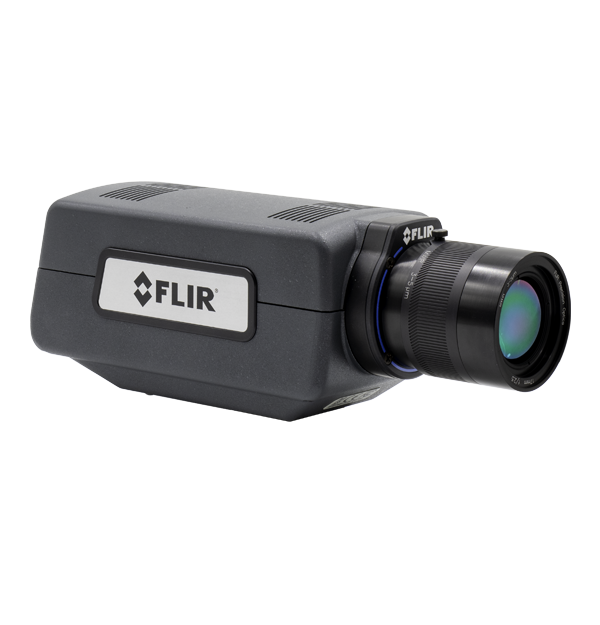
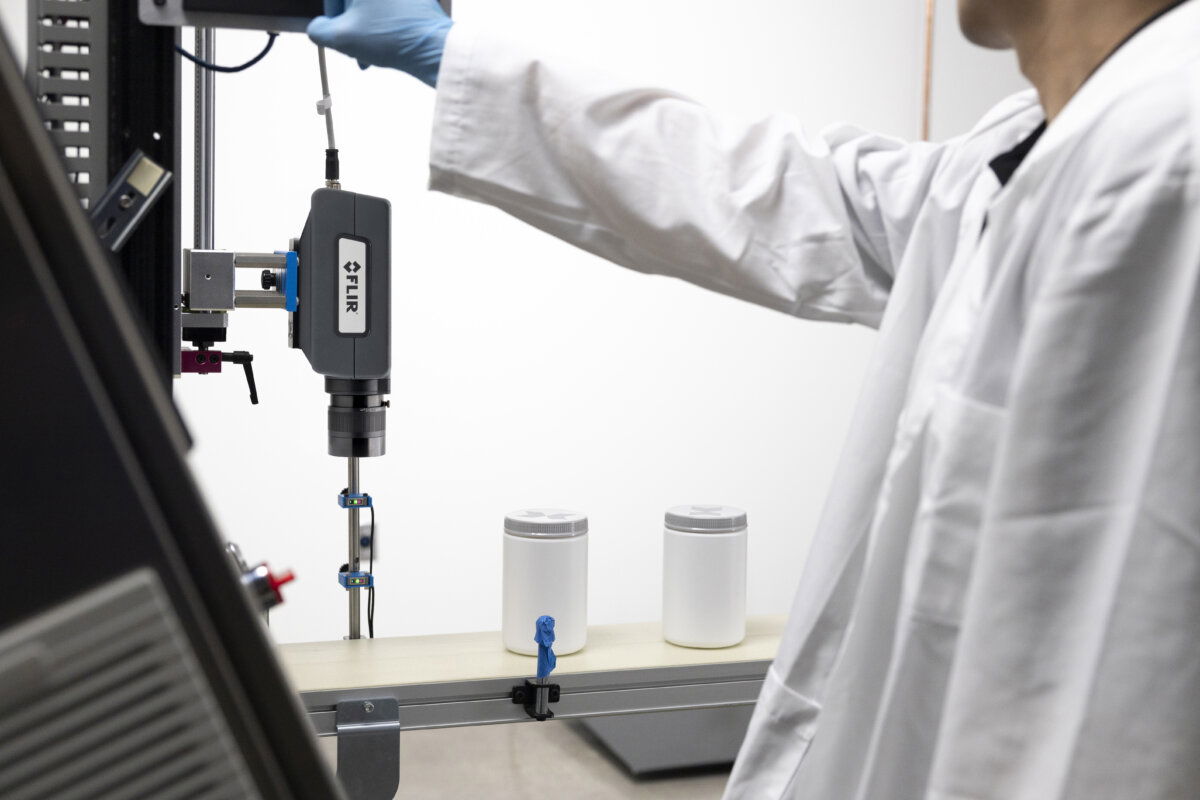
The A6450 Series Long-Life Cooled MWIR Cameras are purpose-designed for demanding automation, process control, and quality assurance applications. Each camera in the series features a 640 × 512 mid-wave infrared sensor with a high-operating-temperature (HOT) detector, paired with an industry-leading linear cooler that delivers up to 27,000 hours of operation before service. This extended cooler lifespan dramatically reduces maintenance needs, allowing manufacturers to plan in terms of years rather than months. With a full-frame rate of 125 Hz, the A6450 series captures rapid thermal events and subtle temperature variations on fast-moving products, essential for non-destructive testing (NDT) and real-time process monitoring. The cameras achieve excellent thermal sensitivity (below 30 mK NETD), so engineers can spot minute heat differences and catch early signs of defects or process drift before they escalate. Integration is straightforward – the A6450 series supports GigE Vision® (Ethernet) and GenICam protocols for plug-and-play connectivity with existing systems, along with synchronisation I/O and an HD-SDI video output for live monitoring. Designed for 24/7 continuous operation, these MWIR cameras operate reliably in industrial environments and come with flexible optical options and multiple calibration ranges (including optional spectral/ND filters) to handle both moderate and extreme temperatures. The A6450 series includes two models – one with manual focus and one with motorised remote focus – enabling users to choose the ideal configuration for their setup, whether it’s a fixed in-line inspection station or a research lab requiring remote lens control and filter switching.
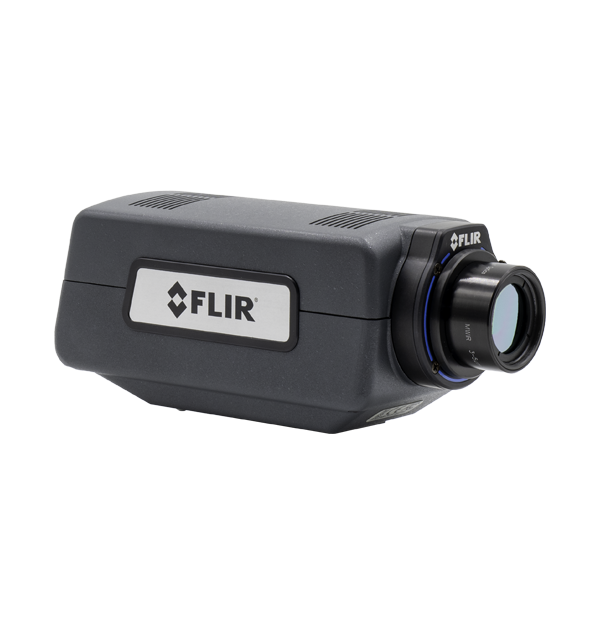
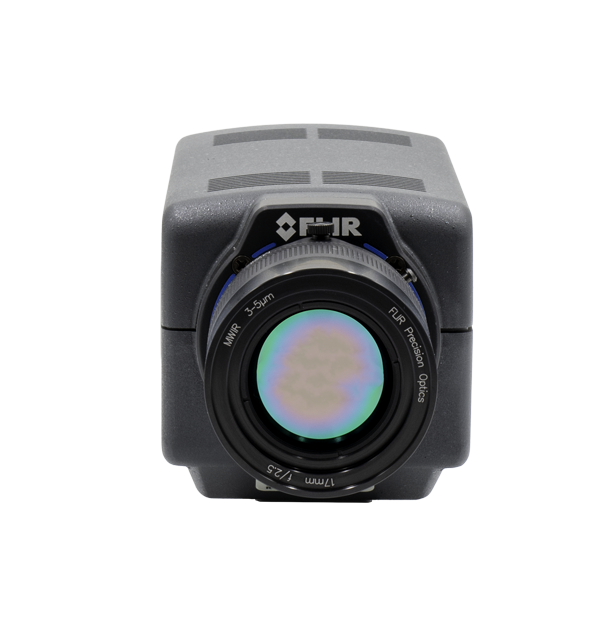
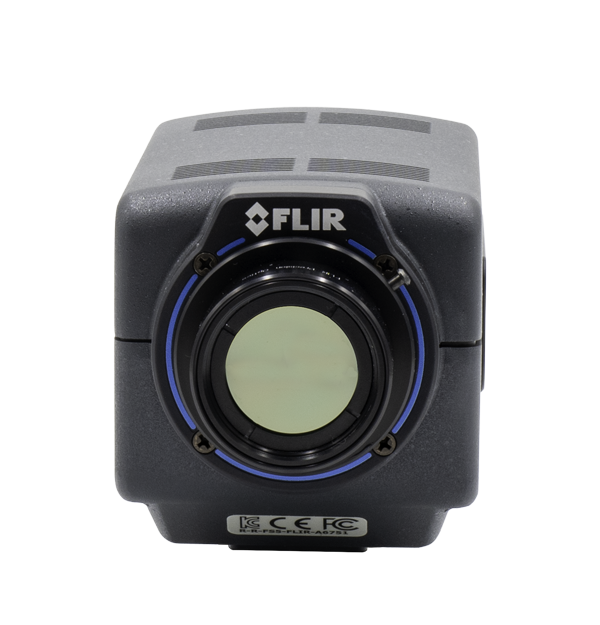
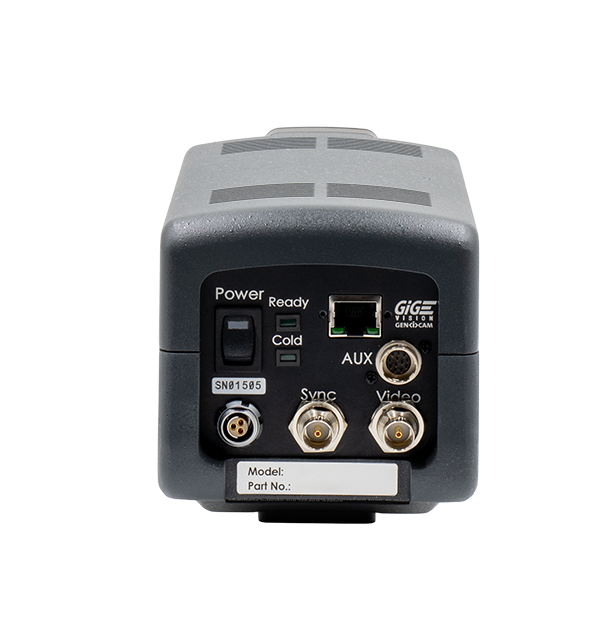
Range features
A high level overview of what this range offers
- Long-life linear cooler (27k hours) – Minimises downtime with multi-year maintenance intervals, keeping production lines running and lowering total cost of ownership.
- High-speed 125 Hz thermal imaging – Captures fast transient events and brief thermal anomalies at full 640×512 resolution, ensuring critical temperature spikes or defects are detected on high-speed processes.
- High thermal sensitivity (<30 mK NETD) – Detects minute temperature differences for early identification of product flaws, material inconsistencies, or process deviations before they become costly problems.
- Broad temperature measurement range – Standard calibration from -20°C up to 350°C, extendable to ~3000°C with optional neutral density filters, allowing accurate monitoring of both low-temperature processes and extreme-heat applications.
- Flexible optics and focus options – Supports a range of interchangeable MWIR lenses (17 mm, 25 mm, 50 mm, 100 mm, 200 mm, including a 50 mm macro) to adapt the field of view. Available in manual focus or motorised focus models (A6451 vs. A6481) to suit fixed installations or setups requiring remote focus adjustment and filter control.
- Automation-ready interfaces – Gigabit Ethernet with GigE Vision® and GenICam compliance for seamless integration into machine vision systems and PLCs. Provides sync-in/out triggers for precise timing, and an HD-SDI video output for real-time analog monitoring on industrial displays.
- Proven, robust design – Built on a field-tested electronics platform for reliability. The camera is engineered to withstand continuous operation in industrial environments (operating range -20°C to 50°C, shock/vibration tested) so it can deliver consistent results in 24/7 production use.
- Plug-and-play thermal analysis – Compatible with software tools for thermal analysis and R&D (such as research studio suites), enabling users to easily configure the camera, record radiometric data, and fine-tune inspections before full deployment.
What’s in this range?
All the variants in the range and a comparison of what they offer
Key Specifications
| Parameter | A6451 | A6481 |
|---|---|---|
Part number | 29674-251 | 29674-281 |
Detector Type | Flir HOT MW (SLS) | Flir HOT MW (SLS) |
Spectral range | 3.0 – 5.0 µm | 3.0 – 5.0 µm |
Resolution | 640 × 512 | 640 × 512 |
Detector pitch | 15 µm | 15 µm |
Thermal Sensitivity / NETD (typical) | < 30 mK, 25 mK typical (50% well-fill at 30°C) | < 30 mK, 25 mK typical (50% well-fill at 30°C) |
Operability | 99.5% | 99.5% |
Sensor cooling | Flir FL-100 linear | Flir FL-100 linear |
Readout type | Snapshot | Snapshot |
Readout modes | Asynchronous integrate while read / Asynchronus integrate then read | Asynchronous integrate while read / Asynchronus integrate then read |
Synchronization modes | Sync in / Sync out | Sync in / Sync out |
Image time stamp | Yes | Yes |
Integration time | 480 ns to ~full frame | 480 ns to ~full frame |
Pixel clock | 50 MHz | 50 MHz |
Frame rate (full window) | Programmable; .0015 Hz to 125 Hz | Programmable; .0015 Hz to 125 Hz |
Subwindow mode | Flexible windowing down to 16 × 4 (steps of 16 columns, 4 rows) | Flexible windowing down to 16 × 4 (steps of 16 columns, 4 rows) |
Dynamic range | 14-bit | 14-bit |
On-camera image storage | None | None |
Radiometric data streaming | Gigabit Ethernet (GigE Vision) | Gigabit Ethernet (GigE Vision) |
Standard video | SDI | SDI |
Command and control | GenICam (GigE), RS-232 | GenICam (GigE), RS-232 |
Standard temperature range (with band matched optics) | -20°C to 350°C (-4°F to 662°F), -10°C for microscopes | -20°C to 350°C (-4°F to 662°F), -10°C for microscopes |
Optional temperature range | 45°C to 600°C (ND1); 250°C to 2000°C (ND2); 500°C to 3000°C (ND3) | 45°C to 600°C (ND1); 250°C to 2000°C (ND2); 500°C to 3000°C (ND3) |
Accuracy | ≤ 100°C ±2°C (±1°C typical),
| ≤ 100°C ±2°C (±1°C typical),
|
Camera f/# | f/2.5 | f/2.5 |
Available lenses | Manual (3–5 µm): 17 mm, 25 mm, 50 mm, 100 mm, 200 mm, 50 mm Macro | Manual (3–5 µm): 17 mm, 25 mm, 50 mm, 100 mm, 200 mm, 50 mm Macro; Motorized (3–5 µm): 17 mm, 25 mm, 50 mm, 100 mm, 200 mm |
Close-up lenses/microscopes | 1x, 3x | 1x, 3x |
Lens Interface | Flir FPO-M (4-tab bayonet, motorized) | Flir FPO-M (4-tab bayonet, motorized) |
Focus | Manual | Motorized (compatible w/ manual) |
Filter holder (warm) | Behind lens mount for standard 1 in. diameter filters | 3-position motorized filter wheel (1 in. diameter filters) |
Palettes | Selectable 8-bit | Selectable 8-bit |
Automatic gain control | Manual, Linear, Plateau equalization, DDE | Manual, Linear, Plateau equalization, DDE |
Overlay | Fixed configuration, can be turned off | Fixed configuration, can be turned off |
Video modes | SDI: 720p @ 50/59.9 Hz, 1080p @ 25/29.9 Hz | SDI: 720p @ 50/59.9 Hz, 1080p @ 25/29.9 Hz |
Standard video zones | Auto, best fit | Auto, best fit |
Operating temperature range | -20°C to 50°C (-4°F to 122°F) | -20°C to 50°C (-4°F to 122°F) |
Power | 24 V DC (< 24 W steady rate) | 24 V DC (< 24 W steady rate) |
Weight w/o lens | 2.3 kg (5 lbs) | 2.3 kg (5 lbs) |
Size (L × W × H) | 226 × 102 × 109 mm (8.9 × 4.0 × 4.3 in.) | 226 × 102 × 109 mm (8.9 × 4.0 × 4.3 in.) |
Mounting | 2 × ¼”-20 tapped holes; 1 × ⅜”-16 tapped hole; 4 × 10-24 tapped holes | 2 × ¼”-20 tapped holes; 1 × ⅜”-16 tapped hole; 4 × 10-24 tapped holes |
Model Comparison – A6451 vs A6481
| Feature | A6451 (Standard) | A6481 (Advanced) |
|---|---|---|
Focus Type | Manual focus (adjust lens by hand) | Motorised focus (remote electronic control) |
Lens Options | Uses manual-focus MWIR lenses | Uses motor-focus MWIR lenses (same focal lengths, with motors) |
Spectral/ND Filter Control | Manual: filters inserted behind lens by operator | Motorised filter wheel: remotely switch or adjust spectral/ND filters |
Ideal Use-Case | Fixed, repetitive processes where camera looks at same target continuously (inline QA, battery production, continuous thermal processes, etc.) | Applications needing remote adjustments or varied conditions (R&D labs, pilot lines, multi-product lines, or scenarios needing both moderate and extreme temp measurement) |
Example Applications | Inline quality inspection, non-destructive testing on a production line, monitoring uniform heating/cooling processes | Research and development setups, additive manufacturing monitoring, production lines with frequent changeovers, scenarios requiring focus changes or spectral filtering on the fly |
Model Part Number | A6451 (Long-Life MWIR camera, manual) | A6481 (Long-Life MWIR camera, motorised) |
FAQs
for A6450-Series Cooled MWIR Camera
The A6450 cameras use a linear Stirling cooler engineered for an exceptionally long service life (around 27,000 hours of operation before maintenance). Traditional cooled infrared cameras often needed annual servicing because their coolers would wear out faster. By extending the cooler’s lifespan to several years of continuous use, the A6450 significantly reduces maintenance downtime and cost. In practical terms, this long-life cooler allows you to run the camera 24/7 in production without frequent interruptions, making it far more feasible to deploy cooled MWIR technology on the factory floor or in other continuous monitoring roles.
Cooled MWIR cameras offer higher sensitivity, faster response, and the ability to see smaller temperature differences or faster events than common uncooled thermal cameras. In the A6450’s case, the cooled MWIR detector (3–5 µm wavelength) can capture fine thermal details with NETD <30 mK sensitivity. This means it can detect subtle heat variations that an uncooled camera might miss. Additionally, the A6450’s cooled sensor and optical setup support high frame rates (up to 125 Hz) and short exposure times (sub-millisecond), enabling it to freeze and analyse very fast thermal phenomena (for example, quick heat spikes or fast-moving targets). The trade-off is that cooled cameras require a cryocooler, but with the A6450’s long-life cooler, you get those performance benefits without the usual maintenance burden.
Both models share the same core sensor and performance, but they differ in focusing and filter capabilities. The A6451 uses a manual focus lens – you adjust focus by hand on the lens itself. In contrast, the A6481 has a motorised focus system, allowing you to focus the lens remotely via software or controller, which is useful if the camera is in a hard-to-reach spot or if you need to automate focus adjustments. Moreover, the A6481 also includes a motorised filter wheel for spectral or ND filters, so you can remotely insert neutral density filters or other spectral filters as needed (for measuring very high temperatures or specific wavelength bands). The A6451 can also use filters, but you have to manually place them in its behind-the-lens holder. In summary, choose the A6451 for simpler, fixed setups where manual focus suffices, and choose the A6481 for more complex setups requiring remote focus changes or frequent use of different filters.
Integration is very straightforward thanks to the camera’s automation-ready interfaces and standards support. The A6450 series communicates over Gigabit Ethernet and is GigE Vision and GenICam compliant, which means you can plug it into standard machine vision networks and software without custom code. You can control the camera, stream full radiometric data, and trigger image capture all through these standard protocols. Additionally, the camera provides hardware I/O: a sync input to accept an external trigger (for example, from a PLC or an encoder on your production line) and a sync output to signal events or synchronise other devices (like strobe lights or another camera). There’s also an HD-SDI video output if you want to display the live thermal feed on a monitor in real time. In practice, many users find they can add the A6450 into their process monitoring system just like any other machine vision camera, using existing cables and software libraries, which speeds up deployment.
Yes, these cameras can measure very high temperatures well beyond the standard range, by using optional neutral density (ND) filters and calibration profiles. Out of the box, the A6450 series can typically measure from about -20°C up to 350°C on a standard calibration. For higher temperatures, you can equip the camera with ND filters (thin heat-resistant filters that attenuate the infrared energy) and apply the corresponding calibration. The manufacturer offers calibrated options like ND1 (for up to ~600°C), ND2 (up to ~2000°C), and ND3 (up to ~3000°C). By sliding in an ND filter (manually on A6451, or remotely via the A6481’s motorised filter wheel), the camera can accurately measure extreme temperatures such as molten metal, furnace interiors, or rocket exhausts without saturating the detector. This flexibility means the same camera can be used for both low-temperature and ultra-high-temperature targets, as long as the appropriate filter and calibration are in place.
The A6450 series is capable of 125 Hz full-frame rate at its native 640 × 512 resolution, which is already fast enough for many high-speed processes and thermal transient analysis. At 125 frames per second, it can capture events that occur in just a few milliseconds. Furthermore, the camera supports windowing (sub-frame readouts): you can reduce the resolution (by selecting a smaller region of interest on the sensor) to achieve even higher frame rates, if needed, for extremely fast events. For example, you could capture a smaller hundred-line-high strip at much higher than 125 Hz, allowing analysis of ultra-fast phenomena (exact maximum rates depend on window size). This flexibility, combined with the camera’s very short integration times (down to 480 nanoseconds), means the A6450 is well-suited for recording and analysing high-speed thermal events like explosions, laser heating, fast-moving objects on a production line, or rapid thermal cycles in materials testing. Even at full speed, all frames are fully radiometric (temperature-calibrated), so you don’t lose measurement accuracy at high frame rates.
The A6450 Series is ideal for any application where continuous thermal monitoring can improve quality or safety. Common use cases include inline quality control (for example, inspecting electronic components for hot spots, checking seal integrity in packaging, or spotting defects in automotive parts), process control in manufacturing (such as monitoring uniform heating in glass or steel production, or ensuring proper cooling rates in forged parts), and non-destructive testing (like detecting delaminations or cracks by thermal variance). Because of the high speed and sensitivity, these cameras excel in catching issues on fast-moving conveyor lines or in rapidly cycling processes – things like detecting a missing weld on a production line or identifying an overheated cell in a battery manufacturing process. Another big area is research and development: the A6450’s ability to capture transient thermal events makes it valuable in laboratories for materials testing, aerospace component development, or any experiments involving heat and energy. Essentially, any scenario that demands 24/7 thermal oversight or analysis of fast thermal dynamics is a strong fit for the A6450 series.
The camera streams calibrated thermal data that can be used with many common tools. If you have an existing machine vision or automation system, the GigE Vision/GenICam interface means you can pull the camera’s feed into your software or PLC just like a normal imaging device. For deeper thermal analysis, such as recording sequences, performing detailed temperature measurements, or creating reports, you can use dedicated thermal analysis software. The cameras are compatible with FLIR’s Research Studio and SDKs (and third-party applications supporting GigE Vision). Using such software, you can capture radiometric video, set up analysis routines (like spot measurements, alarm triggers on temperature thresholds, etc.), and visualise the heat patterns with various colour palettes. The A6450 does not store images onboard (it outputs the data in real-time), so you will generally use a connected PC or device to record and analyse the imagery. The good news is that since it adheres to standard protocols, you aren’t locked into one software environment – you can integrate it into custom programs or use off-the-shelf thermal analysis suites. This gives you a lot of flexibility in how you process and leverage the thermal data from the camera.