High Power Laser Delivery
Advanced optical fibres and components for high-performance laser systems.
High power laser delivery solutions enable the generation, amplification, transmission and controlled delivery of optical energy in demanding laser applications. From industrial laser processing and precision manufacturing to medical equipment and scientific instrumentation, these systems rely on specialised optical fibres and components capable of maintaining performance under high optical power conditions. Active and passive optical fibres, pump combiners, pump-signal combiners and optical amplifier modules play important roles in achieving efficient laser operation and reliable power transmission. In practice, selecting the appropriate high power laser delivery components requires careful consideration of operating wavelength, optical power, fibre characteristics, thermal management and system architecture. Engineers must also evaluate optical efficiency, beam quality, component compatibility and long-term reliability.
Do you want to know more about this technology? Try out our new Chatbot!
Technical overview
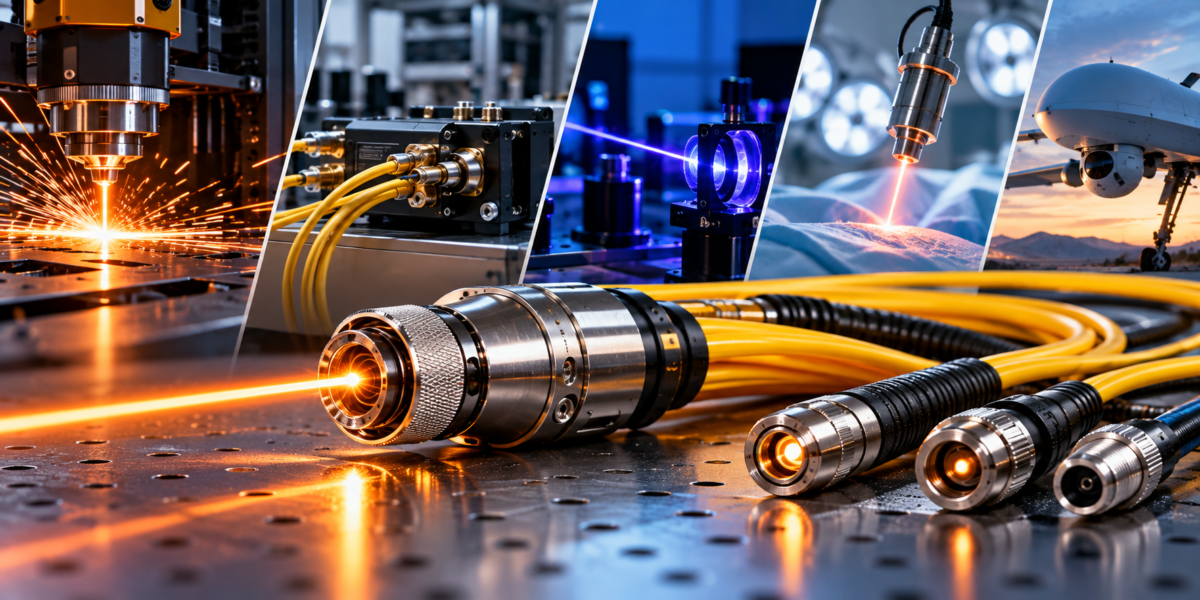
High power laser delivery systems incorporate specialised optical fibres, components and modules designed to support laser generation, amplification and optical power transmission. Active optical fibres provide the gain medium in fibre laser and amplifier architectures, while passive fibres support optical routing, beam delivery and interconnection between system components. Pump combiners and pump-signal combiners integrate optical energy from multiple sources into a common fibre path, supporting efficient pump coupling and laser system integration. Raman modules and erbium-doped fibre amplifier modules provide optical amplification functions for applications requiring specific wavelength coverage, gain characteristics or power performance. Component selection involves balancing optical efficiency, power handling, beam quality, nonlinear effects, thermal behaviour and integration complexity. These technologies support industrial laser processing, scientific research, optical amplification and specialised high-performance laser systems.
Key selection factors
-
Operating wavelength and fibre compatibility – Select optical fibres and components according to the laser wavelength, gain medium and transmission requirements. Material absorption, dopant characteristics and optical coatings influence efficiency and system performance.
-
Optical power handling – Evaluate average power, peak power, pulse energy and operating conditions. A common pitfall is specifying components based on average power alone without considering peak optical intensity, nonlinear effects or damage thresholds.
-
Active and passive fibre selection – Match fibre core diameter, numerical aperture, mode characteristics and optical properties to the laser architecture. Trade-offs may arise between beam quality, power scaling, nonlinear effects and coupling efficiency.
-
Pump and pump-signal combiners – Assess pump coupling efficiency, supported wavelengths, fibre compatibility and thermal performance. Component architecture must accommodate the required pump configuration and optical power distribution.
-
Optical amplifier modules – Consider gain requirements, operating wavelength, noise characteristics, power levels and integration requirements when selecting Raman or erbium-based amplification solutions.
-
Thermal and mechanical integration – Evaluate cooling requirements, fibre routing, bend radius, splice performance, connector design and environmental conditions to support reliable long-term operation.
Integration notes
High power laser delivery components must be integrated as part of the complete optical system, including the laser source, pump architecture, amplification stages and output delivery arrangement. Fibre geometry, splice quality, optical alignment and component compatibility influence transmission efficiency, beam quality and power handling capability. Pump combiners and amplifier modules may require careful thermal management to control heat generated by optical absorption and conversion losses. Watch out for excessive optical intensity, back-reflections, contamination and incompatible fibre interfaces, which can contribute to component degradation or optical damage. Mechanical protection, fibre bend radius, cooling arrangements and appropriate laser safety controls should be considered throughout system development. Validation should address optical performance, thermal behaviour, mechanical reliability and operating stability under representative conditions.
Why our portfolio is right for you
Our high power laser delivery portfolio can be evaluated against wavelength, optical power, fibre architecture, amplification requirements, thermal performance and integration constraints, including active and passive fibres, optical combiners and specialised amplifier modules.
High Power Laser Delivery FAQs
High power laser delivery involves the use of specialised optical fibres and components to generate, amplify, transmit or direct high-intensity laser energy. Depending on the system architecture, these solutions may incorporate active and passive fibres, optical combiners, amplifier modules and beam delivery assemblies. Component selection depends on the laser wavelength, power characteristics and intended application.
High power laser systems can incorporate several types of optical components, each performing a specific function. Common technologies include:
- Active and passive optical fibres
- Pump combiners and pump-signal combiners
- Raman and erbium-doped fibre amplifier modules
The required combination depends on whether the system is designed for laser generation, optical amplification or beam delivery.
Active optical fibres contain a gain medium, commonly introduced through rare-earth doping, that enables optical amplification when appropriately pumped. Passive optical fibres transmit optical energy without providing gain and are used for interconnection, routing and beam delivery. Both technologies must be selected according to wavelength, optical power, mode characteristics and system integration requirements.
Pump combiners combine optical power from multiple pump sources into a common fibre path, supporting efficient delivery of pump energy to the gain medium. Pump-signal combiners additionally accommodate the signal path within the optical architecture. Their performance depends on coupling efficiency, fibre compatibility, power handling and thermal design.
Raman amplifier modules use stimulated Raman scattering to provide optical gain at wavelengths determined by the pump and gain medium. Erbium-doped fibre amplifier modules use optically pumped erbium-doped fibre to amplify signals within supported wavelength bands. The appropriate technology depends on gain requirements, operating wavelength, noise performance and system architecture.
Power handling depends on the interaction between optical intensity, fibre construction, thermal behaviour and operating conditions. Important considerations include:
- Average and peak optical power
- Fibre core geometry and material properties
- Nonlinear effects, coupling losses and thermal management
These factors should be evaluated together rather than relying on a single power specification.
Thermal management helps control temperature increases caused by optical absorption, conversion inefficiencies and localised losses within fibres and optical components. Depending on the design, cooling arrangements, suitable mounting structures and controlled fibre routing can reduce thermal stress. Thermal performance should be verified under representative operating conditions.
Selection should begin with the required laser wavelength, optical power, beam characteristics and overall system architecture. Engineers should then assess active and passive fibre compatibility, pump coupling requirements, amplifier performance, optical losses and thermal behaviour. Mechanical integration, operating environment, safety requirements and long-term component reliability should also be considered before finalising the design.