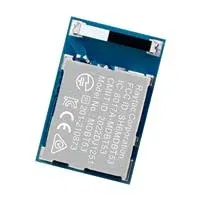
MDBT53 Series, Bluetooth 5.4, LGA module; nRF5340 based
- Technology
- Bluetooth modules
- Partner
- Raytac
The MDBT53 series modules are built for next-generation wireless IoT and Bluetooth LE Audio devices, featuring Nordic’s dual-core nRF5340 SoC with separate network and application processors for simultaneously handling complex protocols and user applications. They fully support Bluetooth 5.4 features (including LE Audio with Auracast™ broadcast and direction finding), making them ideal for cutting-edge applications like wireless audio transmitters, hearing aids, asset trackers, industrial sensors, and wearable electronics. Integration is streamlined thanks to pre-certified radio approvals (FCC, CE, IC, etc.) and a complete 2.4 GHz RF front-end with flexible antenna options (onboard chip or PCB antenna, or external via u.FL connector). Standard module variants (9.3 × 14.3 mm) provide up to 48 GPIOs and a USB interface, while compact variants (7.8 × 12.4 mm) offer the same core functionality with 25 GPIOs in a smaller footprint. These modules support an extended –40 °C to +105 °C operating range and multi-protocol wireless (Bluetooth LE, Mesh, Zigbee, Thread, ANT+) on a secure hardware platform (1.25 MB flash, 576 KB RAM, Arm® TrustZone® and CryptoCell™). In short, the MDBT53 series delivers high-performance Bluetooth LE connectivity and audio streaming in a ready-made module, allowing developers to focus on innovation rather than RF design.
Range features
A high level overview of what this range offers
The MDBT53 series combines cutting-edge features and performance benefits for modern wireless applications, including:
- Dual-core nRF5340 SoC – Dedicated network and application processors ensure reliable real-time connectivity while running complex user code simultaneously.
- Bluetooth 5.4 with LE Audio – Supports the latest Bluetooth Low Energy features, including LE Audio and Auracast™ broadcast, enabling next-gen wireless audio streaming and broadcast capabilities.
- Bluetooth Direction Finding (AoA/AoD) – Capable of Angle-of-Arrival and Angle-of-Departure measurements, opening possibilities for indoor positioning and asset tracking applications.
- Multi-protocol wireless support – Operates not only with Bluetooth LE (and Mesh) but also with Zigbee, Thread (IEEE 802.15.4) and ANT+, giving developers a versatile radio solution for diverse IoT ecosystems.
- Integrated antenna options – Available with a high-performance chip antenna or a space-efficient PCB antenna; alternatively, an external antenna version (u.FL connector) allows maximum range in challenging RF environments.
- Standard and compact footprints – Choose the 9.3 × 14.3 mm module variants for full 48-pin I/O and USB, or the miniature 7.8 × 12.4 mm variants with 25 pins for constrained layouts – both offer identical core functionality.
- Rich peripheral interfaces – Up to 48 GPIOs with multiple SPI (standard & high-speed), QSPI, UART (with RTS/CTS), I²C, I²S, PDM, PWM, ADC, NFC and USB interfaces provide extensive connectivity to sensors, actuators, displays, audio codecs and more.
- Long-range connectivity – Excellent receiver sensitivity and support for Bluetooth Long Range (Coded PHY down to 125 kbps) achieve robust links over 200+ metres line-of-sight, suitable for large-area coverage and outdoor use (actual range depends on antenna and environment).
- Industrial temperature rating – Reliable operation from –40 °C to +105 °C (extended temperature range) makes the modules suitable for industrial, automotive and outdoor applications that demand wide thermal tolerance.
- Hardware security – On-board cryptographic accelerator (Arm CryptoCell-312) and TrustZone secure execution help implement encrypted communication, secure boot, and protection of sensitive data in IoT applications.
- Pre-certified module – Fully certified for FCC, IC, CE, UKCA, MIC (Japan), KC (Korea), SRRC (China), NCC (Taiwan), and others, significantly reducing the effort and cost of regulatory compliance and speeding up product development.
Downloads
for MDBT53 Series, Bluetooth 5.4, LGA module; nRF5340 based
What’s in this range?
All the variants in the range and a comparison of what they offer
| Specification | MDBT53-1M (Chip ant.) | MDBT53-P1M (PCB ant.) | MDBT53-U1M (Ext. ant.) | MDBT53V-1M (Compact chip) | MDBT53V-P1M (Compact PCB) |
|---|---|---|---|---|---|
Antenna type | Chip antenna | PCB antenna | External u.FL connector | Chip antenna | PCB antenna |
Dimensions (L×W×H, mm) | 9.3 × 14.3 × 1.85 | 9.3 × 14.3 × 1.6 | 9.3 × 14.3 × 1.85 | 7.8 × 12.4 × 1.85 | 7.8 × 12.4 × 1.6 |
GPIO count | 48 | 48 | 48 | 25 | 25 |
Operating Temp (°C) | –40 to +105 | –40 to +105 | –40 to +85 | –40 to +105 | –40 to +105 |
USB interface | Yes (USB 2.0 full-speed) | Yes (USB 2.0 full-speed) | Yes (USB 2.0 full-speed) | No | No |
Integrated antenna | Yes (ceramic chip) | Yes (PCB trace) | No (external only) | Yes (ceramic chip) | Yes (PCB trace) |
Modules per series | MDBT53 standard series | MDBT53 standard series | MDBT53 standard series | MDBT53V compact series | MDBT53V compact series |
FAQs
for MDBT53 Series, Bluetooth 5.4, LGA module; nRF5340 based
The MDBT53 series is ideal for a wide range of IoT and wireless applications. Common uses include wearable electronics (fitness trackers, smartwatches), medical devices (remote patient monitors, hearing aids with Bluetooth LE Audio), industrial sensors and actuators, asset trackers, smart building devices (lighting controls, beacons), and any application requiring reliable, low-power Bluetooth connectivity. Thanks to support for Bluetooth LE Audio (with Auracast™) and high-quality audio interfaces, these modules are also well-suited for wireless audio streaming products like earbuds, assistive listening systems, and broadcasting units in public venues.
Yes. The MDBT53 series fully supports Bluetooth Low Energy Audio, including the latest Auracast™ broadcast capability. Built on Nordic’s nRF5340 SoC (which introduced LE Audio features via Bluetooth 5.2 and above), the modules can handle isochronous audio channels for streaming high-quality audio over BLE. This means you can use the MDBT53 to develop next-generation wireless audio devices – for example, broadcasting audio from a TV or public address system to multiple Auracast-enabled receivers, or implementing hearing aid and earbud solutions that leverage BLE Audio’s low-power, high-quality streaming.
The series includes five main variants which differ primarily in antenna configuration and size:
- MDBT53-1M: Standard-size module (9.3 × 14.3 mm) with an integrated chip antenna.
- MDBT53-P1M: Standard-size module with a PCB trace antenna (same size as 1M).
- MDBT53-U1M: Standard-size module with a u.FL connector for an external antenna.
- MDBT53V-1M: Compact module (7.8 × 12.4 mm) with a chip antenna (fewer GPIO pins exposed).
- MDBT53V-P1M: Compact module with a PCB antenna.
All variants share the same nRF5340 dual-core processor and support identical wireless features. The key trade-offs involve antenna choice (onboard convenience vs. external antenna for extended range), module footprint (full-size vs. miniaturized), and available I/O pins (48 on standard modules vs. 25 on compact modules). Notably, the standard modules also route the nRF5340’s USB interface, whereas the compact versions do not include USB pins.
It depends on your design priorities. The chip antenna versions (MDBT53-1M or MDBT53V-1M) are the easiest to integrate – they come pre-tuned and require no additional RF components, making them great for general-purpose use in compact devices. The PCB antenna options (P1M variants) use a printed antenna that typically offers slightly lower gain than the chip antenna but can be a cost-effective choice for medium-range needs. The external antenna version (MDBT53-U1M) is best when you need maximum wireless range or have a metal enclosure – it allows you to connect an external high-gain antenna for the most challenging RF environments. In summary: for most wearable and indoor IoT gadgets, an integrated antenna (chip or PCB) keeps things simple, while for long-range or RF-critical applications, the external antenna variant provides the greatest range.
The MDBT53 is a fully self-contained module that can operate as the main controller in your device. It incorporates Nordic’s nRF5340 SoC, which has a dedicated application processor core (with 1 MB flash and 512 KB RAM available for applications) capable of running your firmware. In other words, you do not need an external MCU – you can program the on-board nRF5340 using Nordic’s SDK and have it handle all tasks (Bluetooth communication, sensor interfacing, logic, etc.). However, if desired, the module can also be used in a network co-processor role with an external host microcontroller communicating over UART or SPI – but this isn’t necessary for most use cases. Many developers run their entire application on the MDBT53 module itself to save space and power.
You can develop firmware on the MDBT53 using Nordic’s nRF Connect SDK (which is based on the Zephyr RTOS) along with standard ARM Cortex-M development tools. The module’s nRF5340 can be programmed via SWD using a debugger (for example, the Nordic nRF5340 DK or a J-Link programmer). Nordic’s nRF Connect for Desktop and Command Line Tools are typically used to flash and manage the device. Nordic provides sample code and documentation for BLE peripherals, LE Audio, Thread, and other features, which can serve as a starting point for your development. Raytac supplies hardware design files and reference layouts for the module, but firmware development is primarily done with Nordic’s SDK and tools. If you are familiar with developing on Nordic’s nRF52 or nRF53 series, working with the MDBT53 will be very straightforward.
Yes. The nRF5340 radio inside the MDBT53 module is multi-protocol, meaning that besides Bluetooth 5.4 (Low Energy, including Mesh), it also supports IEEE 802.15.4 protocols such as Zigbee and Thread. Nordic provides Zigbee and Thread stacks in the nRF Connect SDK, and the module can even run BLE concurrently with those protocols using time-slicing. It also supports ANT+ and proprietary 2.4 GHz protocols. In short, the hardware is capable of all these wireless standards – you just need to load the appropriate firmware stack for the protocol of your choice.
The wireless range depends on several factors like antenna choice, transmit power, and environment. With the integrated antennas, you can typically achieve about 30–50 metres indoors (through a few walls) and much farther in open air. At the lowest BLE data rate (125 kbps coded PHY), the range improves significantly — in unobstructed field tests, the chip antenna variants have reached 200–240 m line-of-sight, and the external antenna version can go even further with a high-gain antenna. That said, in dense urban environments or inside buildings the range will be lower due to obstructions and interference. For maximum range, use the coded PHY (Long Range mode) and consider the external antenna variant. Also, the module supports up to +3 dBm transmit power, which can help extend range (at some cost to power consumption).
Yes. The MDBT53 module comes pre-certified for global regions. It carries regulatory approvals for FCC (USA), IC (Canada), CE (Europe), UKCA (UK), MIC/Telec (Japan), KC (Korea), SRRC (China), NCC (Taiwan), RCM (Australia/New Zealand), India WPC, and more. This means the module’s RF and antenna design have been tested to comply with regulatory requirements. As long as you follow the manufacturer’s integration guidelines (antenna placement, keep-out zone, etc.), you generally won’t need to re-certify the radio in your end product. Leveraging the module’s existing certifications can significantly reduce the time and cost to get your wireless product approved for international markets. (Note: You may still need to perform final product-level compliance tests like EMC or safety, but the module’s pre-approvals cover the radio RF testing.)