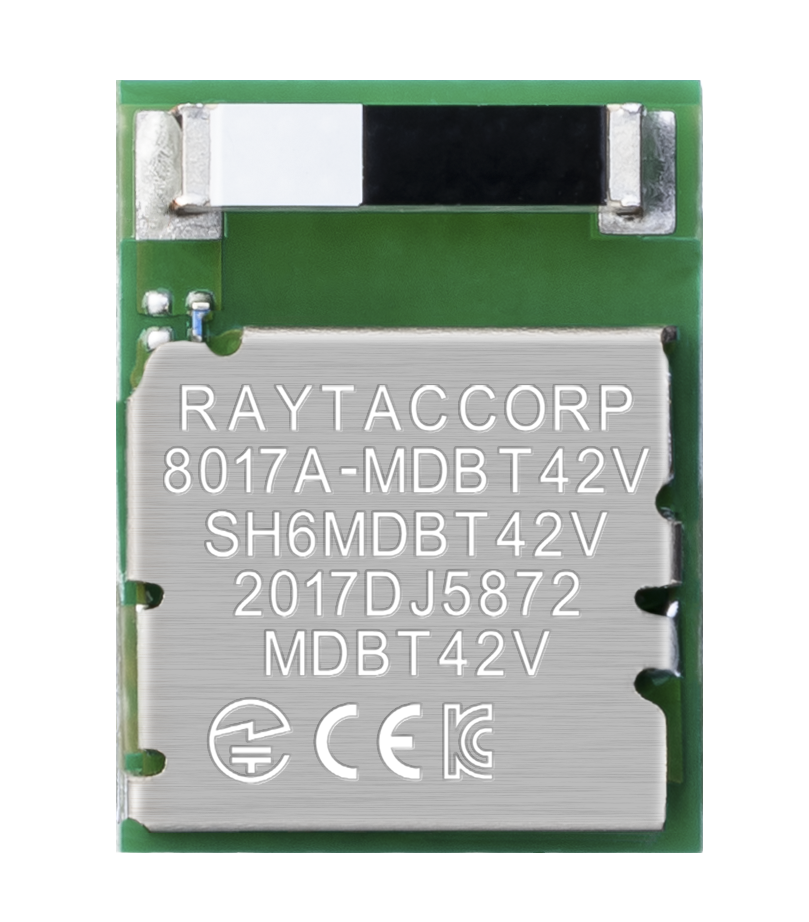
MDBT42V Series, Bluetooth 5.4, LGA module; nRF52832 based
- Technology
- Bluetooth modules
- Partner
- Raytac
This solution is based on the Nordic nRF52832 SoC (Revision 2) and uses a recommended third-party module approved by Nordic Semiconductor. It is certified for Bluetooth 5.4, 5.2, 5.1, 5.0, and 4.2 specifications and carries global certifications including FCC, IC, CE, Telec (MIC), SRRC, and NCC. The module is powered by a 32-bit ARM® Cortex™-M4F CPU and features 512 kB of flash memory and 64 kB of RAM. It is fully RoHS and REACH compliant.
The compact module measures 6.4 × 8.4 × 1.75 mm and provides 20 GPIOs with an integrated chip antenna. It supports multiple interfaces including SPI, UART, I2C, I2S, PWM, ADC, and NFC. This highly flexible multiprotocol SoC is ideally suited for Bluetooth® Low Energy, ANT+, and 2.4 GHz ultra-low-power wireless applications.
Range features
A high level overview of what this range offers
- Nordic nRF52832 SoC solution (Revision 2 IC)
- Nordic-recommended third-party module
- Bluetooth certified: BT 5.4 / 5.2 / 5.1 / 5.0 / 4.2
- Certifications: FCC, IC, CE, TELEC (MIC), SRRC, NCC
- 32-bit ARM® Cortex™-M4F CPU
- 512 kB Flash Memory / 64 kB RAM
- RoHS & REACH compliant
- Ultra-compact dimensions: 6.4 × 8.4 × 1.75 mm
- 20 GPIOs
- Integrated chip antenna
- Interfaces: SPI, UART, I²C, I²S, PWM, ADC, NFC
- Highly flexible multiprotocol support for Bluetooth® Low Energy, ANT+, and proprietary 2.4 GHz ultra-low-power wireless applications
Downloads
for MDBT42V Series, Bluetooth 5.4, LGA module; nRF52832 based
What’s in this range?
All the variants in the range and a comparison of what they offer
| Model | MDBT42V-512KV2 | MDBT42V-P512KV2 |
|---|---|---|
Core | 32-bit ARM® Cortex™ M4F CPU | 32-bit ARM® Cortex™ M4F CPU |
SoC | nRF52832 | nRF52832 |
Power supply | 1.7V – 3.6V | 1.7V – 3.6V |
Memory | 512kB Flash Memory | 512kB Flash Memory |
RAM | 64kB | 64kB |
Tx Power | +4 dBm @ 7.5mA, 0 dBm @ 5.3mA | +4 dBm @ 7.5mA, 0 dBm @ 5.3mA |
Rx Sensitivity | : -96 dBm @ 5.4mA | -96 dBm @ 5.4mA |
GPIO | Flexible and configurable 20 GPIO (8 analogue inputs) | Flexible and configurable 20 GPIO (8 analogue inputs) |
Interface | UART / I2C / SPI / PWM / PDM / I2S / NFC | UART / I2C / SPI / PWM / PDM / I2S / NFC |
Operating temperature | -40°C to +85°C | -40°C to +85°C |
Antenna | Chip Antenna | PCB Antenna |
The MDBT42V-AT comes with AT command firmware preloaded, so the host only needs to send high-level commands over UART to manage Bluetooth functions. In contrast, a standard module without AT firmware typically requires the developer to implement and maintain the BLE stack and application code directly on the SoC.
Applications that need reliable BLE connectivity but have limited firmware resources or tight development schedules are ideal candidates. Examples include beacons, asset tags, compact sensors, remote controls, handheld instruments, consumer accessories and small industrial nodes where a simple UART-based interface to a host microcontroller is preferred.
Advertising settings such as advertising time, enabling or disabling advertising, and LED indication patterns for advertising and connection states are configured through dedicated AT commands. This makes it easy to adjust behaviour during development, production or even in-field firmware updates without rewriting low-level Bluetooth code.
Yes. The module offers selectable on-air data rates of 1 Mbps or 2 Mbps and supports five different TX power levels. By choosing suitable combinations, designers can trade off maximum range, robustness, throughput and current consumption to match their application needs.
The AT command set includes controls for power-down modes and the use of DC-DC or LDO power configurations, while GPIO wake-up allows external events to bring the module out of low-power states. Together with the efficient nRF52832-class SoC, this enables long battery life in devices such as beacons and portable sensors.
The module provides AT commands for both hardware-style and software-style system resets, as well as for restoring configuration to default values. This simplifies recovery from misconfiguration and allows robust in-field maintenance procedures.
A dedicated AT command lets the host retrieve ADC readings, which are commonly used for monitoring battery level or other analogue voltages connected to the module. This avoids the need for a separate analogue front-end on the host system.
The module supports commands for setting and reading a serial number, as well as retrieving the device MAC address. These functions are useful for asset tracking, provisioning workflows and production test logging.
Yes. With regulatory approvals such as FCC, IC, CE, Telec (MIC), SRRC and NCC, together with RoHS and REACH compliance, the module is designed to support deployment in a wide range of territories and sectors, subject to final end-product testing.
The module is positioned as the peripheral/slave element and is intended to work alongside compatible central/master role modules in the same family. This allows designers to build complete systems—for example, a central gateway or controller with multiple MDBT42V-AT peripheral nodes—using closely related hardware across the network.