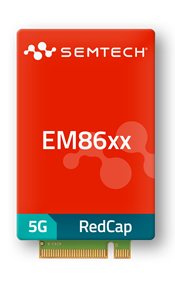
EM8695 5G RedCap M.2 module
- Technology
- 5G modules
- Partner
- Semtech (formerly Sierra Wireless)
The EM8695 5G RedCap module is a first-generation 5G module designed to bridge the gap between legacy LTE and full-scale 5G for IoT and industrial applications. It provides reliable sub-6 GHz 5G NR connectivity with seamless fallback to 4G LTE, serving devices that require long-term 5G availability without the complexity or expense of high-performance 5G eMBB solutions. This compact module is engineered for mid-range IoT use – from wearables and wireless sensors to surveillance cameras, asset trackers, and mobile computing devices – where moderate 5G throughput suffices. Its streamlined design requires fewer antennas and consumes up to 65% less power than an LTE Cat-4 modem, making 5G integration far more accessible for battery-powered and cost-sensitive projects. The EM8695 also supports dual SIM operation (with an optional integrated eSIM) to enhance coverage flexibility, and it includes built-in multi-constellation GNSS (GPS, GLONASS, Galileo, BeiDou) for precise location tracking. Built on proven cellular technology and compliant with 3GPP Release 17, the module offers broad global carrier compatibility (including FirstNet Band 14 support) and industrial-grade reliability. Integrators can also easily upgrade existing designs, as the EM8695 shares the same standard M.2 pin layout and USB interface as previous 4G modules – simplifying the path to 5G.
Range features
A high level overview of what this range offers
- 5G RedCap standard – Provides optimised 5G performance for IoT with lower complexity and cost compared to full 5G eMBB modules.
- Global coverage – Single global SKU supports 25 Sub-6 5G bands and 29 LTE bands, with worldwide certifications (including Band 14 for FirstNet) to accelerate deployment across regions.
- Industrial-grade design – Rugged module operates reliably from –30 °C to +70 °C (up to +85 °C in extended conditions), suited for harsh environments and extreme temperatures.
- High data throughput – Delivers up to 223 Mbps downlink and 123 Mbps uplink on 5G networks, enabling bandwidth-intensive tasks in IoT and mobile devices.
- Simplified RF design – Requires fewer antennas than traditional 5G modules, reducing RF complexity and lowering development costs for device makers.
- Energy efficiency – Consumes up to 65% less power than comparable LTE Cat-4 modems, greatly extending battery life in remote and portable applications.
- Dual SIM flexibility – Supports dual SIM single-standby (1 physical SIM + optional eSIM), allowing fast network switching and redundant connectivity for robust coverage.
- Integrated GNSS – Built-in multi-constellation GNSS (GPS, GLONASS, Galileo, BeiDou on L1/L5) provides precise positioning and tracking without needing a separate GPS module.
- Secure boot & debug – Hardware security features (secure boot and secure debug) prevent unauthorised code execution, enhancing device integrity and data security.
- Seamless 5G upgrade – Utilises a standard M.2 interface (USB 2.0) and is pin-compatible with existing 4G M.2 modules, allowing easy migration from LTE to 5G with minimal redesign.
Downloads
for EM8695 5G RedCap M.2 module
What’s in this range?
All the variants in the range and a comparison of what they offer
| Category | Specification |
|---|---|
5G NR category | 5G NR Sub-6 (RedCap, 3GPP Release 17) |
5G frequency bands | n1, n2, n3, n5, n7, n8, n12, n13, n14, n18, n20, n25, n26, n28, n30, n38, n40, n41, n48, n66, n70, n71, n77, n78, n79 (25 bands total) |
4G LTE category | LTE / LTE-Advanced Pro (3GPP Release 16) |
4G frequency bands | B1, B2, B3, B4, B5, B7, B8, B12, B13, B14, B17, B18, B19, B20, B25, B26, B28, B30, B34, B38, B39, B40, B41, B42, B43, B48, B66, B70, B71 (29 bands total) |
Peak download rate | Up to 223 Mbps (5G NR) |
Peak upload rate | Up to 123 Mbps (5G NR) |
Fallback network | 4G LTE (multiple LTE-Advanced bands supported for global fallback) |
GNSS (satellite) | Multi-constellation GNSS (L1 & L5 bands: GPS, GLONASS, Galileo, BeiDou) |
SIM support | Dual SIM (1× external 1.8 V/3 V SIM + optional eSIM; dual SIM single standby mode) |
Host interface | M.2 (52-pin) interface, USB 2.0 high-speed data bus (MBIM and QMI protocol support; AT command interface) |
Antenna ports | 3 antenna connectors (Main Tx/Rx, Auxiliary diversity, GNSS) |
OS driver support | Windows 10/11, Linux (MBIM driver / QMI SDK), Android (RIL integration) |
Security features | Secure Boot; Secure Debug (cryptographic integrity checks on start-up) |
Form factor | M.2 module (NGFF, 30 × 42 mm dimensions) |
Operating temp. | –30 °C to +70 °C (Class A operational); –40 °C to +85 °C (Class B extended) |
Certifications | Regulatory and carrier approvals in NAM, EMEA, APAC regions (incl. FirstNet and global LTE bands) |
FAQs
for EM8695 5G RedCap M.2 module
5G RedCap (Reduced Capability) is a streamlined version of 5G introduced in 3GPP Release 17. It offers 5G connectivity with lower bandwidth, fewer antennas, and reduced complexity compared to full 5G eMBB devices. In the EM8695, using RedCap means the module can deliver substantial 5G data rates while consuming less power and costing less. This makes it ideal for IoT and industrial applications that don’t require the absolute highest 5G speeds but still need long-term 5G support and better performance than LTE. In short, RedCap enables the EM8695 to “right-size” connectivity – providing the benefits of 5G (like low latency and long service life) in a more efficient, IoT-friendly package.
The EM8695 is tailored for mid-tier IoT and industrial applications that need reliable broadband connectivity without the extreme throughput of top-tier 5G. Typical use cases include industrial sensors and controllers, video surveillance cameras, asset tracking devices, smart wearables, and mobile computing terminals (like tablets or light laptops). These devices benefit from 5G’s longevity and low latency but also value the module’s lower power draw and cost. Essentially, any application that is transitioning from LTE Cat-4/Cat-6 to 5G – such as smart city devices, portable medical equipment, or gateway routers – can take advantage of the EM8695’s balanced performance and efficiency.
Yes. The EM8695 supports extensive 4G LTE fallback to ensure connectivity in the absence of 5G signals. It includes support for 29 LTE bands (LTE-Advanced Pro, 3GPP Release 16), covering all major operators and regions worldwide. If a device with the EM8695 is deployed in an area without 5G coverage (or if it moves out of 5G range), the module will automatically connect via 4G LTE. This dual-network capability guarantees continuous service and a smooth transition between 5G and 4G, without needing any hardware changes. (Note that the EM8695 is focused on 5G/4G and does not provide 3G or 2G connectivity, as those legacy networks are being phased out in many regions.)
On 5G networks, the EM8695 RedCap module can reach peak download speeds up to ~223 Mb/s and peak upload around 123 Mb/s under ideal conditions. These speeds are plenty for high-bandwidth IoT tasks such as HD video streaming, real-time sensor data aggregation, or on-device AI analysis. When operating on LTE networks, the maximum data rates will be lower (dictated by LTE network capabilities and category), but the module still supports advanced LTE throughput comparable to Cat-4/Cat-6 performance. The key advantage is that devices using the EM8695 can enjoy faster links on 5G when available, while still maintaining solid LTE speeds as a fallback.
Absolutely – the EM8695 is optimised for energy efficiency. Its 5G RedCap design and power-saving features (like reduced RF chain complexity and support for LTE/5G power-saving modes such as eDRX and PSM) can reduce power consumption by up to 65% compared to older LTE Cat-4 modules. This means devices using the EM8695 can run significantly longer on battery or rely on smaller power sources. For remote or off-grid IoT installations – for example, an outdoor sensor node running on a solar-charged battery – the module’s low power draw minimises the impact of cellular connectivity on overall power budget. In short, the EM8695 is well-suited to battery-operated applications, helping extend operational life without sacrificing connectivity.
The EM8695 provides a standard physical SIM interface (supporting both 1.8 V and 3 V SIM cards) and also features an optional embedded SIM (eSIM). This dual SIM capability allows two subscriber profiles (for example, two different carriers) to be provisioned on one device. The module operates in dual SIM single standby mode (DSSS), meaning it has two SIMs available but actively uses one at a time. In practice, an IoT device maker could solder an eSIM onto the board (pre-loaded with a global roaming profile, for instance) while also including a micro-SIM slot for a local carrier SIM. The EM8695 can then switch between the two as needed – for example, using one network as a primary connection and automatically switching to the second if the primary network is unavailable or if a better rate/coverage is desired in a given region. This flexibility simplifies logistics and offers devices greater connectivity resilience.
It has integrated multi-constellation GNSS on board – no separate GPS module is needed. The EM8695’s GNSS receiver supports the major satellite systems (GPS, GLONASS, Galileo, and BeiDou) and even utilises dual-frequency (L1 and L5) for improved accuracy and faster time-to-first-fix. This is especially useful for asset tracking devices, vehicle telematics, wearable trackers, and any IoT application where location data is required. You can use AT commands or standard location services to retrieve coordinates directly from the module. By combining cellular and GNSS in one unit, the EM8695 reduces the component count and integration effort for developers, and it ensures that location tracking works seamlessly alongside the cellular connectivity.
The EM8695 is designed to be OS-agnostic and connects via a standard USB 2.0 interface, so it works with a variety of host systems. For Windows 10/11, it supports the native MBIM interface (Windows will typically recognise it as a mobile broadband device). For Linux, the module works with USB CDC-ECM/MBIM or Qualcomm’s QMI interface – drivers or libraries are available (including open-source options) to manage connections and AT commands. For Android devices, the EM8695 can be integrated using the Android RIL (Radio Interface Layer) support, allowing it to function in tablets or other Android-based systems with cellular capabilities. In summary, whether you’re connecting it to an embedded Linux board, a Windows PC, or an Android platform, the necessary driver support and interfaces (MBIM, QMI, AT command set) are in place to ensure smooth integration.
One of the key design goals of the EM8695 is drop-in upgradeability for existing cellular designs. The module adheres to the standard M.2 form factor (30 × 42 mm) and uses the same 52-pin connector and pin assignments as many 4G LTE M.2 modules. In practice, this means if you have a device or PCB designed for an older Sierra Wireless (Semtech) EM-series 4G module (for example, the EM7400-series or EM7690), you can replace or populate it with the EM8695 with minimal or no hardware changes. The USB interface and power pins are in the expected places, and even features like SIM signals, antenna ports, and control pins (reset, wake, etc.) align with legacy layouts. As a result, upgrading to 5G RedCap often only requires a firmware/software update and perhaps minor adjustments, rather than a complete redesign. This pin-compatibility significantly reduces engineering effort and cost when migrating IoT products from LTE to 5G.
Yes – the EM8695 is built to industrial-grade specifications. It can operate within a wide temperature range: from –30 °C up to +70 °C under normal conditions, and even tolerates extremes from –40 °C to +85 °C (defined as Class B extended temperature range). This makes it suitable for outdoor and industrial installations, such as smart city infrastructure, agricultural and environmental sensors, factory equipment, or fleet telematics units that may face winter cold or high heat in engine compartments. The module’s robust design (including its RF components and thermal characteristics) ensures reliable performance in challenging conditions. Of course, as with any RF module, it should be mounted and integrated according to recommended guidelines (for example, proper enclosure, antenna placement, and protection from water or dust as needed by the application), but the EM8695 itself meets the environmental requirements for a broad range of industrial and automotive scenarios.