LE271 4G Global Cat.1 bis LGA Module
- Technology
- 4G modules
- Partner
- Fibocom
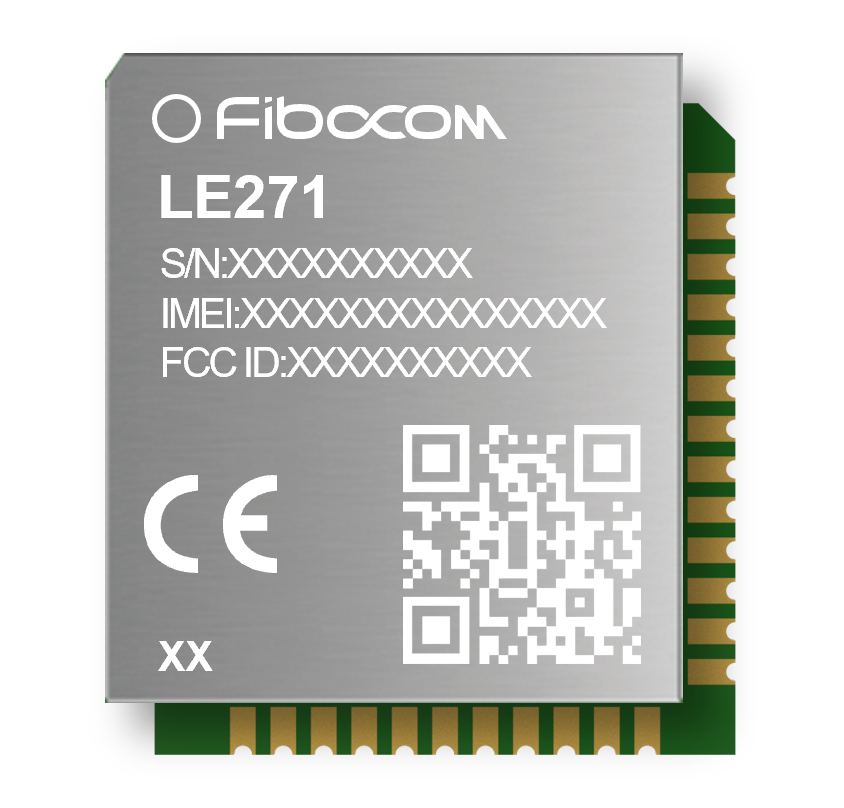
The LE271 4G Global Cat.1 bis LGA Module is a wireless communication module crafted for industrial IoT applications that demand dependable 4G connectivity across the globe. In a single hardware unit, it supports major LTE bands worldwide, allowing IoT device manufacturers to use one module for deployments in Europe, Asia, the Americas, and beyond. The Cat.1 bis technology offers moderate data speeds – more than enough for assets like trackers, smart meters, and mobile terminals – while avoiding the higher costs and power draw of full broadband modems.
With its single-antenna design and LGA form factor, the LE271 simplifies hardware integration by reducing antenna complexity and fitting into space-constrained devices. It’s also pin-to-pin compatible with earlier modules in the same family, meaning developers can upgrade existing designs with minimal PCB changes. Power efficiency is a core strength: the module is optimised for battery-powered operation with deep sleep modes and quick network registration, making it well-suited to long-life IoT devices in the field.
From shared micromobility trackers to payment terminals and smart sensors, the LE271 module delivers a balance of performance, coverage, and energy savings that helps businesses scale their IoT solutions globally.
Range features
A high level overview of what this range offers
- Single global SKU – One module covers all major 4G LTE bands, simplifying global certifications and logistics for device makers.
- LTE Cat.1 bis connectivity – Supports mid-tier data rates (up to ~10 Mbps) ideal for IoT applications, bridging the gap between slow NB-IoT links and high-speed LTE Advanced.
- Single antenna design – Uses a single RF antenna (no diversity needed), which reduces hardware complexity, lowers BOM cost, and eases integration into compact devices.
- Ultra-low power operation – Built for battery-powered devices, with microamp-level sleep currents and power-saving modes (eDRX, DRX standby) to extend operational life in the field.
- OpenCPU support – Allows developers to run custom applications on the module itself, removing the need for an external microcontroller. This can reduce component count and simplify firmware updates.
- Rich interface options – Provides multiple I/O interfaces (USB 2.0, UART ×2, SPI, I²C, ADC, GPIO, I²S) to connect sensors, controllers, and peripherals, offering design flexibility for diverse IoT projects.
- Dual SIM & eSIM capable – Supports dual SIM slots and eSIM functionality, giving devices more connectivity options and simpler provisioning for global roaming or carrier switching.
- Pin-to-pin compatible – The LE271 shares its footprint and pin layout with previous module generations, enabling straightforward upgrades in existing hardware designs without a complete redesign.
- Fast network attach – Optimised for quick network registration (often <3.5 s), which means devices connect faster on power-up, minimising transmission delays and saving power during reconnections.
- LBS and Wi-Fi positioning – Supports Location Based Services (cell-tower LBS) and Wi-Fi scan positioning, allowing basic location tracking capabilities even without a dedicated GNSS receiver.
What’s in this range?
All the variants in the range and a comparison of what they offer
| Category | Specification |
|---|---|
Package | LCC+LGA (surface mount) |
Dimensions (mm) | 17.7 × 15.8 × 2.4 |
LTE FDD bands | B1, B2, B3, B4, B5, B7, B8, B12, B13, B18, B19, B20, B28 (global coverage) |
LTE TDD bands | B38, B40, B41 |
3G/2G fallback | Not supported (LTE-only module) |
Peak data rate (LTE FDD) | 10.3 Mbps downlink / 5.1 Mbps uplink |
Peak data rate (LTE TDD) | 9.1 Mbps downlink / 3.1 Mbps uplink |
Power supply | 3.4 V – 4.5 V (typical 3.8 V) |
Operating temperature | -35 °C to +75 °C |
Interfaces | USB 2.0, UART ×2, SPI, I²C, ADC, GPIO, I²S |
SIM support | 2 × external SIM (3 V/1.8 V); eSIM compatible |
Special features | OpenCPU; DFOTA (Delta Firmware Over-The-Air updates); LBS positioning; SSL/TLS support |
FAQs
for LE271 4G Global Cat.1 bis LGA Module
The LE271 provides single-SKU global connectivity for IoT. This means one module can work on 4G networks worldwide, greatly simplifying device deployment across different regions. It reduces the need for multiple regional variants and streamlines certification and logistics for global projects.
Cat.1 bis is a variant of LTE Category 1 that uses a single antenna and focuses on moderate data rates. Unlike LTE Cat 4 (which offers higher speeds at higher power usage) or LTE Cat M1/NB-IoT (which offer very low speeds for ultra-low power), Cat.1 bis hits a sweet spot for IoT – it provides enough bandwidth for sensors, trackers, or cameras to send data (up to around 10 Mbps) while keeping device cost and power consumption much lower than high-category modems. It’s an excellent upgrade path as 2G and 3G networks shut down, offering broader coverage than NB-IoT with simpler hardware than standard Cat 1.
The LE271-GL is designed as a global module, covering a wide range of LTE bands used in Europe, Asia, North America, Latin America, and other regions. It supports popular FDD bands like 1, 2, 3, 4, 5, 7, 8, 12, 13, 20, 28 (among others) and TDD bands such as 38, 40, 41. In practical terms, it can operate on most carriers’ 4g LTE networks worldwide, so a device using this module can be deployed in many countries with the same hardware.
No. The LE271-GL is an LTE-only module and does not fall back to 3G or 2G networks. It’s built for networks that have 4G LTE coverage. This reflects the industry trend of phasing out 2G/3G in favour of LTE-based IoT connectivity. If a deployment area has no 4G coverage, this module would not connect; in such cases, a different module with legacy network support would be needed. However, Cat.1 bis has been widely adopted by carriers specifically to provide a future-proof alternative to those retiring 2G/3G.
The LE271 is designed to be easy to integrate into IoT devices. Firstly, its LGA package and compact size allow it to be surface-mounted on small circuit boards. It uses a single antenna, so engineers don’t have to design in dual antennas or diversity receivers, which simplifies the RF layout and lowers the bill of materials. Moreover, the LE271 is pin-to-pin compatible with earlier modules in the same family (such as previous Cat 1 or Cat M modules), meaning you can often replace an older module with the LE271 on an existing board design without redesigning the hardware. These factors save development time and costs when upgrading or designing new devices.
OpenCPU means the module can double as a basic microcontroller by running user applications internally. In practical terms, developers can program the LE271-GL module itself (using the provided SDK and AT commands) to read sensors, control outputs, or process data, instead of always needing a separate external MCU. This capability can reduce the component count and power consumption of the device, as the module handles both connectivity and some local processing. It also simplifies firmware management, since updates to both connectivity firmware and application logic can be done on the same unit.
Yes. The module is versatile in how it handles SIMs. It has interfaces for dual physical SIM cards, allowing a device to have two SIM slots (for example, to switch between two carriers). In addition, it supports eSIM (embedded SIM) functionality, which means it can work with a soldered-down SIM chip or integrated SIM, useful for compact or sealed devices. This gives product designers flexibility to choose traditional SIM cards or eSIM for provisioning connectivity, and even implement dual-SIM setups for redundancy or optimal coverage.
Absolutely – the module is optimised for low power operation. It supports power-saving modes like extended DRX (Discontinuous Reception) and can enter deep sleep states where it draws minimal current (on the order of microamps). Even when connected, it’s engineered to use just the necessary power, and it avoids power-intensive network modes by being Cat.1 bis. This makes it very suitable for devices that run on batteries or energy harvesting. For instance, a tracker or a remote sensor can remain dormant and wake up quickly to send data, benefiting from the LE271’s fast network registration to minimise active time. The result is longer battery life, often measured in years for well-optimised IoT deployments.
The LE271-GL is ideal for mid-rate IoT applications that need wide area connectivity and mobility. Common use cases include asset trackers and telematics devices (for vehicles, logistics pallets, etc.), shared mobility assets like e-scooters or bicycle locks, smart meters and smart city sensors (which periodically send data), mobile payment terminals (POS) that require reliable uptime across regions, and various industrial monitors or controllers. Essentially, any application that doesn’t need the high bandwidth of 4G Cat.4/5G, but does need more speed or coverage than technologies like NB-IoT, can benefit from this Cat.1 bis module. Its global band support also makes it a strong choice for devices that may be deployed in multiple countries.
While the LE271-GL does not have an integrated GNSS/GPS receiver, it does provide basic location services through the network. It supports Cell-ID location (LBS) and Wi-Fi scanning to assist in determining the device’s approximate location. Using these features, a device can get a rough position fix by identifying nearby mobile network cells or Wi-Fi hotspots – useful for indoor or urban scenarios where GPS might not be available. For applications requiring precise positioning, an external GNSS module would typically be added; however, the built-in LBS and Wi-Fi scan features can enhance location awareness or serve as a backup method without significantly increasing power usage or cost.