Kompakte gütegeschaltete DPSS-Laser der NL200-Serie
- Technologie
- DPSS-Laser
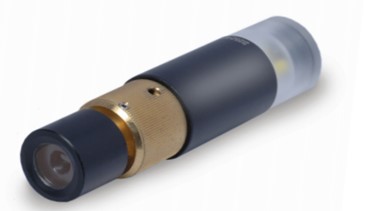
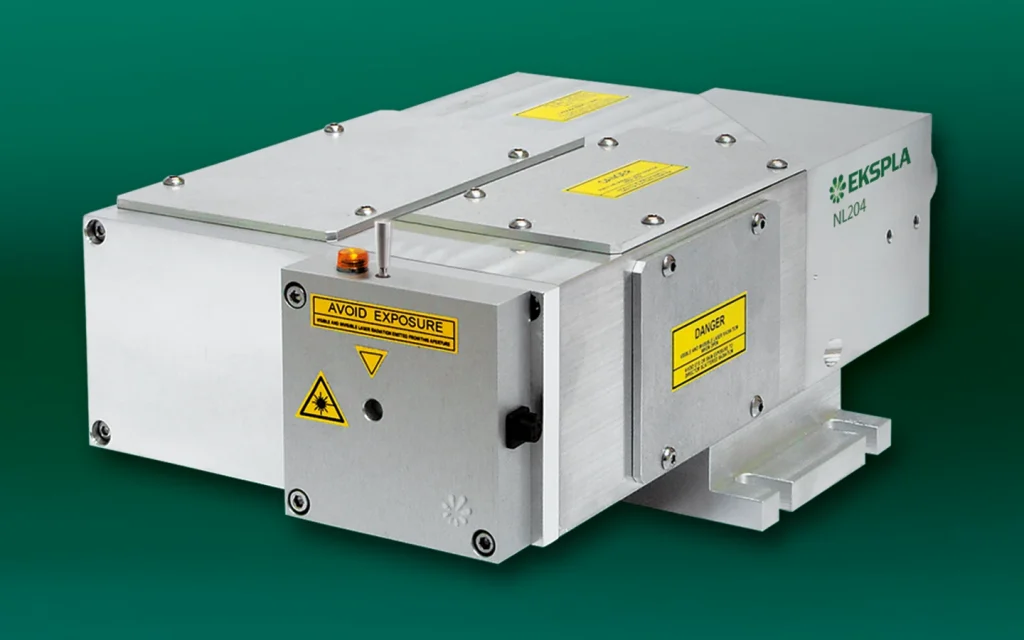
The NL200 Series includes the NL201, NL202 and NL204 models, providing three combinations of pulse energy and repetition rate. The systems generate short nanosecond pulses through electro-optical Q-switching and support external TTL triggering for integration with automated equipment. Their end-pumped, amplifier-free optical design is housed in a compact, sealed laser head with air cooling. Engineers can select the fundamental 1064 nm output or add harmonic generation for operation at 532, 355, 266 or 213 nm.
A close-to-Gaussian beam profile, M² below 1.3 and beam pointing stability of no more than 10 µrad RMS support applications requiring controlled focusing. Typical uses include marking, micromachining, display panel repair, ablation, laser cleaning, spectroscopy, OPO pumping and remote sensing. Remote operation is available through a keypad, USB, RS232, LAN, WLAN or REST API commands, allowing the system to be incorporated into laboratory and OEM control architectures.
Eigenschaften
- Three model variants – Match pulse energy and repetition rate to the application.
- Up to 4 mJ at 1064 nm – Provides selectable pulse-energy levels for processing, pumping and measurement tasks.
- Variable repetition rate up to 2500 Hz – Supports adjustment of pulse frequency for process or acquisition requirements.
- 532, 355, 266 and 213 nm harmonic options – Extends operation from the fundamental infrared wavelength into visible and ultraviolet ranges.
- Typical pulse duration below 10 ns – Delivers short pulses for nanosecond material interaction and time-resolved applications.
- Close-to-Gaussian beam with M² below 1.3 – Supports controlled focusing and a smooth spatial energy distribution.
- Beam pointing stability of ≤10 µrad RMS – Helps maintain focused-spot position during repeated operation.
- External TTL triggering and optical jitter below 0.5 ns – Supports synchronisation with instrumentation and automated processes.
- USB, RS232, LAN, WLAN and REST API control – Provides several options for local, remote and OEM integration.
- Air-cooled, sealed construction – Eliminates the need for an external water-cooling circuit and limits exposure of the optical cavity to the surrounding environment.
- Compact laser head – Supports installation where available bench or machine space is limited.
- Two-year warranty – Provides a defined initial support period.
Verfügbare Modellvariationen
Alle verfügbaren Varianten und ein Vergleich ihrer Spezifikationen
Common Specifications
| Specification | Value |
|---|---|
Laser technology | End-pumped diode-pumped solid-state laser |
Pulse generation | Electro-optical Q-switching |
Available models | NL201, NL202 and NL204 |
Fundamental wavelength | 1064 nm |
Harmonic wavelength options | 532, 355, 266 and 213 nm |
Pulse energy stability at 1064 nm | <0.5% StdDev |
Pulse energy stability at 532 nm | <2.5% StdDev |
Pulse energy stability at 355 nm | <3.5% StdDev |
Pulse energy stability at 266 nm | <4% StdDev |
Pulse energy stability at 213 nm | <5% StdDev |
Power drift | ±2% |
Beam spatial profile | Close to Gaussian in near and far fields |
Roundness | 0.9–1.1 at 1064 nm |
Beam quality | M² <1.3 |
Beam divergence | <3 mrad, full angle at the 1/e² level at 1064 nm |
Polarisation | Linear |
Typical beam diameter | 0.7 mm at the 1/e² level at 1064 nm |
Beam pointing stability | ≤10 µrad RMS |
Optical jitter | <0.5 ns StdDev relative to QSW IN or SYNC OUT |
Laser head dimensions | 164 × 320 × 93 mm, excluding optional harmonic module |
Power supply dimensions | 470 × 390 × 140 mm |
Umbilical length | 3 m |
Cooling | Air cooled |
Operating temperature | 18–30 °C |
Relative humidity | 20–80%, non-condensing |
Power input | 100–240 V AC, single phase, 50/60 Hz |
Power consumption | <600 W |
Room cleanliness | ISO Class 9 or better |
External triggering | TTL |
Control interfaces | Keypad, USB, RS232, LAN, WLAN and REST API |
Laser classification | Class IV laser product |
Model and Wavelength Comparison
| Specification | NL201 | NL202 | NL204 |
|---|---|---|---|
Pulse energy at 1064 nm | 0.9 mJ | 2.0 mJ | 4.0 mJ |
Pulse energy at 532 nm | 0.3 mJ | 0.9 mJ | 2.0 mJ |
Pulse energy at 355 nm | 0.2 mJ | 0.6 mJ | 1.3 mJ |
Pulse energy at 266 nm | 0.08 mJ | 0.2 mJ | 0.6 mJ |
Pulse energy at 213 nm | 0.04 mJ | 0.1 mJ | 0.2 mJ |
Typical pulse duration at 1064 nm, FWHM | <8 ns | <10 ns | <8 ns |
Pulse repetition rate | 0–2500 Hz | 0–1000 Hz | 0–1000 Hz |
Unless otherwise stated, values apply at 1064 nm, maximum repetition rate and in the basic configuration without options. NL201 values are measured at 2500 Hz, while NL202 and NL204 values are measured at 1000 Hz. Pulse energy stability is averaged over a 30-second interval. Power drift is measured over eight hours after a 20-minute warm-up, with ambient temperature variation below ±2 °C and humidity variation below ±5%. When harmonic generation is ordered, the 1064 nm output may be optimised for frequency conversion and can differ from the tabulated fundamental pulse energy.
Ordering Information
| Part-number segment | Available code | Meaning |
|---|---|---|
Model | NL201, NL202 or NL204 | Laser model and pulse-energy class |
Harmonic option | H200SHC | Second-harmonic generator |
Harmonic option | H200THC | Third-harmonic generator |
Harmonic option | H200FHC | Fourth-harmonic generator |
Complete ordering example: NL201-H200SHC
The ordering scheme lists second-, third- and fourth-harmonic modules. A separate ordering code for the 213 nm option is not provided.
FAQs
für Kompakte gütegeschaltete DPSS-Laser der NL200-Serie
The model choice is mainly a balance between pulse energy and maximum repetition rate. NL201 reaches 2500 Hz and provides 0.9 mJ at 1064 nm, making it suitable when pulse frequency takes priority over energy per pulse. NL202 increases the 1064 nm pulse energy to 2.0 mJ at up to 1000 Hz, while NL204 provides 4.0 mJ at the same maximum rate. The harmonic outputs follow the same progression; at 532 nm, for example, the models provide 0.3, 0.9 and 2.0 mJ respectively. Selection should therefore be based on the required energy at the actual working wavelength, together with the process throughput and trigger rate needed by the wider system.
The series can operate at 1064 nm and can be equipped for 532, 355, 266 or 213 nm output. Pulse energy decreases as the harmonic order rises: across the three models, the specified ranges are 0.3–2.0 mJ at 532 nm, 0.2–1.3 mJ at 355 nm, 0.08–0.6 mJ at 266 nm and 0.04–0.2 mJ at 213 nm. This matters when shorter wavelengths are selected for material absorption, spectroscopy or ablation, because the available pulse energy must still meet the application threshold. If 1064 nm output is also required with a harmonic option, that requirement should be defined when ordering because the fundamental output may be optimised for harmonic conversion and differ from the tabulated value. The final wavelength choice should therefore be based on both the optical interaction and the available energy budget, rather than wavelength alone.
The beam is specified as close to Gaussian in both near and far fields, with M² below 1.3. At 1064 nm, roundness is 0.9–1.1, the typical beam diameter is 0.7 mm at the 1/e² level, and full-angle divergence is below 3 mrad. Beam pointing stability is ≤10 µrad RMS, which helps limit movement of the focused spot during repeated operation. These characteristics support controlled focusing for micromachining, display repair and other processes where spot shape and position influence the result. The focusing optic, working distance and selected harmonic wavelength must still be considered in the complete optical design, as the tabulated beam diameter and divergence are specified at 1064 nm.
Short-term pulse energy stability is specified by wavelength, while long-term behaviour is represented by the power-drift figure. The standard deviation is below 0.5% at 1064 nm, below 2.5% at 532 nm, below 3.5% at 355 nm, below 4% at 266 nm and below 5% at 213 nm. These figures are averaged from pulses emitted over a 30-second interval. Power drift is ±2% over eight hours after a 20-minute warm-up, provided ambient temperature varies by less than ±2 °C and humidity by less than ±5%. Process qualification should separate pulse-to-pulse variation from longer-term drift and reproduce the stated warm-up and environmental conditions.
The NL200 Series supports external TTL triggering and remote operation through a keypad or digital control interfaces. Available connections include USB, RS232, LAN and WLAN, while REST API commands allow control from a host running different operating systems. Optical jitter is specified below 0.5 ns standard deviation relative to the QSW IN or SYNC OUT pulse, providing a defined timing parameter for synchronised experiments and automated equipment. This allows the laser to be coordinated with motion stages, acquisition systems or process controllers, provided the overall timing budget also includes delays elsewhere in the system. Interface selection can therefore follow the host controller, cable layout and facility network rather than requiring one fixed control method.
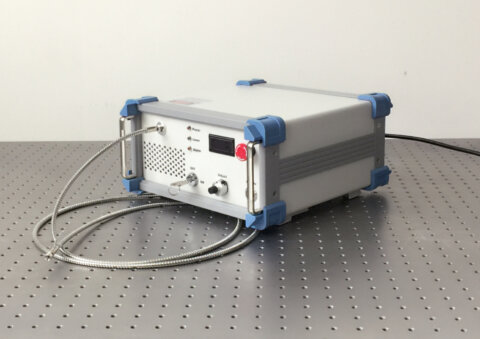
Installation requires space for a separate laser head and power supply, together with suitable ventilation and environmental control. The basic head measures 164 × 320 × 93 mm without an optional harmonic module, the power supply measures 470 × 390 × 140 mm, and the umbilical is 3 m long. The system is air cooled, operates from 100–240 V AC single phase at 50/60 Hz and consumes less than 600 W. The specified environment is 18–30 °C, 20–80% relative humidity without condensation, and room cleanliness no worse than ISO Class 9. The mains supply should remain connected continuously; after an interruption longer than one hour, a warm-up of several hours is required before switching on. These constraints should be included in the bench layout, enclosure design and facility power planning.
The range covers industrial processing and scientific use where short nanosecond pulses, variable repetition rate and selectable wavelengths are required. Listed processing applications include marking, micromachining, engraving, thin-film removal, laser cleaning, deposition, ablation and LCD or OLED panel repair. Scientific applications include spectroscopy, OPO pumping, remote sensing, photoacoustic imaging and LIBS-related material analysis. The sub-10 ns pulse duration, M² below 1.3 and external triggering can support controlled focusing and synchronisation, but suitability still depends on the material, optical arrangement and required pulse energy. A practical selection process should start with the target wavelength and pulse-energy threshold, then confirm the repetition rate, beam delivery and environmental requirements.