Highspeed-Kameras der Non High-G-Serie
- Technologie
- High-speed Kameras
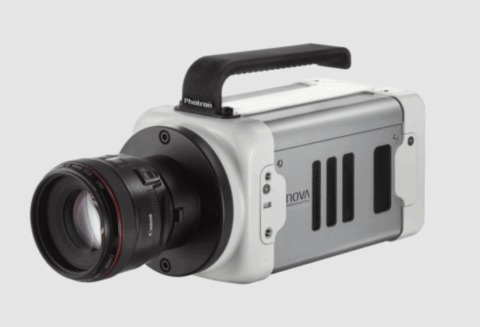
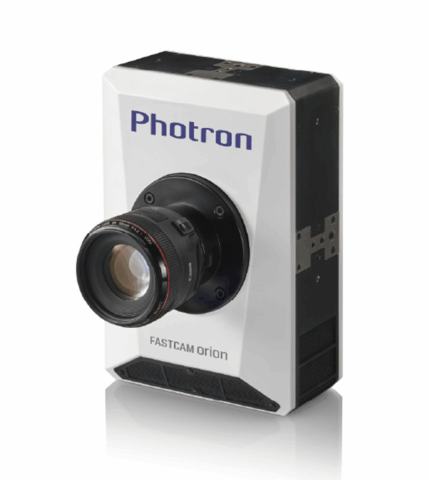
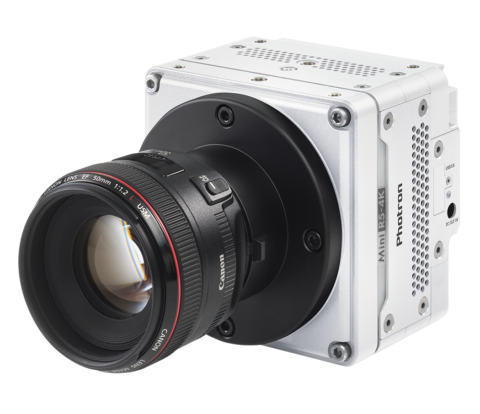
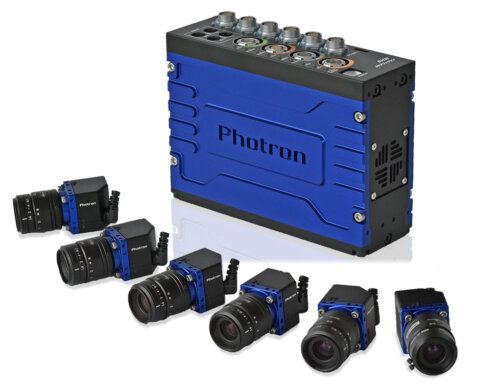
This product range brings together the J-PRI, L-PRI, M-PRI and PROMON 2000 HSR platforms for recording high-speed events in controlled environments without mounting the imaging equipment directly on a high-G test article. Typical applications include scientific research, manufacturing analysis, off-board automotive crash testing, airbag development, biomedical engineering, industrial troubleshooting and sports analysis. J-PRI prioritises spatial resolution and provides configurations up to 2560 × 1920.
L-PRI balances Full HD resolution with nominal frame-rate grades up to 3500 fps. M-PRI combines a 14 µm pixel sensor with nominal speed grades up to 4000 fps at 1280 × 800 for applications requiring greater light sensitivity. PROMON 2000 HSR combines a tethered monochrome camera head with direct non-volatile recording for extended Full HD acquisition. Adjustable image height enables substantially higher frame rates when a reduced vertical field of view is acceptable. Imaging Studio V4 supports camera configuration, live viewing, triggering, recording management, image processing and file export.
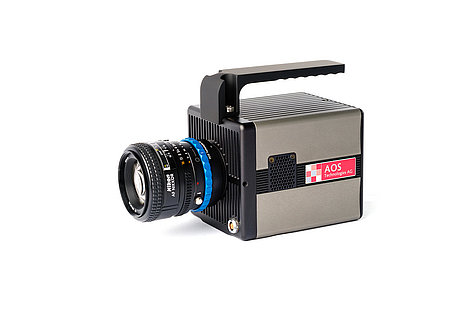
Eigenschaften
- Four imaging platforms: Match spatial resolution, speed, light sensitivity and recording duration to the application.
- Non-high-G laboratory construction: Suitable for off-board test rigs, research facilities and stationary industrial installations.
- Global-shutter CMOS sensors: Provide frame-wide exposure timing for analysing rapid movement.
- Adjustable vertical resolution: Enables higher frame rates when the application can use a reduced image height.
- Internal PRI-series memory up to 128 GB: Records short, high-speed events without requiring a separate recorder.
- PROMON recording capacity from 2 TB to 8 TB: Supports extended acquisition without repeatedly clearing internal camera memory.
- Pre-trigger, post-trigger and circular-buffer modes: Retain image data immediately before and after an event.
- Trigger, synchronisation and strobe connections: Support integration with test equipment and pulsed illumination.
- Imaging Studio V4 software: Provides parameterisation, live viewing, data handling, processing and export functions.
- Optional PRI battery and built-in SSD: Support portable operation and automatic sequence transfer.
- C, F and EF lens-mount options: Accommodate different sensor coverage, available lenses and remote lens-control requirements.
- J-PRI Pay-As-You-Record licensing: Temporarily activates higher configuration levels for defined 24-hour periods.
Verfügbare Modellvariationen
Alle verfügbaren Varianten und ein Vergleich ihrer Spezifikationen
Core range specifications
| Specification | Details |
|---|---|
Product type | Non-high-G high-speed camera range for controlled, laboratory and off-board use |
Platforms | J-PRI, L-PRI and M-PRI buffered cameras; PROMON 2000 HSR tethered camera and recorder |
Sensor technology | CMOS sensors with global shutters |
Image formats | J-PRI, L-PRI and M-PRI: monochrome or colour; PROMON 2000 HSR: monochrome |
Environmental classification | Laboratory use; not designed for high-G onboard installation |
PRI control interface | Gigabit Ethernet RJ45 |
PRI camera I/O | 14-pin circular push-pull connector; optional 19-pin single-connector interface |
PRI I/O tolerance | TTL-compatible I/O, tolerant up to 24 V |
PRI control signals | Trigger input, armed output, synchronisation input/output and strobe output |
PRI timing | IRIG-B available for frame synchronisation and time stamping |
PRI dimensions and weight | 98 × 98 × 118 mm; 1.5 kg |
PRI operating temperature | −5 °C to +40 °C |
PRI storage temperature | −40 °C to +70 °C |
J-PRI power | 10–36 V DC, 36 W |
L-PRI and M-PRI power | 10–36 V DC, 30 W |
PRI memory | J-PRI: 16, 32, 64 or 128 GB; L-PRI and M-PRI: 8, 16, 32, 64 or 128 GB |
PRI storage option | Built-in SSD up to 1 TB for automatic sequence transfer |
PRI battery option | BP-Uxx-compatible snap-on battery holder; stated operating time up to three hours |
PRI mounting | Three M6 threads on the top and bottom; 1/4-inch UNC tripod mounting point |
PROMON recorder memory | 2 TB standard, approximately 30 minutes at 1920 × 1080 and 1000 fps; up to 8 TB optional |
PROMON recorder dimensions and weight | 180 × 140 × 80 mm; 2 kg |
PROMON recorder I/O | 2.5 Gb Ethernet, BNC trigger input, USB 3.2 data connection and HDMI live-view output |
PROMON camera data link | 10 Gb image-data link; 5 m standard camera cable and up to 10 m optional |
PROMON recorder power | 19 V DC, 90 W |
PROMON order identifier | 782041-40-5500 |
Software | Imaging Studio V4 |
Range comparison
| Specification | J-PRI | L-PRI | M-PRI | PROMON 2000 HSR |
|---|---|---|---|---|
Architecture | Integrated buffered camera | Integrated buffered camera | Integrated buffered camera | Tethered camera head and recorder |
Highest listed full-resolution mode | 2560 × 1920 at 2060 fps | 1920 × 1080 at 3500 fps | 1280 × 800 at 4140 fps | 1920 × 1080 at 1000 fps, 8-bit |
12-bit Full HD mode | Not listed | Not listed | Not listed | 1920 × 1080 at 393 fps |
Highest listed reduced-height rate | 32,000 fps at 2560 × 64 | 76,400 fps at 1920 × 16 | 67,560 fps at 1280 × 16 | 50,847 fps at 1920 × 16, 8-bit |
Pixel size | 7.8 µm | 10 µm | 14 µm | 10 µm |
Sensor dimensions | 19.96 × 14.97 mm; 24.95 mm diagonal | 19.20 × 10.80 mm | 17.90 × 12.10 mm | 19.20 × 10.80 mm; 22.3 mm diagonal |
Stated sensitivity without gain | ISO 7200 mono; ISO 3000 colour | ISO 8000 mono; ISO 6000 colour | ISO 10,000 mono; ISO 8000 colour | ISO 8000 mono |
Bit depth | 10-bit mono; 30-bit colour | 10-bit mono; 30-bit colour | 10-bit mono; 30-bit colour | 8-bit or 12-bit |
Exposure adjustment | 2 µs to one frame period | 2 µs to one frame period | 2 µs to one frame period | 10 µs to one frame period |
Internal or recorder memory | 16–128 GB | 8–128 GB | 8–128 GB | 2 TB standard; up to 8 TB |
Lens interface | F mount; optional motorised EF mount | C mount; optional F or EF mount | C mount; optional F or EF mount | C mount with adjustable back focus; optional EF mount |
IRIG-B | Available | Available | Available | Trigger and synchronisation I/O provided; no IRIG-B function stated |
Frame rates depend on the selected speed grade, image height, bit depth and camera configuration. Model designations indicate nominal speed grades, while detailed performance data may list slightly higher frame rates at the corresponding resolution.
Model and configuration comparison
| Series or configuration | Full or nominal resolution | Nominal frame-rate grade |
|---|---|---|
J-PRI Configuration 1 | 1500 × 1125 | 2500 fps; higher with reduced image height |
J-PRI Configuration 2 | 2000 × 1125 | 2500 fps; higher with reduced image height |
J-PRI Configuration 3 | 2560 × 1920 | 2000 fps; 2060 fps listed in the detailed table |
L-PRI 1000 | 1920 × 1080 | 1000 fps |
L-PRI 1500 | 1920 × 1080 | 1500 fps |
L-PRI 2000 | 1920 × 1080 | 2000 fps |
L-PRI 3500 | 1920 × 1080 | 3500 fps |
M-PRI 1000 | 1280 × 800 | 1000 fps grade; 1090 fps listed in the detailed table |
M-PRI 2000 | 1280 × 800 | 2000 fps grade; 2150 fps listed in the detailed table |
M-PRI 3000 | 1280 × 800 | 3000 fps grade; 3250 fps listed in the detailed table |
M-PRI 4000 | 1280 × 800 | 4000 fps grade; 4140 fps listed in the detailed table |
PROMON 2000 HSR | 1920 × 1080 | 1000 fps at 8-bit; 393 fps at 12-bit |
Selected full-resolution recording-duration examples
| Configuration | Recording mode | 16 GB | 32 GB | 64 GB |
|---|---|---|---|---|
J-PRI Configuration 1 | 1500 × 1125 at maximum configuration rate | 2.4 s | 4.9 s | 9.9 s |
J-PRI Configuration 2 | 2000 × 1125 at maximum configuration rate | 2.0 s | 4.1 s | 8.3 s |
J-PRI Configuration 3 | 2560 × 1920 at maximum configuration rate | 1.5 s | 3.1 s | 6.2 s |
L-PRI 1000 | 1920 × 1080 at 1000 fps | 7.5 s | 15.0 s | 30.0 s |
L-PRI 3500 | 1920 × 1080 at 3500 fps | 2.1 s | 4.3 s | 8.7 s |
M-PRI 1000 | 1280 × 800 at the full-resolution rate | 14.2 s | 28.5 s | 57.0 s |
M-PRI 4000 | 1280 × 800 at the full-resolution rate | 3.7 s | 7.5 s | 15.0 s |
With 128 GB, the listed full-resolution recording times extend to 60 seconds for L-PRI 1000, 17 seconds for L-PRI 3500, 114 seconds for M-PRI 1000 and 30 seconds for M-PRI 4000. PROMON 2000 HSR uses a different recording architecture and provides approximately 30 minutes at Full HD and 1000 fps with its standard 2 TB recorder.
FAQs
für Highspeed-Kameras der Non High-G-Serie
No. This range is intended for non-high-G use and should not be treated as having a shock rating for onboard impact, sled or projectile installation. The J-PRI, L-PRI, M-PRI and PROMON 2000 HSR are identified for laboratory environments, and the individual platforms do not provide a G-shock trigger. They remain applicable to crash, airbag and impact studies when positioned off-board on a stationary support. In practice, the camera should be mounted outside the severe acceleration zone and protected against debris, vibration and cable strain. A purpose-designed high-G camera should be selected when the imaging device must travel with the test article.
Choose the platform by balancing image detail, full-resolution speed, available light and required recording duration. J-PRI provides the highest spatial resolution, reaching 2560 × 1920 at 2060 fps in Configuration 3. L-PRI provides 1920 × 1080 operation across 1000, 1500, 2000 and 3500 fps grades, while M-PRI prioritises sensitivity with 14 µm pixels and a 4000 fps nominal grade at 1280 × 800. PROMON 2000 HSR is the appropriate architecture when uninterrupted or extended Full HD recording matters more than an integrated camera body. The final choice should be checked against the required field of view, exposure time, recording duration and mounting arrangement.
M-PRI has the highest stated sensitivity within the colour-capable PRI platforms, at ISO 10,000 monochrome and ISO 8000 colour without gain. Its 14 µm pixels are larger than the 10 µm pixels used by L-PRI and PROMON 2000 HSR and the 7.8 µm pixels used by J-PRI. L-PRI is rated at ISO 8000 monochrome and ISO 6000 colour, while J-PRI is rated at ISO 7200 monochrome and ISO 3000 colour. PROMON 2000 HSR provides ISO 8000 monochrome sensitivity and a stated spectral range of 350–950 nm. Lens aperture, illumination wavelength, exposure time and acceptable motion blur must still be included in the lighting calculation.
Reducing vertical resolution is the principal method used to increase frame rate across this range. J-PRI Configuration 3 moves from 2060 fps at 2560 × 1920 to 32,000 fps at 2560 × 64, while L-PRI 3500 reaches 76,400 fps at 1920 × 16. M-PRI 4000 reaches 67,560 fps at 1280 × 16, and PROMON 2000 HSR reaches 50,847 fps at 1920 × 16 in 8-bit mode. The horizontal dimension remains comparatively wide, but the captured vertical field becomes progressively narrower. The test should therefore be framed so that the expected motion remains inside the reduced region of interest throughout the event.
Use J-PRI, L-PRI or M-PRI internal memory for short triggered events, and PROMON 2000 HSR when acquisition must continue for minutes rather than seconds. At full resolution, 64 GB provides 6.2 seconds for J-PRI Configuration 3, 8.7 seconds for L-PRI 3500 and 15 seconds for M-PRI 4000. Lower speed grades provide longer durations, including 57 seconds for M-PRI 1000 with 64 GB and 60 seconds for L-PRI 1000 with 128 GB. PROMON provides approximately 30 minutes at 1920 × 1080 and 1000 fps with 2 TB, with capacities up to 8 TB available. Recording time also increases when resolution or frame rate is reduced.
The PRI platforms provide a trigger input, armed output, synchronisation input/output and a strobe output for coordinating illumination. Their TTL-compatible I/O is tolerant up to 24 V, but signal levels and grounding should still be checked against the connected controller. J-PRI supports IRIG-B 122–127 AM and 002–007 DCLS for frame synchronisation and time stamping, while L-PRI and M-PRI also list IRIG-B timing support. PROMON 2000 HSR provides trigger, synchronisation input and synchronisation output connections together with software-based motion detection. For multi-camera testing, the required master clock, cable lengths, trigger polarity and propagation delays should be defined before installation.
J-PRI uses an F mount with an optional motorised EF interface, while L-PRI and M-PRI use a C mount with optional F and EF arrangements. PROMON 2000 HSR uses a C mount with adjustable back focus and offers an optional externally controlled EF interface. The PRI camera bodies measure 98 × 98 × 118 mm, weigh 1.5 kg and provide M6 and 1/4-inch UNC mounting points. J-PRI requires 10–36 V DC at 36 W, while L-PRI and M-PRI require 10–36 V DC at 30 W; a snap-on battery arrangement can provide up to three hours of operation. The PROMON recorder requires 19 V DC at 90 W and uses a separate tethered camera connection.
Pay-As-You-Record is a J-PRI-specific licensing method for temporarily enabling a higher resolution and speed configuration. A licence can unlock Configuration 2 or Configuration 3 for 24 hours from activation, allowing a basic camera configuration to operate at the licensed settings during that period. Activation is handled through Imaging Studio V4 and does not require an internet connection. Multiple licence keys do not have to be used on consecutive days, and a permanent upgrade can also be arranged. Unused keys should be stored securely because misplaced licence codes cannot be regenerated.