AIF13WAC 600W AC-DC Power Module Series
- Technology
- AC-DC uninterruptable power supplies
- Partner
- Artesyn / Advanced Energy
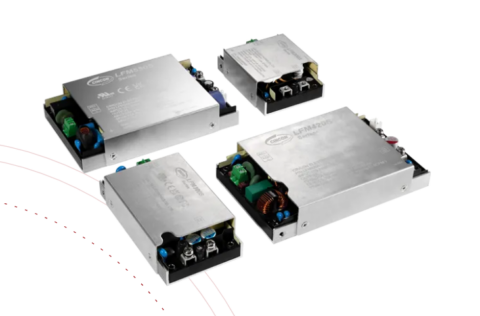
The AIF13WAC-01N series 600 W AC-DC full-brick power module provides a high-density power solution for industrial and telecom applications requiring reliable performance in harsh environments. Housed in a standard 2.4 × 4.6 inch full-brick package only 0.55″ tall, it delivers 600 W of isolated DC power at 48 V, along with a convenient 10 V auxiliary output for housekeeping needs. The module accepts a universal 86–264 VAC input (47–63 Hz), making it suitable for global mains voltages from 115 V to 230 V.
Designed for contact-cooled operation, it achieves up to 94% efficiency (typical at high line), allowing it to run at full load with baseplate temperatures up to 100 °C in sealed, fanless enclosures. Digital control via PMBus is built in, simplifying system integration by enabling remote monitoring, output adjustment, and configuration of key parameters. With features like internal inrush current limiting, active current sharing for parallel use, and comprehensive safety isolation, the AIF13WAC series is ideal for demanding applications such as 5G network equipment, telecommunications infrastructure, industrial robotics, and other sealed systems where efficient conduction-cooled power is essential.
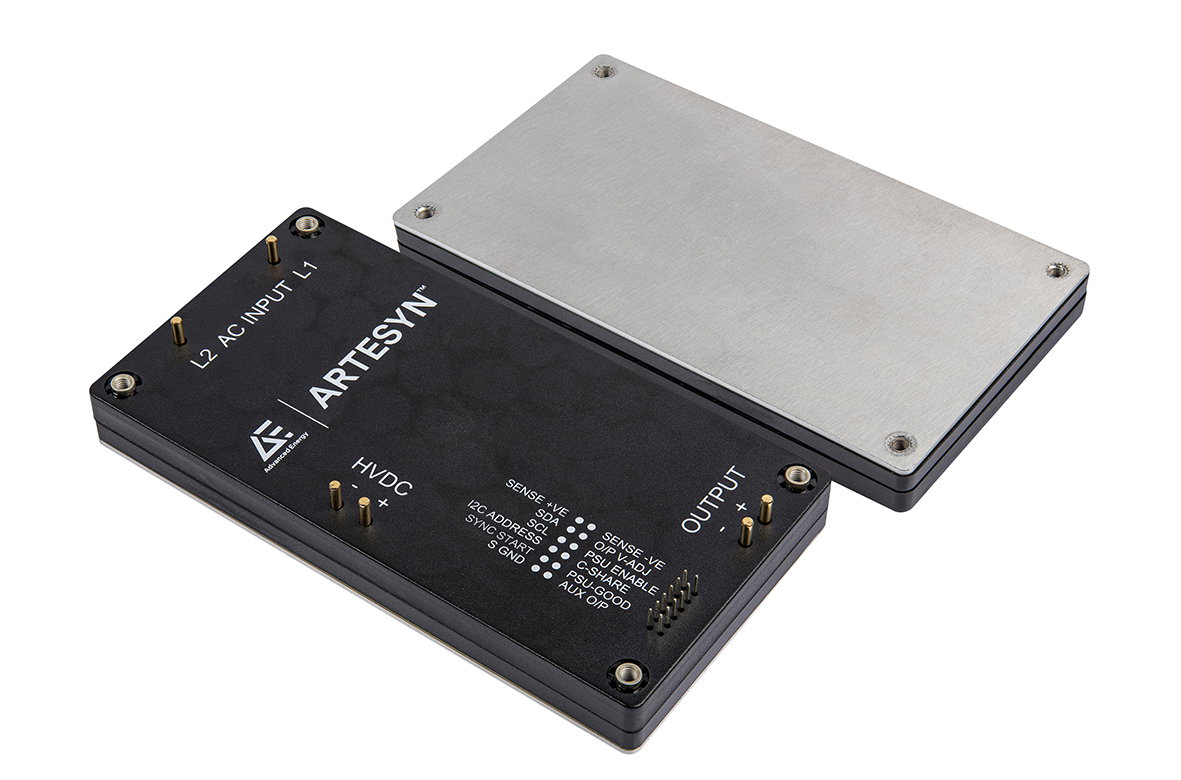
Range features
A high level overview of what this range offers
- Standard full-brick 2.4″ × 4.6″ size, 0.55″ height – Provides an easy upgrade path to 600 W without changing existing full-brick layouts or hardware
- Wide 86–264 VAC input range (47–63 Hz) – Supports all common worldwide AC mains voltages for versatile global deployment
- Up to 94% efficiency at high line – Minimises wasted heat and eases thermal management, particularly in sealed or fanless designs
- Contact-cooled baseplate design – Allows full 600 W output at up to 100 °C baseplate temperature, enabling reliable operation in high-temperature or sealed environments
- 48 V DC isolated main output (13 A) – Delivers a standard telecom/datacom voltage rail at 600 W, suitable for powering communication equipment and industrial systems
- 10 V/250 mA auxiliary output – Provides a convenient secondary supply for control logic, fans, or standby circuits without requiring an extra regulator
- Low output ripple (≤ 480 mVp-p) – Ensures a stable, clean DC output to support sensitive loads and reduce noise in the system
- Adjustable output voltage (−20% to +10%) – Allows fine tuning of the 48 V output to compensate for voltage drops or meet specific load requirements
- Remote sense capability – Maintains accurate voltage at the load by compensating for cable/connection losses, improving regulation in distributed systems
- Parallel operation up to 3 units – Supports active current sharing between modules for scaling output power beyond 600 W while maintaining load balance
- Internal inrush current limiting – Protects the input supply from surge currents at startup, eliminating the need for external surge limiting components
- PMBus digital interface – Enables remote monitoring, control, and fault reporting via standard digital power management commands for easy integration into intelligent power systems
- Remote on/off control (enable pin) – Simplifies system sequencing and safety interlocks by allowing the module to be enabled or disabled externally
- Power-good signal output – Indicates the health of the output voltage, facilitating reliable system monitoring and alarms
- High isolation design (4 kV DC input-to-output) – Safeguards end-user and equipment safety with reinforced electrical isolation between input and output (plus 2.5 kV input-to-baseplate and 1 kV output-to-baseplate)
- Comprehensive protection features – Built-in safeguards like over-voltage, over-current, over-temperature, and short-circuit protection ensure safe and robust operation under fault conditions
What’s in this range?
All the variants in the range and a comparison of what they offer
| Specification | AIF13WAC-01N | AIF13WAC-01NT |
|---|---|---|
AC Input Voltage Range | 86–264 VAC (47–63 Hz) | 86–264 VAC (47–63 Hz) |
DC Input Capability | 127–370 V DC (typical) | 127–370 V DC (typical) |
Output Voltage (Nominal) | 48 V DC | 48 V DC |
Output Current (Max) | 13 A (600 W) | 13 A (600 W) |
Auxiliary Output | 10 V DC @ 0.25 A | 10 V DC @ 0.25 A |
Efficiency (Typical) | Up to 94% (230 VAC in) | Up to 94% (230 VAC in) |
Output Ripple (Max) | 480 mV peak-to-peak | 480 mV peak-to-peak |
Isolation Voltage | 4000 V DC (In–Out){{BR}}2500 V DC (In–Baseplate){{BR}}1000 V DC (Out–Baseplate) | 4000 V DC (In–Out){{BR}}2500 V DC (In–Baseplate){{BR}}1000 V DC (Out–Baseplate) |
Parallel Capability | Up to 3 units (active current share) | Up to 3 units (active current share) |
Operating Temp. (Baseplate) | -40 °C to +100 °C (full power at 100 °C) | -40 °C to +100 °C (full power at 100 °C) |
Module Format | Full-brick, through-hole mount | Full-brick, through-hole mount |
Mounting Inserts | Threaded baseplate inserts | Non-threaded baseplate inserts |
FAQs
for AIF13WAC 600W AC-DC Power Module Series
Yes. The AIF13WAC-01N series supports active current sharing, allowing up to three modules to operate in parallel. This means you can connect two or three units to scale the output power beyond 600 W while maintaining balanced load sharing between modules. No additional external circuitry is required for current sharing – the feature is built-in, ensuring each module delivers its fair share of the load safely.
The two models are electrically identical in performance and specifications. The key difference lies in their mechanical mounting provision. AIF13WAC-01N versions come with threaded inserts in the baseplate, allowing you to use screws to mount the module to a heatsink or chassis. In contrast, AIF13WAC-01NT versions have non-threaded through-hole inserts, which may be preferable for certain mounting methods (e.g. using nuts and bolts or stand-off hardware). This choice gives you flexibility in how you mechanically integrate the module, depending on your assembly preferences.
Yes. The module features a PMBus digital interface, which is an industry-standard protocol for power management. Through the PMBus interface, you can monitor parameters like output voltage, output current, module temperature, etc., and also send commands to adjust the output voltage or configure settings. This allows remote monitoring of the power supply’s status and simplifies integration into intelligent systems or networked power management setups. The digital control capability helps in fine-tuning performance and implementing remote diagnostics or control schemes in your application.
Absolutely. The main 48 V output of the AIF13WAC module can be trimmed or adjusted from approximately –20% to +10% of its nominal value. This means you can lower the output to around 38 V or raise it up to about 52.8 V to suit your load’s requirements. Additionally, the module provides a remote sense function: you can connect sense wires from the module to the load point, and the converter will compensate for voltage drops across the connection. Using remote sensing ensures the load receives the correct voltage even if there is a voltage drop on the power leads, which is particularly useful in installations with long cables or high current draw.
The AIF13WAC is designed for contact-cooled operation, meaning it uses its baseplate to dissipate heat to an attached heatsink or the equipment chassis. It does not require direct air cooling or a fan, as long as the baseplate is properly thermally connected to a cooling surface. In fact, the module is rated to deliver full 600 W output at baseplate temperatures up to 100 °C, which indicates it can operate in high-temperature environments if appropriately mounted. For best results, you should attach the module’s flat baseplate to a heat-dissipating surface (using thermal interface material if needed). This conduction cooling approach is ideal for sealed or rugged systems where fans are undesirable or where the unit is enclosed (for example, sealed outdoor telecom equipment or mobile robotics power systems).
The AIF13WAC module comes with a suite of protection functions to ensure safe operation under various fault conditions. It includes over-current protection (OCP) to limit the output current if the load tries to draw too much, and over-voltage protection (OVP) on the output to prevent the voltage from exceeding safe limits. The unit also has over-temperature protection (OTP) – it will shut down if the internal temperature exceeds a safe threshold to prevent damage. Short-circuit protection is inherent, meaning the module will withstand a short on the output without permanent damage (usually by entering a safe hiccup or current-limited mode until the short is removed). Additionally, the built-in inrush current limiter protects against input surges at startup, and the power-good signal provides a logical indication that output voltage is within its regulated window. Together, these protections make the power supply robust and reliable in real-world conditions.
No, the AIF13WAC series does not require any minimum load to maintain regulation. The converter is designed to remain stable and keep its output within specification even at 0% load on the main output. This is advantageous for systems that have widely varying load conditions or periods of idle operation – you won’t need to waste energy on a dummy load to keep the power module in regulation. The module will smoothly regulate from no-load to full-load conditions.
Yes, it can. Internally, the AIF13WAC is an AC-DC converter that first rectifies AC into a high-voltage DC bus (around 380 V DC). You can therefore input DC directly within the appropriate range and the module will operate normally. The acceptable DC input range is approximately 127 V to 370 V DC, which corresponds to the same range as the 90–264 VAC RMS (after rectification). This means if you have a DC supply (for example, a 270 V DC bus or battery stack) within that voltage window, you can use it to power the module. Keep in mind that safety precautions still apply when using high-voltage DC. Also, without AC, the module’s input won’t have a frequency component, but that’s fine as long as the DC stays within range. Always consult the datasheet for any additional guidelines when using DC input, but in principle the unit supports both AC mains and high-voltage DC sources.
The integrated 10 V auxiliary output is a low-power secondary output provided in addition to the main 48 V output. Its purpose is typically to supply power for housekeeping circuits, control logic, or small loads within the system that need a stable lower-voltage supply. For instance, it might be used to power the fan of a power supply unit (though in this case the module is fanless, other system fans or controllers could use it), or to power remote monitoring and control boards, relays, or other support functions. The auxiliary output can provide up to 250 mA, which is enough for many control electronics. Having this aux output built-in means you may not need a separate bias supply module for those functions, simplifying the overall power architecture of your design.