RT Series DC/DC Converter 1 – 2W SMD (SMD8/SMD10)
- Technology
- DC-DC power supplies
- Partner
- RSG
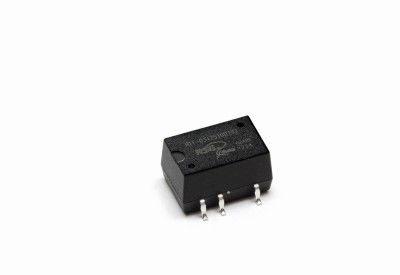
The RT Series is a compact SMT DC/DC converter family designed for space-efficient PCB integration using SMD packages with a DIL-style footprint concept. The product range covers low-power conversion at 1 W and 2 W levels across common input rails including 3.3 V, 5 V, 12 V, 15 V and 24 V options. Output selections include popular rails such as 3.3 V, 5 V, 6 V, 9 V, 12 V, 15 V and 24 V, depending on the specific variant. The family includes single-output and dual-output models, supporting simple single-rail designs as well as split-rail requirements using ± outputs. Isolation options are offered at 1.5 kVdc or 3.0 kVdc (variant-dependent), supporting designs that require galvanic separation. The naming logic supports systematic selection by input voltage code, output voltage code, output type and power class. RT Series DC/DC converter SMT modules are positioned for straightforward power distribution in compact industrial electronics.
Range features
A high level overview of what this range offers
- Compact SMT packages: SMD8 and SMD10 options for dense PCB layouts
- Unregulated conversion for efficient point power distribution at 1 W and 2 W levels
- Single and dual output options, including ± outputs on selected models
- Isolation choices up to 3.0 kVdc (variant-dependent) for galvanic separation requirements
- Broad coverage of common industrial input and output rails across the family
- Consistent selection logic via structured part numbering across RT Series DC/DC converter SMT modules
Downloads
for RT Series DC/DC Converter 1 - 2W SMD (SMD8/SMD10)
What’s in this range?
All the variants in the range and a comparison of what they offer
FAQs
for RT Series DC/DC Converter 1 – 2W SMD (SMD8/SMD10)
RT Series DC/DC converter SMT modules are designed for compact surface-mount power conversion in low-power applications. The range focuses on 1 W and 2 W unregulated modules with common industrial voltage options.
RT Series DC/DC converter SMT modules are offered in SMD8 and SMD10 packages. Package choice depends on the sub-series and the required output configuration.
Yes, RT Series DC/DC converter SMT modules include dual-output variants in the RT3 and RT7 sub-series. These models provide ± outputs to support split-rail requirements.
RT Series DC/DC converter SMT modules include isolation options at 1.5 kVdc or 3.0 kVdc, depending on the specific model. If a design has a strict isolation requirement, the isolation rating should be matched directly to the chosen part number.
The listed RT Series DC/DC converter SMT modules variants are unregulated. If regulation is required in the power architecture, a regulated converter family should be selected instead of assuming closed-loop control.
RT Series DC/DC converter SMT modules support common nominal input rails including 3.3 V, 5 V, 12 V, 15 V and 24 V, depending on the sub-series. RT1 and RT3 cover broader input options, while RT7 focuses on a reduced set.
Selection for RT Series DC/DC converter SMT modules is typically driven by input voltage, required output voltage, output type (single or dual) and isolation level. Matching these parameters to the model line in the specification table is the most reliable starting point.
For RT Series DC/DC converter SMT modules, final checks should confirm the exact input option, output option, power class and the isolation rating for the selected model. It is also sensible to confirm whether an unregulated output is acceptable for the downstream load requirements.