SM Series – Miniatur NIR/MIR Spectrometer
- Technology
- Spectrometers
- Partner
- Spectral Products
The SM241, SM301, and SM304 miniature NIR/MIR spectrometers are a versatile set of infrared analytical instruments for professional laboratory and industrial use. Together, they cover wavelengths from the near-infrared into the mid-infrared, so you can examine everything from NIR laser emissions to the spectral properties of chemicals and materials.
Each model is aimed at a slightly different job. The SM241 uses a CCD detector with a special up-conversion coating, which extends sensitivity into the NIR (up to ~1.7 µm) at an affordable cost. That makes it well suited to high-resolution NIR laser and molecular analysis. The SM301 uses a cooled PbS array (with an optional PbSe extended-range variant, SM301-EX) to push further into the SWIR/MIR range (1.0–3.0 µm, or up to 5.0 µm with the EX). It is a good fit for work such as low-intensity signal detection and mid-IR spectroscopy. The SM304 series uses a thermoelectrically cooled InGaAs array with up to 512 pixels, delivering extremely high signal-to-noise ratios across 0.9–2.5 µm. It is a strong choice for demanding tasks like moisture detection, semiconductor and photovoltaic material characterisation, and other broadband NIR/SWIR analyses.
All models share a compact, robust design and offer flexible optical input (free-space slit or fibre coupling), which helps when integrating them into experimental setups or OEM systems. With 16-bit dynamic range electronics, fast data acquisition, and Windows-based software/SDK support, they provide a capable, user-friendly option for a wide range of infrared spectroscopic applications.
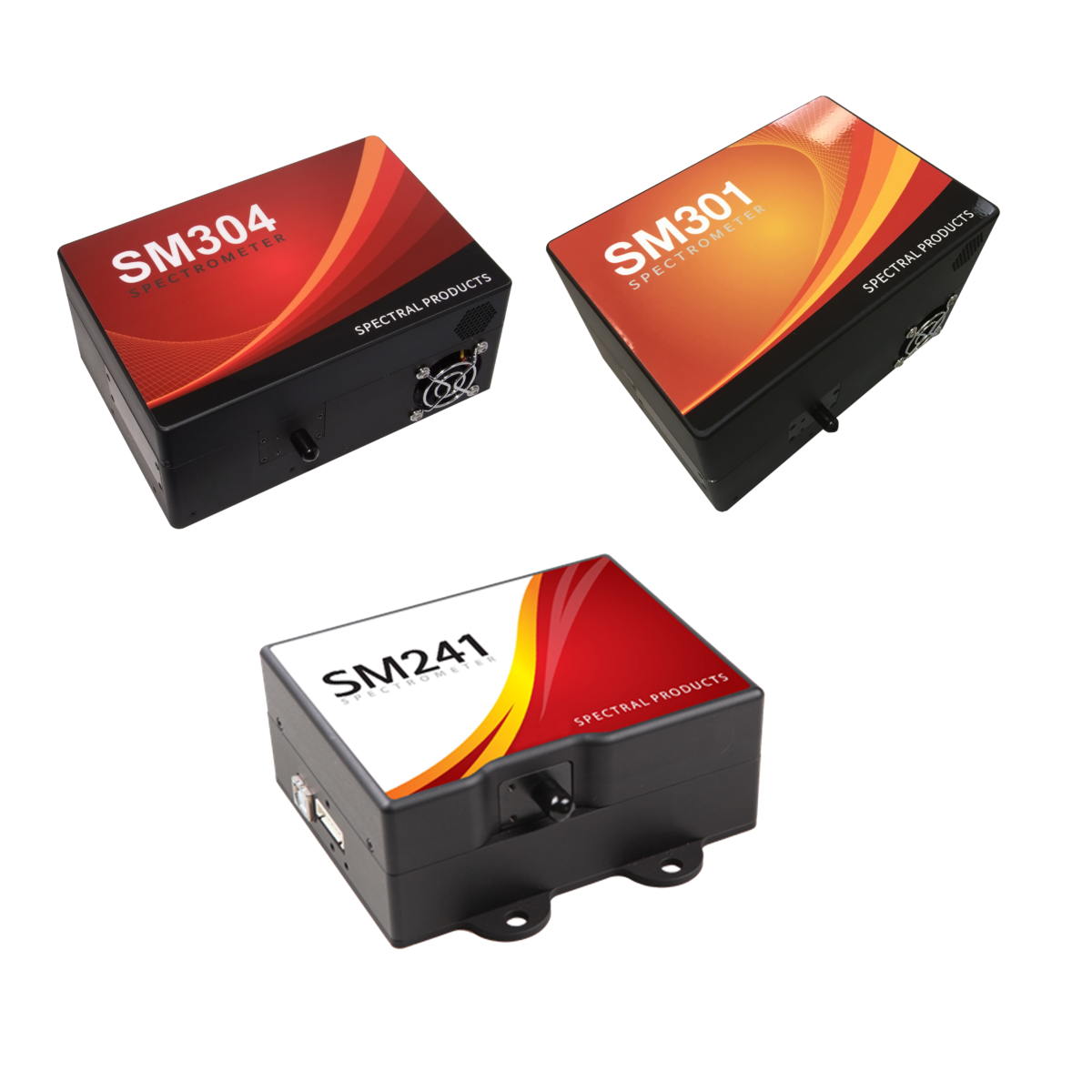
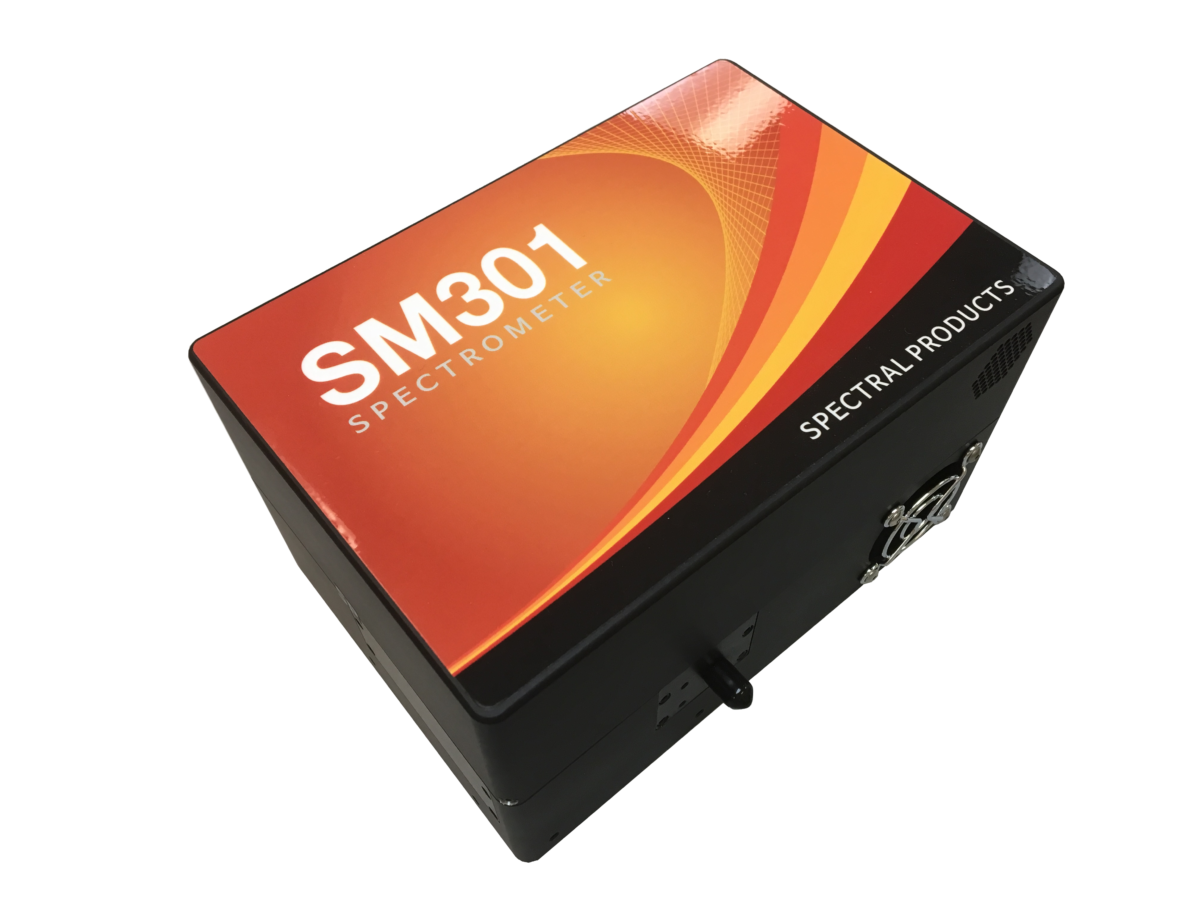
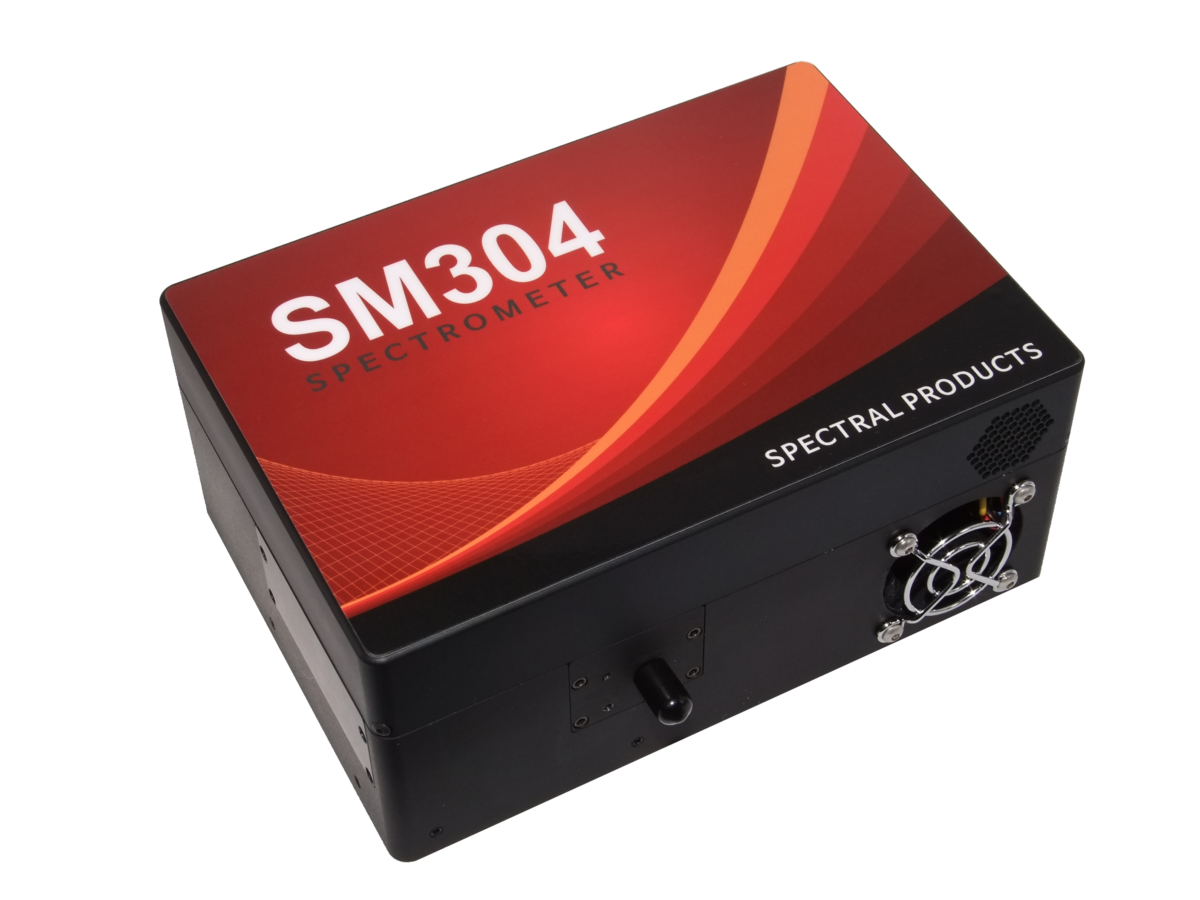
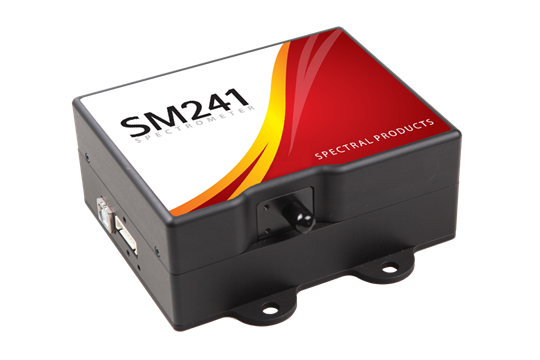
Range features
A high level overview of what this range offers
-
Wide Infrared Coverage – As a range, these spectrometers span ~0.9 µm to 2.5 µm (and up to 5.0 µm with the SM301-EX variant), covering both the near-infrared and mid-infrared regions. In practice, that means you can choose the right model to look at anything from NIR laser lines to mid-IR absorption bands in chemical samples.
-
Multiple Detector Technologies – Each model uses a different detector type, tuned to its operating range. The SM241’s up-conversion CCD (phosphor-coated) extends silicon CCD sensitivity beyond 1.1 µm into the NIR, offering a cost-effective alternative to InGaAs sensors for laser work. The SM301 uses a thermoelectric-cooled PbS array (with an optional PbSe variant for extended MIR) for stable, low-noise performance across 1–5 µm. The SM304 integrates a two-stage TE-cooled InGaAs array (256 or 512 pixels), delivering excellent sensitivity and very high SNR over 0.9–2.5 µm. This spread of detector options helps match performance to the spectral region and signal level you are working with.
-
High Spectral Resolution (Adjustable) – All models support interchangeable entrance slits (10 µm to 400 µm) and various gratings, so you can trade spectral resolution against light throughput. With a narrow 10 µm slit and the right grating, the SM241 can reach ~1 nm resolution in the NIR. The larger-area detectors in the SM301/SM304 typically deliver resolutions from around 3 nm up to 30 nm, depending on configuration. The key point is flexibility: you can tune for higher resolution to separate fine spectral features, or widen the slit to improve sensitivity in low-light conditions.
-
Thermoelectric Cooling & Low Noise – The SM301 and SM304 include built-in thermoelectric cooling (roughly -15 °C for PbS/PbSe, and -20 °C for InGaAs). Lower detector temperature reduces thermal noise and dark current, which matters most when you are pushing into the longer-wavelength SWIR/MIR range. In practical terms, you get a steadier baseline and can pick up weaker signals. For example, the SM304 achieves signal-to-noise ratios above 10,000:1 (single scan, no averaging), which makes it a good fit for low-signal measurements and quantitative analysis.
-
Multi-Channel & Fast Acquisition – Unlike scanning monochromators, these array-based spectrometers capture all wavelengths at once on their multi-pixel sensors, which makes measurements much faster. The SM301 and SM304 can run at high readout rates (up to 2 MHz pixel clock in the SM301), so you can acquire spectra quickly and average them in a short time. The system also supports multi-channel setups: up to 8 spectrometer units can be connected via USB and run in parallel. This is useful for multi-point or multi-specimen work, and it helps improve throughput in industrial or research environments.
-
Flexible Optical Input – Each spectrometer has a configurable optical input to suit different setups. Light can be coupled directly through a slit aperture for free-space beams, or via standard fibre optic connectors (SMA 905 or FC). This makes it straightforward to connect fibre-optic probes, remote sampling heads, or mount the unit directly to an optical bench. It also makes integration simpler whether you are sampling a laser beam, an LED, or the output of a fibre-coupled system.
-
Robust Compact Design – These instruments are miniature and portable, built with a sturdy optical bench and gold-coated optics for maximum IR reflectivity. The smallest model (SM241) is about 4.7 × 3.7 × 2.4 inches and weighs ~1.5 lbs, so it suits handheld use and tight mounting spaces. The larger cooled models (SM301/SM304) are still fairly compact (around 6.8 × 4.7 × 3 inches) and lightweight, which helps when fitting them into racks, field setups, or OEM devices where space is limited.
-
Included Software & SDK – Each spectrometer includes Windows-based software (SM32Pro/SMProMX) for acquisition, display, and analysis. It covers practical basics such as live spectrum viewing, data export, zooming, overlay comparisons, and measurements in absorbance, transmittance, or reflectance modes. For developers and system integrators, there is a full SDK with DLL libraries, plus example code (for example in VC++, LabVIEW, MATLAB), so you can integrate the spectrometers into your own software or automate measurements. The result is a setup you can use straight away for out-of-the-box measurements, with the option to customise later for more specific applications.
What’s in this range?
All the variants in the range and a comparison of what they offer
| Specification | SM241 (CCD-based) | SM301 (PbS array) | SM304 (InGaAs array) |
|---|---|---|---|
Detector Type | 2048-pixel CCD (with NIR phosphor coating) | 256-pixel PbS array, TE-cooled (≈–15 °C) | 256 or 512-pixel InGaAs array, two-stage TE-cooled (≈–20 °C) |
Spectral Range | 0.90 – 1.65 µm (NIR) | 1.0 – 3.0 µm (SWIR) {{BR}}1.5 – 5.0 µm with SM301-EX | 0.9 – 2.5 µm (NIR/SWIR variants) |
Spectral Resolution | ~1.0 – 10 nm (slit & grating dependent) | ~10 – 30 nm (slit & grating dependent) | ~3 – 10 nm (variant & slit dependent) |
f-number (Spectrograph) | f/3.5 | f/3.5 | f/3.3 |
Optical Input | Free-space slit or fibre-coupled (SMA905 / FC) | Free-space slit or fibre-coupled (SMA905 / FC) | Free-space slit or fibre-coupled (SMA905 / FC) |
Entrance Slit Options | 10, 25, 50, 100, 200, 400 µm widths | 10, 25, 50, 100 µm widths (25 µm default) | 10, 25, 50, 100, 200, 400 µm widths |
Min. Integration Time | 1 ms | 0.01 ms (10 µs) | 1 ms |
Signal-to-Noise Ratio | ~250:1 (at full signal) | Not explicitly specified |
|
Stray Light | < 0.1% (estimated @ NIR) | < 0.1% | < 0.01% (at 632 nm; ~0.05% average) |
Trigger Modes | Free-run or External trigger | Free-run or External trigger | Free-run, Software, External, plus TTL sync I/O |
Computer Interface | USB 2.0 (16-bit ADC, supports multi-channel) | USB 2.0 (16-bit ADC) | USB 2.0 (16-bit ADC, supports multi-channel) |
Dimensions (L×W×H) | 4.72″ × 3.74″ × 2.36″ (approx 120 × 95 × 60 mm) | 6.81″ × 4.72″ × 3.86″ (173 × 120 × 98 mm) | 6.81″ × 4.72″ × 2.95″ (173 × 120 × 75 mm) |
Weight | 1.5 lbs (0.68 kg) | 5.5 lbs (2.5 kg) | 4.5 lbs (2.0 kg) |
Order Sorting Filter | None required (n/a) | None (n/a) | Longpass or variable filter installed per range |
Note: SM301-EX is an extended variant of SM301 with a cooled PbSe detector for 1.5–5.0 µm MIR coverage. SM304 series includes models with either 256 or 512 pixel InGaAs arrays; higher pixel models (e.g. SM304-512) offer finer resolution at shorter max ranges, while 256-pixel models cover longer wavelengths up to 2.5 µm with slightly lower resolution.
FAQs
for SM Series – Miniatur NIR/MIR Spectrometer
The SM241 is ideal for near-infrared applications in the ~0.9–1.65 µm range that require high spectral resolution. Typical uses include analysis of organic compounds and moisture (water content) in solvents, NIR laser spectroscopy, and any measurements where a narrow bandwidth NIR source (like a laser) needs to be characterised with fine resolution (on the order of 1–2 nm).
Cooling the SM301’s PbS detector (to around -10 to -15 °C) greatly reduces its thermal noise and dark current. This leads to a higher sensitivity and a more stable baseline, which is crucial for accurate spectroscopic measurements in the 1–3 µm range (especially when detecting very low light levels or weak absorption features). In practice, the cooled detector allows the SM301 to deliver cleaner signals and better precision for low-intensity or high-noise applications compared to an uncooled equivalent.
Yes. The SM301-EX is an extended version of the SM301 that uses a PbSe detector array and is thermoelectrically cooled. It covers the mid-infrared range from approximately 1.5 µm to 5.0 µm. This model is well-suited for mid-IR applications such as analysing molecular vibrations in the fingerprint region, high-temperature process monitoring, or any scenario in the chemical/petrochemical industry where mid-infrared spectra are of interest. The cooling in the SM301-EX ensures that thermal background noise is minimised, which is especially important for MIR measurements.
The SM304’s InGaAs array detector offers excellent sensitivity in the extended NIR/SWIR range (roughly 0.9–2.5 µm). When cooled to -20 °C, it exhibits extremely low noise and can achieve very high signal-to-noise ratios (often exceeding 10,000:1 for a single quick scan). In practical terms, this makes the SM304 particularly effective for low-signal or high-precision applications. For example, it benefits photovoltaic and semiconductor research (e.g. characterising bandgaps and material absorption in the NIR), moisture or chemical analysis (detecting overtone/combination bands in the SWIR), and reflectance spectroscopy, where having both a broad spectral coverage and low noise is crucial. The high pixel count (up to 512) also allows finer spectral detail to be resolved compared to lower-resolution detectors.
The SM304 series provides the highest signal-to-noise ratio among these models. Thanks to its cooled InGaAs detector and high-quality optics, it can achieve SNR levels on the order of 7,500:1 up to 15,000:1 (depending on the specific variant and integration time) without averaging. This is significantly higher than the CCD-based SM241 (which has an SNR around 250:1 under similar conditions) and generally superior to the SM301’s performance. Therefore, if you need to detect very weak or low-light signals (for instance, in trace analysis or when measuring very small absorbance changes), the SM304 would be the recommended choice due to its exceptionally low noise floor and high dynamic range.
Yes. All three spectrometer models are designed to accept light either through a direct free-space slit or via fibre-optic coupling. They each support standard fibre connector adapters – typically SMA 905 or FC connectors – which attach to the entrance slit assembly. This means you can easily connect a fibre-optic cable to gather light from a remote sampling point or integrate the spectrometer with other fibre-based optical systems. The ability to use fibre coupling provides flexibility for setups where aligning a free-space beam is inconvenient or when you want to measure light collected from probes, integrating spheres, etc.
The spectral resolution is primarily determined by the entrance slit width (along with the grating in use). Each model allows you to swap the slit – for example, common options are 10 µm, 25 µm, 50 µm, 100 µm, etc. Using a narrower slit will improve the spectral resolution (resolving finer wavelength differences) but also reduces the amount of light entering, which can make the signal dimmer. Conversely, a wider slit increases light throughput (useful for low-light samples) at the cost of lower resolution (more wavelength blending). For instance, in the SM241 a 10 µm slit can yield around 1 nm resolution, whereas a 100 µm slit might give ~10 nm resolution but with significantly higher signal intensity. By choosing the appropriate slit width for your needs, you can trade off resolution versus sensitivity. Additionally, selecting an appropriate grating (with finer groove density for higher resolution over a smaller range, or vice versa) is another way to tune the resolution. All models come with multiple slit options and can be configured with different gratings to suit the desired spectral detail.
Yes. Each spectrometer in this range is supplied with a comprehensive Windows-based software package (commonly referred to as SM32Pro/SMProMX). This software allows you to control the device, acquire spectra, and perform basic analysis (such as switching between absorbance, transmittance, or intensity modes, doing baseline corrections, overlaying spectra, etc.). In addition to the user software, an SDK (Software Development Kit) is provided, including DLL libraries and programming examples (for environments like C++, LabVIEW, MATLAB, etc.). This enables integration of the spectrometer into custom applications, automation scripts, or OEM hardware setups. In short, out-of-the-box you have an easy graphical interface for measurements, and if needed you have tools for more customised or automated control through your own code.