Customised Nanocrystalline Cores
- Technology
- Nanocrystalline cores
- Partner
- Acal BFi kOr
Nanocrystalline ribbon is the standard core material for power components, mainly transformers for 1 – 80kHz, broad-band Common Mode Chokes (CMC), and high-permeable cores for RCDs and CTs replacing expensive NiFe and Co-amorphous materials.
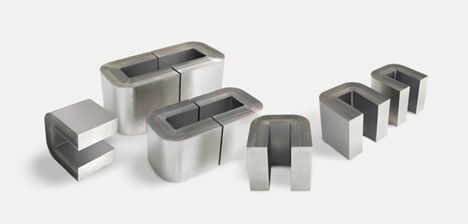
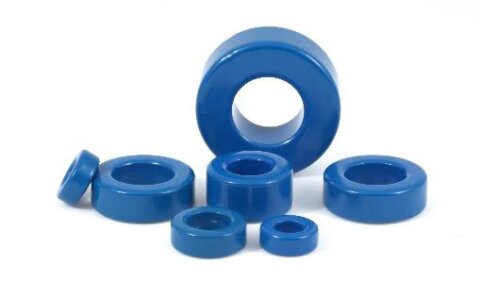
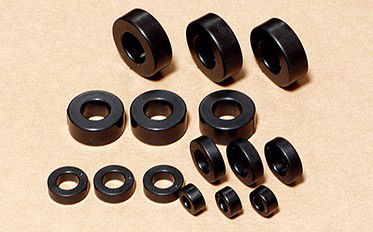
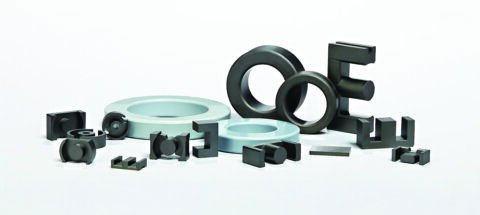
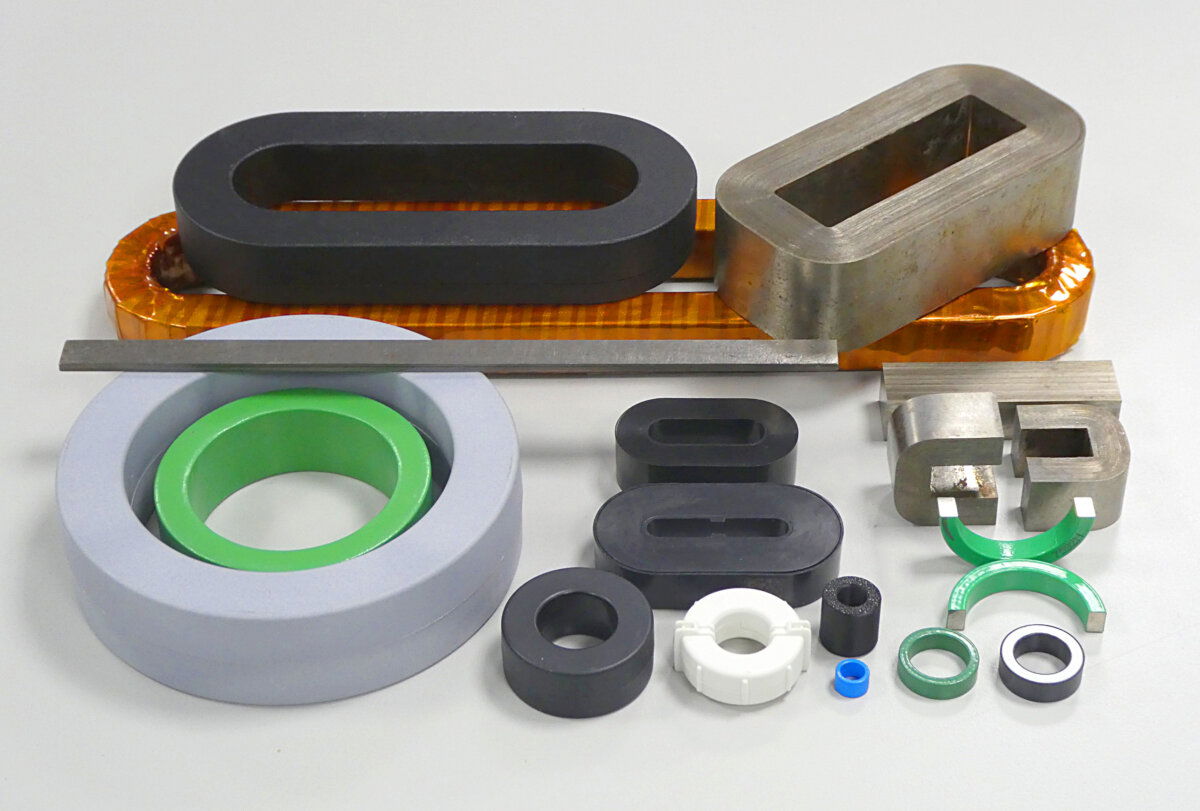
The core’s key features include high saturation induction (1,2 – 1,7 T), low core losses, and the possibility to tailor core shapes and magnetic properties. A wide variety of designs such as toroid, oval, rectangular cores, or blocks and strips can be produced from the rapid solidified ribbon material without complex tools.
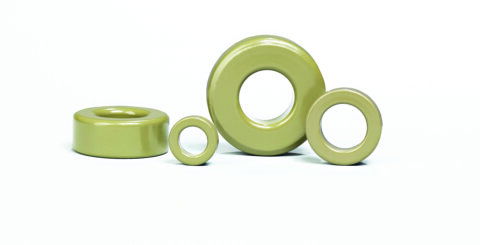
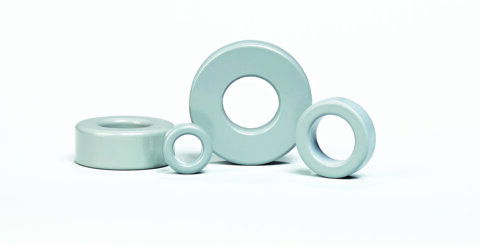
Initial permeabilities in the wide range from 250 to 250.000 can be achieved without cuts. There are many possibilities for protection and stabilisation such as plastic or metal housings (cases), epoxy coating, or epoxy impregnation complete the flexible options.
Range features
A high level overview of what this range offers
- Space-saving designs due to saturation induction 1,2 – 1,7T, which can be used for pure AC operation up to a few 10kHz due to the low losses
- Adjustable magnetic properties regarding hysteresis loop shape, permeability and remanence; for F-loop (linear, low remanence) initial permeabilities of 4000 – 200.000 are possible, for example
- Long-term stable up to 120 – 200°C depending on properties and operational conditions
- Standard sizes for toroids (in cases) and cut cores available
- Cost-efficient bespoke designs, sizes, magnetic properties even for small quantities
Downloads
for Customised Nanocrystalline Cores
What’s in this range?
All the variants in the range and a comparison of what they offer
| kOr 118 | kOr120 | kOr 120HF | kOr 120LP | kOr 122 | kOr 125 | kOr 140 | kOr 170 | |
|---|---|---|---|---|---|---|---|---|
Saturation induction Bs [T] at room temperature | 1.2 | 1.2 | 1.2 | 1.2 | 1.22 | 1,25 | 1.4 | 1.7 |
Saturation magnetostriction λs [ppm] | <1 | <0,5 | <0,5 | <0,5 | 2-4 | 2 | 3 | 15 |
Hysteresis loop shapes | R, F | Z, R, F | F | F | F | F | F | F/R |
For R-/F-loop: |
|
|
|
|
|
|
|
|
Initial permeability µi | 20.000 – 250.000 | 20.000 – 250.000 | 20.000 – 200.000 | 250 – 3000 | 4000 – 18.000 | 120.000 | 30.000 – 70.000 | ~10.000 |
Maximum permeability at 50 Hz | 500.000 | 500.000 |
|
|
| 250.000 |
|
|
Permeability at 100 kHz |
|
|
| same as µi | similar as µi |
|
| ~7000 |
Power losses at 10 kHz / 0,6 T [W/kg] (in case) |
| 5 | 3,5 |
| 6 | 6 | 5 | 20 |
Power losses at 100 kHz / 0,3 T [W/kg] |
| 60 | 40 |
| 90 | 70 | 65 |
|
Target frequency range (transformers) |
| 5 – 30 kHz | 20 – 80 kHz |
|
|
| 5 – 30 kHz | 1 – 8 kHz |
Usability for CMCs | – | + | ++ | – | + | o | o | – |
Usability for RCD devices and current transformers | ++ | + | – | DC-tolerant CTs | – | – | – | – |
|
|
|
|
|
|
|
|
|
Available ribbon width (core height) [mm] | 3 – 72 | 3 – 72 | 3 – 72 | 3 – 12 | 3 – 72 | 3 – 72 | 5 – 65 | 5 – 65 |
Cut cores, blocks available | – | + | – | – | – | – | + | + |
Reference materials | VITROPERM® VP400, 1K107 | VITROPERM® VP500/800, Nanoperm®, 1K107B,Finemet® FT-3 | VITROPERM® VP550HF |
| VITROPERM® VP250, VP270, VP712, Nanoperm®LM | K107A |
|
|
FAQs
for Customised Nanocrystalline Cores
Nanocrystalline magnetic cores often outperform traditional ferrite cores in key areas. They can achieve much higher initial permeability and a higher saturation flux density (for example ~1.2–1.7 T, versus around 0.5 T for ferrites). This means a nanocrystalline core can handle more magnetic flux (or current) before saturating, allowing a smaller core size or higher power handling for the same application. Additionally, nanocrystalline materials typically exhibit lower core losses at mid-range frequencies (tens of kHz) and maintain better performance at elevated temperatures, whereas ferrite cores tend to have increasing losses and can require larger safety margins as frequency and temperature rise. In short, nanocrystalline cores enable more compact, efficient designs, especially for high-power or broadband applications, compared to equivalent ferrite solutions.
Nanocrystalline cores are produced by rapidly solidifying a special metal alloy into a thin ribbon and then heat-treating it to form an extremely fine crystalline microstructure (grain sizes on the order of nanometres). The resulting material combines an amorphous-like uniformity with nanoscale crystal regions, giving it exceptional soft-magnetic properties. This manufacturing process yields very high permeability and low coercivity, along with minimal magnetostriction (mechanical strain from magnetisation). The unique structure is what provides nanocrystalline cores with their very low losses and high saturation induction. In practical terms, this means these cores can store and transfer magnetic energy more efficiently than conventional steel or ferrite cores, especially over a broad frequency range, while also exhibiting low audible noise and stable performance over time.
They are used in a range of power and electromagnetic interference (EMI) control applications that demand high performance in a compact form. Common uses include medium-frequency power transformers (operating from a few kilohertz up to a few tens of kHz) in converters and inverters, where the high saturation flux allows smaller transformer sizes. They are also widely used in common-mode chokes and EMI filters to suppress unwanted noise in power lines – the high permeability of nanocrystalline cores enables strong noise attenuation over broad frequency bands. Additionally, certain grades of nanocrystalline core are tailored for precision current transformers and sensing devices (for example in smart metering or residual current circuit breakers), because they can be made with near-zero remanence. In summary, any application that needs a compact, efficient magnetic component – from renewable energy systems and electric vehicles to industrial drives and power supplies – can benefit from customised nanocrystalline cores.
Yes. A key feature of the kOr nanocrystalline core range is the ability to produce cores in a variety of shapes, sizes, and form factors to meet specific customer requirements. The cores are initially wound as tape-wound rings from the nanocrystalline ribbon; from there, they can remain as toroidal cores or be cut and formed into C-cores, E-cores, oval shapes, rectangular blocks, or other geometries as needed. Different outer dimensions, inner diameters, and heights (stacking of tape layers) can be specified. The manufacturing process for these ribbon cores doesn’t require expensive moulds or tooling for each new shape, so even custom one-off or low-volume designs are feasible in a cost-effective way. This means you can get a core that fits your available space and mounting requirements exactly, rather than having to design around standard off-the-shelf core sizes.
Besides geometry, the magnetic characteristics of a nanocrystalline core can be tuned through material selection and heat treatment. By adjusting the alloy composition and the annealing conditions (such as temperature, duration, and whether a magnetic field is applied), the manufacturer can tailor the core’s key properties. For example, initial permeability can be set anywhere from a few thousand up to hundreds of thousands, depending on the target use – higher permeability is often beneficial for better inductance in chokes, while lower permeability or a controlled rectangular loop may be desired for current transformers to avoid saturation. Cores can also be annealed to exhibit different hysteresis loop shapes: F-loop cores have a “flat” loop with low remanence, ideal for applications like RCD sensors where the core must reset to zero magnetic flux; R-loop or Z-loop treatments produce very square or sharp saturation loops, which can support certain pulse transformer or storage applications. In short, through controlled processing, the same core geometry can be given different magnetic behaviors to best suit a specific circuit function.
The nanocrystalline cores in this range are designed to operate reliably across a wide temperature span suitable for industrial use. Typically, they maintain stable magnetic performance from normal ambient temperatures up to around 120 °C continuously, with some grades remaining stable to approximately 180–200 °C (as noted for certain material types). This high thermal stability is an advantage over many standard ferrite cores, which often have a more limited upper temperature range. It means these cores can be used in harsh environments – such as inside power converters, EV chargers, or aerospace electronics – without significant degradation of permeability or losses as the temperature rises. It’s always important to consult the specific material datasheet for the exact temperature ratings, but generally the kOr nanocrystalline cores handle elevated temperatures very well, thanks to their ferrous alloy composition and robust annealed structure.
Certain nanocrystalline core grades are indeed suitable for applications that involve a DC bias or unbalanced AC currents, but it depends on the material’s hysteresis loop design. In general, nanocrystalline cores saturate with DC much like other soft magnetic materials, but some variants are optimised to handle a small DC component without losing too much inductance. For instance, the kOr range includes materials that are not recommended for significant DC (marked as “no or small Iₙₛᵧₘ” usage), as well as a grade like kOr 122 which is formulated to tolerate medium to high unbalanced DC currents. When designing something like a choke that will carry DC (bias) plus AC, or a sensor core that might see offset currents, you should select a core material that is rated for such conditions. These specialised nanocrystalline cores have a different magnetic anisotropy to maintain inductance even with a bias. Always check the specific datasheet parameters such as the inductance drop vs DC bias curve for the chosen core material. Overall, if DC bias tolerance is needed, it’s important to choose the appropriate nanocrystalline grade (or consider an air gap in the core if using a high-permeability type) to ensure the device meets its performance requirements.