Lepton Series – LWIR Micro Thermal Camera Module
- Technology
- Infrared thermal cores
- Partner
- Teledyne FLIR
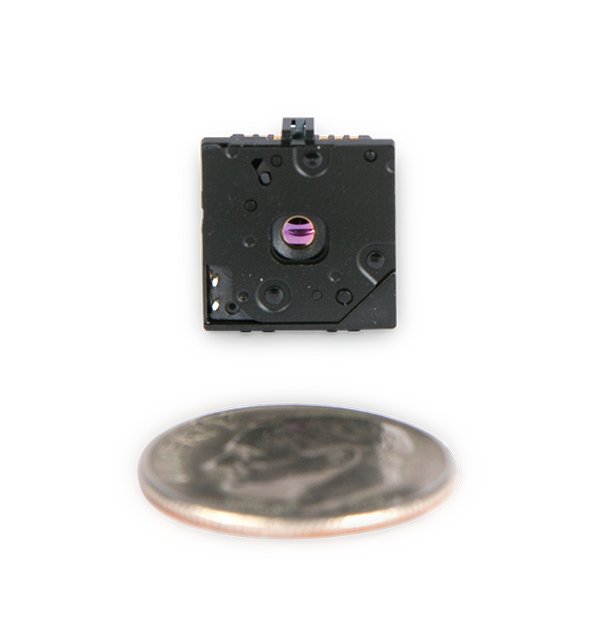
The Lepton series is a family of miniature long-wave infrared (LWIR) camera modules engineered for OEMs who need to add thermal imaging to their products without bulk or high cost. Each module is about the size of a coin, making it possible to embed thermal vision into smartphones, wearable sensors, drones, and other compact electronics. The series offers both 80×60 and 160×120 resolution models, including versions that provide calibrated temperature data (radiometric imaging) for every pixel. Despite their small form factor, Lepton cameras deliver reliable and detailed thermal imagery, thanks to high sensitivity (<50 mK NETD) and integrated image processing. A range of built-in lens options (from 50° up to 160° field of view) lets designers choose between narrow or wide coverage to suit different applications – from focused equipment monitoring to wide-area occupancy sensing. Low-power consumption (around 150 mW active, with standby modes of only a few milliwatts) means these modules run cool and are well-suited for battery-powered devices. Extensive integration support is provided – including reference designs, software libraries, and development kits – so product teams can prototype and deploy thermal capabilities quickly and with lower risk. In summary, the Lepton series brings affordable, high-volume thermal imaging to a broad range of smart building systems, safety and security devices, mobile gadgets, and industrial IoT sensors.
Range features
A high level overview of what this range offers
-
Multiple resolution options (80×60 or 160×120) – Choose between lower-resolution modules for basic thermal sensing or higher-resolution modules for greater image detail. Select models are radiometric, meaning they output accurate temperature values per pixel for precision monitoring.
-
High thermal sensitivity (< 50 mK NETD) – Capable of detecting minute temperature differences, the Lepton modules capture fine thermal details and subtle temperature changes that typical thermopile array sensors would miss. This high sensitivity translates to clearer images and more reliable detection of small heat anomalies.
-
Wide scene dynamic range (up to 450 °C) – Depending on the model, Lepton can measure scenes ranging from sub-zero temperatures to as high as 450 °C. This wide thermal range makes it suitable for diverse applications, from monitoring room-level temperature variations to spotting high-heat events like electrical faults or fires.
-
Integrated signal processing – Onboard digital thermal image processing delivers an optimised, stabilised thermal picture without requiring external processors. Each module handles functions like automatic gain control and non-uniformity correction internally (including a built-in shutter on most models for self-calibration), simplifying integration and ensuring consistent image quality.
-
Multiple lens FOV options (50°, 57°, 95°, 160°) – Available with a variety of built-in lenses, Lepton modules offer different horizontal field-of-view (FOV) angles from narrow 50° up to ultra-wide 160°. This flexibility allows you to select a narrow FOV for focusing on distant targets with more detail, or a wide-angle lens to cover broad areas (ideal for occupancy sensing or surveillance) in a single shot.
-
Ultra-compact size (~10.5 × 12.7 × 7.2 mm) – With dimensions only on the order of a cubic centimetre, a Lepton module is incredibly small. Its tiny footprint and light weight (~0.9 g without socket) mean it can be embedded in space-constrained designs and portable devices where traditional thermal cameras would never fit.
-
Low power consumption (~150 mW) – Lepton modules draw very little power, making them well-suited for battery-powered and wearable applications. Typical power usage is only about 0.15 W while operating, with a standby mode consuming under 5 mW to save energy when the sensor isn’t active. Even during an automatic calibration shutter event (which lasts ~0.5 s), power spikes only briefly (~650 mW), ensuring minimal impact on battery life. Additionally, the module runs on standard mobile device voltage rails (e.g. 2.8 V and 1.2 V supplies), simplifying power integration into handheld or wireless products.
-
High-volume reliability – Field-proven in millions of units worldwide, the Lepton series is mass-produced with rigorous quality control. It leverages the kind of robust manufacturing and testing standards found in consumer electronics, ensuring each module delivers consistent performance and long-term reliability even in volume deployments. This proven track record helps reduce development risk for new products.
-
NDAA-compliant, ITAR-free design – Lepton modules meet key government/commercial compliance requirements. They are NDAA compliant, meaning they are approved for use in U.S. government-related projects (not made by blacklisted entities), and ITAR-free, which greatly eases export and import restrictions. Integrators can deploy Lepton-based products globally without heavy regulatory obstacles, and with confidence in supply chain security.
-
Comprehensive integration support – A wealth of development resources is provided to speed up design cycles. OEMs get access to detailed datasheets, electrical/mechanical drawings, and a full integration toolkit including application notes, software drivers, and reference source code for platforms like Windows, Linux, Raspberry Pi and BeagleBone. There’s also a dedicated support centre and knowledge base to assist with troubleshooting and best practices. This extensive support ecosystem allows engineering teams to incorporate the Lepton module quickly and with lower engineering effort.
What’s in this range?
All the variants in the range and a comparison of what they offer
| Model | Resolution (pitch) | HFOV | Radiometric | Size |
|---|---|---|---|---|
Lepton 2.5 | 80 x 60 (17µm) | 50° | Yes | 11.8mm x 12.7mm x 7.2mm |
Lepton 3.0 | 160 x 120 (12µm) | 56° | No | 10.5mm × 12.7mm × 7.1mm |
Lepton 3.5 | 160 x 120 (12µm) | 56° | Yes | 10.5mm × 12.7mm × 7.1mm |
FAQs
for Lepton Series – LWIR Micro Thermal Camera Module
Radiometric Lepton modules output calibrated temperature values for each pixel, meaning they can measure actual object temperatures (within a certain range and accuracy). These modules (e.g. Lepton 2.5 and Lepton 3.1R) include an internal shutter and calibration data to provide real-time temperature readings across the scene. Non-radiometric versions (e.g. Lepton 3.5 and Lepton UW) produce a thermal image where pixel intensities correlate to relative heat, but are not absolutely calibrated – they’re useful for seeing heat patterns, but you would need an external reference or calibration if precise temperature measurements are required.
The Lepton series offers two core resolution configurations: 80×60 pixels (sometimes called Lepton 2.x) and 160×120 pixels (Lepton 3.x models). The 160×120 resolution modules provide a much finer thermal image with four times the number of pixels, allowing you to discern smaller details and cover a larger area with adequate resolution. The 80×60 modules, while lower in detail, are extremely cost-effective and sufficient for basic thermal detection tasks like presence sensing or spotting larger hot/cold spots. Both types have similar thermal sensitivity, but the higher resolution sensors, combined with their smaller pixel pitch (12 µm vs 17 µm on the 80×60), deliver a sharper and more detailed thermal picture when you need it.
Lepton modules come with a range of factory-configured lens FOV options to suit different applications. 50° FOV is a relatively narrow lens (standard on some 80×60 units like Lepton 2.5), focusing on a smaller area which can be useful for targeting distant objects or specific equipment. 57° FOV is a medium-wide view (common on Lepton 3.5) providing a balance between coverage and detail. 95° FOV is a wide-angle lens (as on Lepton 3.1R) ideal for covering larger areas or capturing more of a scene at once – for example, in security cameras or occupancy sensors to monitor an entire room. The widest option is 160° FOV on the Lepton UW, which is an ultra-wide fisheye-like lens capturing an extremely broad scene (such as an entire 180° hemisphere) – great for maximum coverage, though with significant distortion and lower effective resolution per area. In summary, a smaller FOV number (narrow lens) sees a tighter, more distant view with greater detail on a specific target, while a larger FOV (wide lens) sees a broader area which is useful for general monitoring or when you need to cover as much of the environment as possible.
Integrating a Lepton camera module is straightforward. The module mates via a standard 32-pin board-to-board connector (compatible with a Molex® 32-pin socket), and communicates using SPI for video data and a small I²C-like bus (CCI) for control commands. In practice, you supply power (the Lepton requires a few low-voltage rails, e.g. 2.8 V and 1.2 V) and connect the SPI lines to your microcontroller or processor to receive the live thermal video stream. The I²C connection is used to send commands or query status (for example, to perform calibrations or change settings). For development and prototyping, many engineers use a Lepton Breakout Board or similar adapter, which routes the Lepton’s pins to more accessible connections (and often includes power regulators) – this allows quick testing of the module on platforms like Raspberry Pi, Arduino, or PC interfaces before designing it into a custom PCB.
Yes – the Lepton is designed to be very power-efficient, which is one of the reasons it’s popular for mobile and handheld applications. In normal operation it typically draws around 150 mW of power or less, which is quite low for a thermal imager. In standby or low-power modes, it can sip as little as 4–5 mW (essentially negligible, allowing you to conserve energy when not actively capturing images). When the module performs an internal calibration (which involves a mechanical shutter, on radiometric versions), there is a brief power surge of up to ~650 mW, but this lasts only about 0.5 seconds and only occurs occasionally (you can control the frequency of these calibrations). Overall, the Lepton’s minimal power draw means it can run for long periods on a small battery – making it ideal for battery-operated IoT sensors, drones, wearable thermal cameras, and other portable uses.
The Lepton modules can detect a broad range of scene temperatures, though the exact range and accuracy depend on the model and whether it’s radiometric. For radiometric Leptons (like 2.5 and 3.1R), the typical calibrated temperature range in High Gain mode covers approximately -10 °C to +140 °C. This means these cameras accurately measure temperatures from about below freezing up to around the boiling point of water, which covers most normal environments and human/animal temperature ranges. They also have a Low Gain mode (automatically used when looking at hotter scenes) extending the measurable range up to around 450 °C – useful for viewing very hot objects like fires or machinery, albeit at a lower sensitivity/accuracy. Non-radiometric Leptons (3.5, UW) also detect heat far into these ranges (you will see very hot or very cold objects in the image), but since they don’t output absolute temperature values, you’d just interpret the relative intensities. It’s also worth noting the module’s operating temperature (the ambient temperature the camera itself can function in) is typically between about -10 °C and +80 °C. So, in summary, Lepton can handle and measure everyday temperature scenes easily, and even extreme heat up to a few hundred degrees Celsius in a limited way – which is impressive given its tiny size.