X6980 / X8580 HS INSB™ and HS SLS High-Speed MWIR Science-Grade Camera
- Technology
- Infrared R&D cameras
- Partner
- Teledyne FLIR
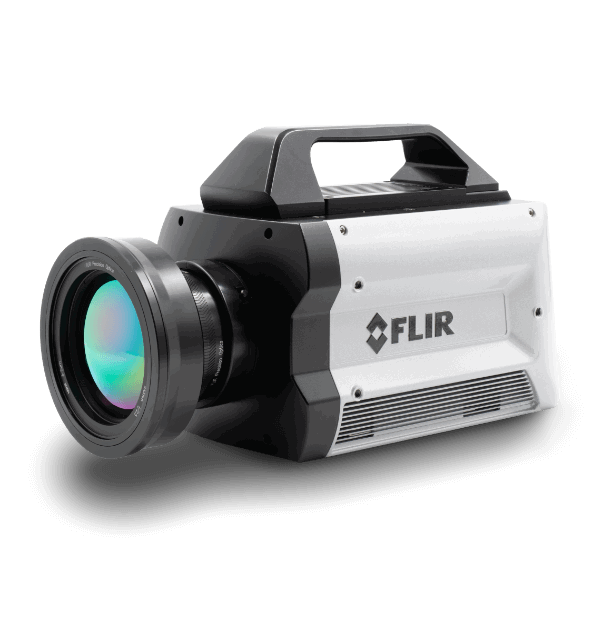
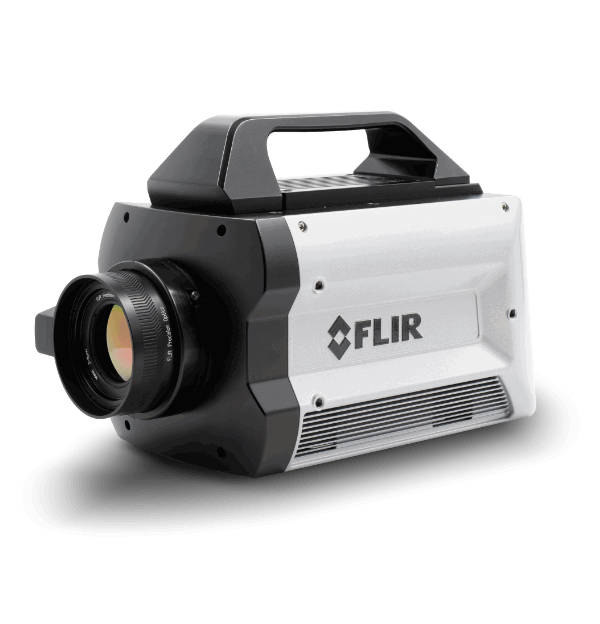
The X6980 HS and X8580 HS camera range is designed for engineers and scientists who demand no-compromise thermal imaging performance in challenging environments. These cameras capture crisp infrared imagery of fast events, making them ideal for applications like aerospace and defence testing, electronics diagnostics, material science (e.g. detecting failures in composites or solar cells), and any scenario where split-second thermal data is critical. Each model in the series is a cooled, science-grade camera: the InSb variants cover the midwave IR band (around 3–5 µm) for high-sensitivity detection of hot targets, while the SLS variants operate in the longwave IR band (around 8–12 µm) to capture thermal signatures of cooler objects or through certain obscurants. The X8580 HS models deliver a high-definition 1280 × 1024 resolution, revealing fine thermal details across the scene. In contrast, the X6980 HS models prioritise speed with a 640 × 512 sensor that can achieve blistering frame rates (over 1000 frames per second) for slow-motion thermal analysis. All cameras feature robust on-board recording and advanced synchronization, ensuring zero dropped frames and precise timing for every capture. Whether you need to study rapid heating in a lab experiment or record critical thermal events on a test range, the X6980/X8580 HS series provides the flexibility and performance to get reliable data every time.
Range features
A high level overview of what this range offers
- Ultra-fast frame rates – Capture events at up to ~1000 fps (full frame) with X6980 models, enabling slow-motion playback of extremely rapid thermal phenomena. Even at maximum resolution, the cameras ensure no critical moment is missed.
- High-resolution thermal imagery – X8580 HS models offer 1280 × 1024 HD resolution for detailed temperature mapping, useful when small hotspots or fine spatial details matter. The X6980’s 640 × 512 resolution comes with larger pixels for even greater thermal sensitivity, excelling in low-signal scenarios.
- Dual-band detector options – Choose between InSb detectors for midwave IR (≈3–5 µm) and SLS detectors for longwave IR (≈8–12 µm). This flexibility lets you target the spectral band that best suits your application – for example, midwave for high-temperature targets or longwave for ambient-temperature subjects – without sacrificing speed or quality.
- No dropped frames, extended recording – A built-in 4 TB removable SSD lets you record hours of high-speed thermal data with zero frame loss. This ensures critical test events are captured in full, and the data can be reviewed frame-by-frame later. High-speed interfaces (10 GigE, CoaXPress 2.1, Camera Link Full) also support live streaming or rapid data offload without bottlenecks.
- Precise timing & sync – An advanced timing system with IRIG-B timestamping, trigger in/out, and sync ports allows these cameras to integrate into complex test setups. You can synchronise frame capture with external events or multiple cameras with microsecond accuracy, which is vital for correlating thermal data with phenomena in high-speed experiments.
- Motorised focus & filters – Both X6980 and X8580 series support motorised infrared lenses and feature a 4-position motorised filter wheel. This motorisation simplifies remote operation, letting you adjust focus or switch spectral filters quickly during experiments. The result is sharper images and the ability to tailor the camera’s sensitivity (with neutral density filters) to different temperature ranges without manual intervention.
- Rugged, scientific design – Built around cooled photon detectors with 14-bit dynamic range, these cameras deliver accurate radiometric data for quantitative analysis. They are engineered for reliability (with long-life coolers) and operate over a wide temperature range, making them suitable for use in both laboratory and outdoor range environments. Comprehensive software support is provided for data analysis and camera control, ensuring a smooth workflow from capture to results.
What’s in this range?
All the variants in the range and a comparison of what they offer
| Specification | X6980 HS InSb (MWIR) | X6980 HS SLS (LWIR) | X8580 HS InSb (MWIR) | X8580 HS SLS (LWIR) |
|---|---|---|---|---|
Detector Type | Cooled InSb (Indium Antimonide) sensor | Cooled SLS (Strained Layer Superlattice) sensor | Cooled InSb (Indium Antimonide) sensor | Cooled SLS (Strained Layer Superlattice) sensor |
Spectral Range | 1.5 – 5.0 µm (midwave IR) | 7.5 – 12.5 µm (longwave IR) | 1.5 – 5.0 µm (midwave IR) | 7.5 – 12.5 µm (longwave IR) |
Detector Resolution | 640 × 512 pixels | 640 × 512 pixels | 1280 × 1024 pixels | 1280 × 1024 pixels |
Pixel Pitch | 25 µm | 25 µm | 12 µm | 12 µm |
Max Frame Rate (full frame) | ~0.0015 to 1004 fps (programmable) | ~0.0015 to 1004 fps (programmable) | ~0.5 to 181 fps (programmable) | ~0.5 to 181 fps (programmable) |
Thermal Sensitivity (NETD) | ~20 mK (typical) | ~40 mK (typical) | ~30 mK (typical) | ~40 mK (typical) |
Sensor Cooling Method | Closed-cycle rotary cooler | Closed-cycle rotary cooler | Linear Stirling cooler | Linear Stirling cooler |
Table: Key specifications for X6980 HS vs X8580 HS models in InSb and SLS versions. The X8580 offers higher resolution, while the X6980 offers higher maximum frame rates. InSb detectors cover midwave IR (MWIR) and typically exhibit lower NETD (higher sensitivity), whereas SLS detectors cover longwave IR (LWIR). All models use cooled detectors and support adjustable integration times (as short as ~270 ns) and flexible subwindowing for even higher frame rates.
FAQs
for X6980 / X8580 HS INSB™ and HS SLS High-Speed MWIR Science-Grade Camera
The key difference is the infrared wavelength range they cover. InSb (Indium Antimonide) detectors are sensitive to the midwave infrared band (approximately 1.5–5 µm, often 3–5 µm useful range). These are ideal for capturing high-temperature targets and fast thermal transients with very high sensitivity (NETD as low as 20 mK in the X6980 model). SLS (Strained Layer Superlattice) detectors operate in the longwave infrared band (around 7.5–12 µm). Longwave cameras can detect cooler objects and are useful for seeing thermal detail at ambient temperatures or through some obscurants like smoke. In general, InSb cameras will have slightly better sensitivity and are suited for hotter or mid-temperature phenomena, while SLS cameras allow you to measure thermal scenes that emit most strongly in the longwave spectrum. Both types in the X6980/X8580 series are science-grade cooled detectors, meaning they offer precise, calibrated temperature measurement; the choice simply depends on the spectral region of interest in your application.
The X8580 HS models provide a higher spatial resolution (1280 × 1024 pixels) for more detailed images, whereas the X6980 HS models have a lower resolution (640 × 512 pixels) but can achieve much higher full-frame speeds. In practice, the X8580 can capture full-frame at up to ~181 fps, while the X6980 can reach ~1000 fps at full frame. So if your priority is maximizing frame rate to capture extremely fast events, the X6980 is the better choice. If you need finer image detail to resolve small thermal features and your events can be recorded at a few hundred frames per second or less, the X8580 would be advantageous. Both share many features (such as the same storage, interface, and software capabilities), so the decision mainly comes down to resolution vs. speed for your use case.
At full sensor resolution, the X6980 HS can capture at approximately 1004 frames per second, and the X8580 HS at around 181 frames per second. These frame rates are programmable and can be adjusted to suit the experiment’s needs. If an even higher frame rate is required, both cameras support subwindowing, where you read out a smaller region of interest on the sensor. By reducing the number of pixels (for example, using a small subset of the frame), the cameras can achieve significantly higher frame rates (potentially many thousands of frames per second) because there is less data per frame to read out. This allows researchers to capture extremely high-speed phenomena in a small area of the frame. The exact maximum depends on the window size, but the cameras are designed to give users lots of flexibility in trading off resolution for speed when needed.
Yes. The X6980/X8580 HS series are fully radiometric thermal cameras, meaning each pixel output corresponds to a calibrated temperature value (within the stated accuracy). They have a standard temperature measurement range of about –20°C to +300°C when using the standard optics and calibration. This covers typical ambient to moderately hot objects. For higher temperature targets, you can equip the cameras with optional neutral density filters (or use the factory optional calibrated ranges) to extend the measurable range. For instance, using filter optics (ND filters), you can measure up to +600°C (ND1 filter) or up to +1500°C/2000°C/3000°C with higher-grade filters, depending on the model (the InSb variants offer options like 600°C, 2000°C, 3000°C ranges). In summary, the cameras can accurately measure temperatures from sub-zero up to several hundred degrees standard, and into the thousands of degrees with the appropriate filters and calibrations. The measurement accuracy is typically within ±2°C (or ±2% for higher temps), with even finer precision (±1°C/±1%) under certain conditions, making these cameras suitable for detailed thermal analysis tasks.
The X6980/X8580 series was engineered to stream and record data at full frame rates without loss. To achieve this, the cameras feature a high-bandwidth data path and on-board storage. Specifically, they come with a built-in 4 TB solid-state drive (SSD) onto which thermal data can be recorded directly in real time. This internal SSD is fast and large enough to capture over an hour (in fact, for X6980 around 1.5+ hours, and about 2+ hours for X8580 at their top rates) of continuous frames with zero dropped frames. Additionally, the cameras have advanced interfaces like 10 Gigabit Ethernet, CoaXPress 2.1, and Camera Link Full. These interfaces support rapid data transfer to a connected PC or receiving system if you choose to stream instead of (or in addition to) recording on the SSD. The combination of a dedicated, high-speed recorder and state-of-the-art interface options means that even at very high frame rates and data rates, you won’t lose frames – every bit of your thermal data is captured reliably for analysis.
Yes, the X6980 and X8580 are equipped with comprehensive synchronisation and trigger features. They include trigger input and output ports, plus a precise timing system. You can input an external trigger to start or sync frame capture with an event (for example, a blast, a mechanical impact, or any lab trigger signal), ensuring the camera’s frames align exactly with the moment of interest. They also provide a synchronization output if you want the camera to drive other instruments or strobe lights in sync with its frame capture. Moreover, the cameras support IRIG-B time stamping, which is a common precision timing signal used in test ranges. With IRIG, each frame can be stamped with an absolute time (to the microsecond level), making it easy to correlate the thermal data with other data sources or timeline events. This is particularly useful when using multiple cameras or instruments together – all devices can share the same time base. In short, these cameras are very flexible for integration: you can synchronize multiple cameras together for multi-angle shots, or sync with external events, ensuring every frame is captured at exactly the right moment.
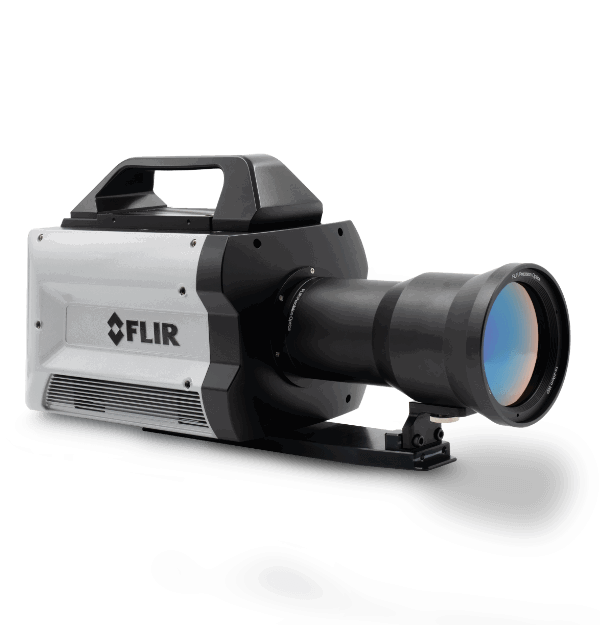
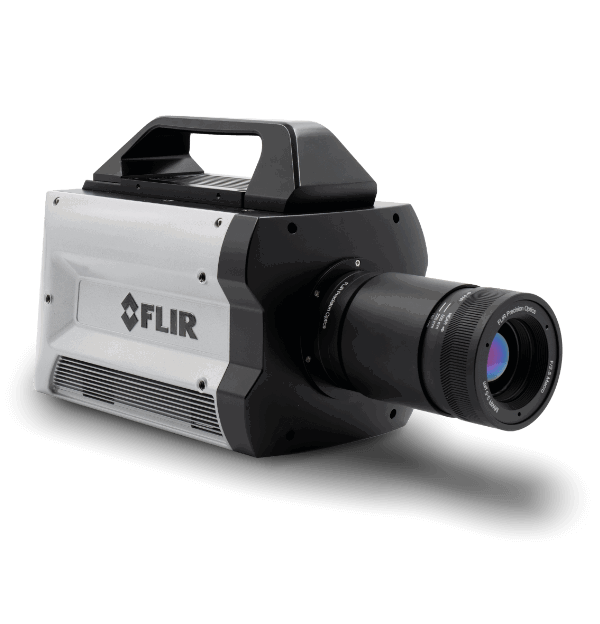
The X6980/X8580 series supports a range of interchangeable lenses to accommodate different fields of view and distances. Lenses of varying focal lengths (for example, common options include 25 mm, 50 mm, 100 mm, and even up to 200 mm for telephoto needs) are available. Importantly, the camera platform is compatible with motorised focus lenses. This means you can remotely adjust focus through software or the camera’s control interface, which is extremely convenient when the camera is in a hard-to-reach location or when you need to quickly refocus between experiments. In addition to focus, the cameras come with a motorised 4-position filter wheel in front of the detector. This allows you to insert different filters (such as spectral filters or neutral density filters for high-temperature measurement) without manually disassembling anything – you can switch filters with a command. The combination of motorised focus and filter wheel makes the system very adaptable: you can automate focus adjustments during a test and cycle through filters as needed, all while the camera remains sealed and stable. Overall, the lens selection ranges from wide-angle to high-magnification optics (including microscope and close-up lenses for small targets), ensuring you can optimise the camera’s view and focus for virtually any scenario.