4-Wire AC/DC-Powered Splitters
- Technology
- Industrial I/O Modules & Embedded Interfaces
- Partner
- Acromag
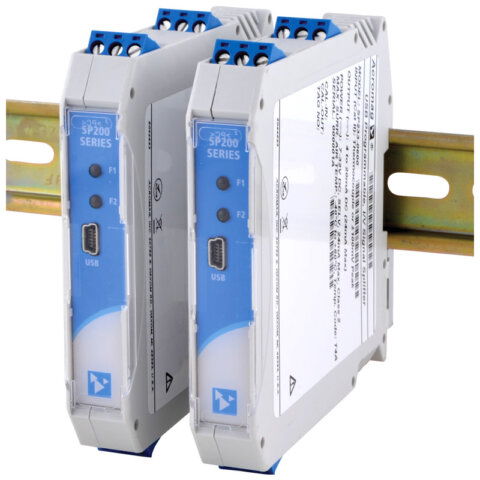
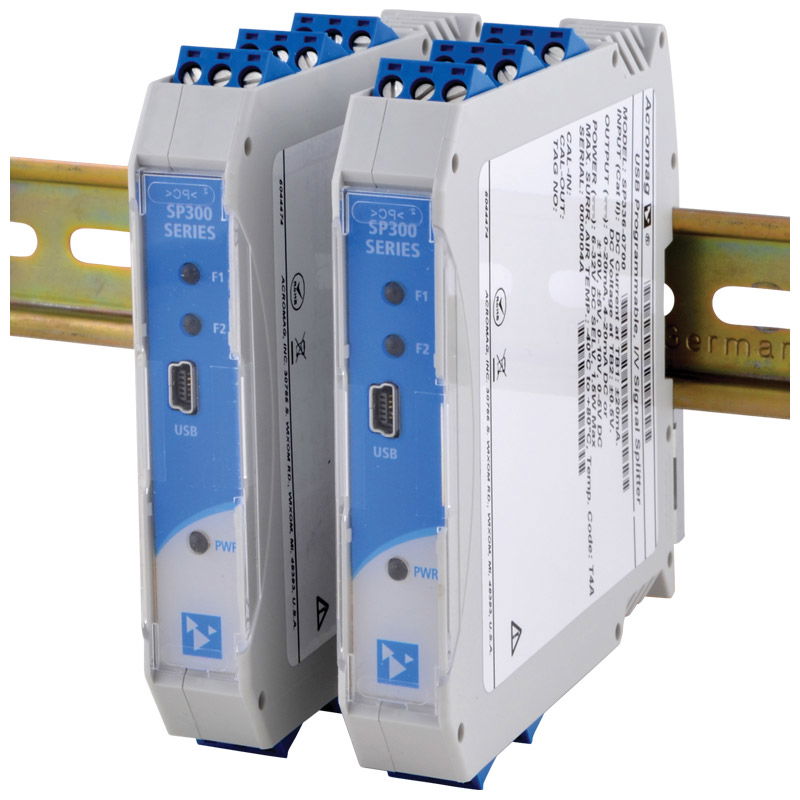
Designed for industrial process control and automation, these 4-wire AC/DC signal splitters provide a convenient way to drive two separate instruments from one sensor signal. The range includes the 633T module and the SP333/SP336/SP337/SP338 models (SP330 series), covering virtually any input type – from 4–20 mA loops and DC voltages to thermocouples and even high-level signals. Each unit isolates and duplicates the input, delivering two identical outputs (such as 4–20 mA or voltage) for simultaneous use in different systems.
This allows an operator to send one measurement to a primary control system while also feeding a secondary device (like a data logger or local display) without interference or signal degradation. Built for harsh environments, these splitter modules feature rugged industrial-grade construction, wide operating temperature ranges, and strong immunity to electrical noise. In short, they ensure accurate, noise-free signal sharing across multiple devices – an essential function in chemical plants, factories, energy facilities, and any application requiring reliable signal isolation and distribution.
Range features
A high level overview of what this range offers
-
Dual isolated outputs from one input – Split a single sensor signal into two independent, identical outputs, enabling one process variable to be sent to two different systems without loading or interference.
-
Wide input signal versatility – Models accommodate various input types (4–20 mA current loops, ±mV signals, process voltage levels, thermocouple sensors, etc.), providing flexibility to interface with many sensor/transmitter types using a suitable module.
-
Galvanic isolation up to 1500 V – High-voltage isolation safely separates input, outputs, and supply power. This protects equipment from surges, eliminates ground loop errors, and reduces electrical noise, ensuring stable and accurate readings.
-
Broad output range options – Each splitter supports multiple standard output ranges (including 4–20 mA, 0–20 mA, 0–5 V, 0–10 V, ±5 V, ±10 V). Scalable outputs and normal/reverse action settings let you tailor the output signals to your control system’s requirements.
-
Wide power range & redundancy – Operates from a low-voltage DC supply (6–32 V), with the 633T also accepting 90–250 V AC. Power can be wired via the terminal block or a DIN-rail bus (on SP series) – or both for redundant power backup. This flexible powering simplifies installation in diverse setups.
-
Integrated excitation supply (633T model) – The 633T unit includes an isolated 24 VDC transmitter supply that can power one or two 2-wire field transmitters. This built-in excitation means you won’t need an extra power source for loop-powered sensors, saving cost and panel space.
-
Easy configuration & calibration – SP330 series modules offer plug-and-play setup via USB using free Windows software or a mobile app (Agility™ for Android). This allows quick range scaling, calibration, and filter settings through a user-friendly interface. (By contrast, the 633T provides multi-turn trim pots for fine analogue calibration on-site.)
-
Excellent accuracy and stability – High-precision design with low drift ensures reliable performance even in demanding conditions. These splitters maintain signal integrity over time and temperature, so you can trust the output readings for critical processes.
-
Rugged industrial design – Housed in slim DIN-rail mount enclosures (as narrow as 17.5 mm for SP series), they save panel space and feature pluggable terminals for easy wiring. The modules withstand shock (up to 25 g) and vibration (4 g) and operate over a wide temperature range (e.g. -40 to 75 °C), suitable for harsh factory and outdoor environments.
-
Safety approvals – Engineered to meet stringent safety standards, SP330 series units are CE compliant and certified for UL/cUL Class I Division 2 and ATEX/IECEx Zone 2 (hazardous areas). This provides confidence when deploying in industrial hazardous locations.
What’s in this range?
All the variants in the range and a comparison of what they offer
Model | Input Types & Ranges | Output Ranges | Power Supply |
633T (600T series) | 4–20 mA DC current (single channel input) | Two 4–20 mA outputs (isolated current loops) | 12–36 V DC or 90–250 V AC (model options) |
SP333 (SP330 series) | Thermocouple (Types J, K, T, R, S, E, B, N) or ±100 mV DC | 0–20 mA, 4–20 mA; 0–5 V, 0–10 V; ±5 V, ±10 V | 6–32 V DC (external supply) |
SP336 (SP330 series) | ±20 mA DC; ±500 mV DC; 0–20 A AC (with external current sensor) | 0–20 mA, 4–20 mA; 0–5 V, 0–10 V; ±5 V, ±10 V | 6–32 V DC (external supply) |
SP337 (SP330 series) | ±1 V, ±5 V, ±10 V DC (process voltage input) | 0–20 mA, 4–20 mA; 0–5 V, 0–10 V; ±5 V, ±10 V | 6–32 V DC (external supply) |
SP338 (SP330 series) | ±15 V, ±75 V, ±150 V DC (high voltage input) | 0–20 mA, 4–20 mA; 0–5 V, 0–10 V; ±5 V, ±10 V | 6–32 V DC (external supply) |
FAQs
for 4-Wire AC/DC-Powered Splitters
A 4-wire signal splitter has a separate power supply input (typically an external DC supply or AC power), whereas a 2-wire (loop-powered) splitter draws its power from the 4–20 mA loop itself. The 4-wire design (used by the 633T and SP330 series) allows driving two isolated output loops with full signal power and stability, and it can accommodate a wider range of input types. In contrast, a loop-powered splitter is simpler but only suitable when both power and signal share the same loop and typically can only source one additional loop output with limited drive capacity.
The modules use high-quality isolation amplifiers and precision electronics to ensure the two output signals faithfully replicate the input. Galvanic isolation (1500 V) between input, outputs, and power prevents ground loop errors and noise coupling. Each output channel is independently regulated and buffered, so loading one output (within the specified load resistance) won’t affect the other channel. The result is that both output signals remain accurate and stable, closely tracking the original input within the module’s specified accuracy and drift limits.
Yes – certain models in the range are designed for low-level sensor inputs. For example, SP333 accepts direct thermocouple inputs (Types J, K, T, R, S, E, B, N) or small ±100 mV signals. It internally cold-junction compensates and linearizes thermocouple inputs, producing two scaled outputs (current or voltage) proportional to the temperature. Other models like SP336 handle DC current (±20 mA) or millivolt shunt signals, and SP337/SP338 accept higher voltage inputs. By selecting the appropriate model, you can interface a variety of sensors (from thermocouples and RTDs via transmitters, to process transducers) and split their signal to two outputs.
The SP330 series splitters (SP333, SP336, SP337, SP338) are fully software-configurable for ease of use. You simply connect a standard USB cable from the module to a PC and launch the free configuration utility (Windows software) or use the Agility mobile app on an Android device. The software provides a user-friendly interface to select the input type/range, output ranges (which can be set the same or different for the two outputs), filtering level, and perform calibration or field adjustments. This eliminates the need for manual DIP switches or pots. Once configured, settings are stored in non-volatile memory on the unit. (The older 633T module uses fixed ranges for 4–20 mA and has zero/span trim potentiometers for fine adjustment, since it is analog in nature.)
Signal splitters are widely used in industrial instrumentation whenever a single sensor’s data needs to be sent to two places. For example, you might have a flow transmitter outputting 4–20 mA that needs to be monitored by both a local PLC and a remote DCS/SCADA system. A splitter module will duplicate the flow signal into two isolated outputs so both systems get the same real-time reading. Other use cases include sending a process measurement to both a controller and a chart recorder, or to separate control loops (primary and backup). Splitters are also handy when implementing redundant safety systems, where one sensor feeds both the primary control system and an independent safety shutdown system. Essentially, any scenario requiring signal isolation, noise reduction, or multiple destinations for one process signal is an ideal application for these modules.
Both the 633T and SP33x modules require an external power supply (4-wire operation). The 633T has two variants: one that accepts 90–250 VAC mains and another for 12–36 VDC. The SP330 series modules operate on a 6–32 VDC supply (typically a 24 VDC nominal supply is used). The SP modules also support a power rail bus system on DIN rail, so multiple units can be conveniently powered from a bus strip. For redundancy, you can wire both the terminal power input and the rail bus – if one supply fails, the other can seamlessly maintain power. In the event of power loss with no backup, the outputs will drop to zero since the modules are active devices. It’s recommended to use a reliable, uninterruptible DC supply or redundant feeds for critical applications to prevent signal loss during power interruptions.
Yes, the SP330 series splitters are certified for use in hazardous locations. They carry approvals including UL/cUL Class I Division 2 and ATEX/IECEx Zone 2 (for potentially explosive atmospheres). This makes them suitable for oil & gas refineries, chemical plants, and other classified areas (when installed per the certification conditions). The 633T model is an earlier design and should be checked on a case-by-case basis for approvals (it may not have C1D2/ATEX). Always consult the data sheet and certification documents to ensure the module meets the safety requirements of your installation. In general, the SP series is designed with industrial hazardous environment standards in mind.
Each output channel on these splitter modules is isolated not only from the input and power supply, but also isolated from the other output channel. That means Output 1 and Output 2 are individually floating and share no common reference, eliminating any interaction between them. This is important when the two receiving systems have different grounds or voltage potentials. By isolating the outputs from each other, the splitter prevents any ground loops or faults on one output loop from affecting the other loop. In practice, you can connect each output to a separate system with complete freedom – even at different ground potentials – and the readings will remain stable and accurate.