2-Wire Loop-Powered Splitters
- Technology
- Industrial I/O Modules & Embedded Interfaces
- Partner
- Acromag
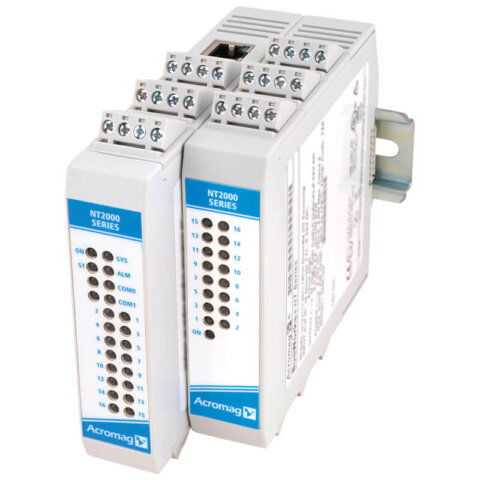
The SP230 series two-wire signal splitters are high-performance modules that duplicate one sensor or transmitter signal into two independent 4–20mA outputs. Designed for plant engineers and system integrators, these splitters simplify sharing a process signal between two instruments or control systems in industrial applications. Each unit operates on loop power from the output lines, eliminating the need for a dedicated power supply and streamlining installation in remote or space-constrained locations.
Multiple models in this range accommodate a wide variety of input types – from standard 4–20mA currents and DC voltages to low-level millivolt signals and even direct thermocouple inputs – all converted to isolated 4–20mA outputs. Advanced galvanic isolation (1500 V protection) ensures that each output is electrically separated, preventing ground loops and protecting against noise and surges. These rugged splitters are built for harsh industrial environments, with a shock-resistant, compact design that mounts on DIN rails and operates reliably across -40…+80 °C temperature extremes. In essence, the SP230 series delivers convenient signal duplication and isolation to improve the safety, flexibility, and redundancy of process measurement and control systems.
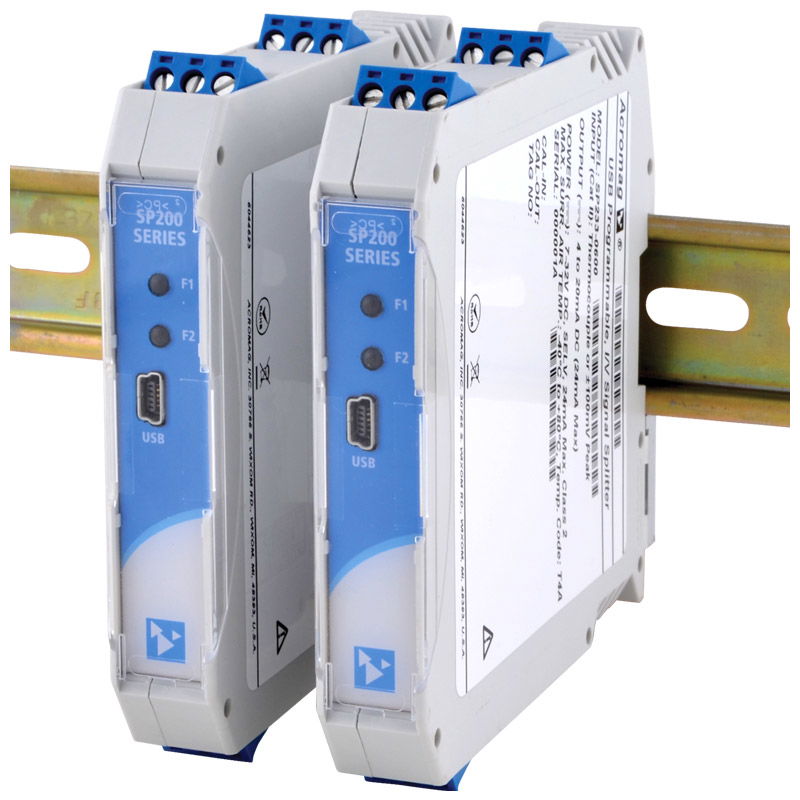
Range features
A high level overview of what this range offers
- Dual output from a single input – Provides two identical 4–20mA outputs from one input signal, enabling parallel monitoring or redundant control without affecting the original signal.
- Loop-powered operation – Draws its operating power directly from the 4–20mA output loops, so no separate supply wiring is needed. This simplifies installation and allows use in remote locations or existing loops.
- Universal input options – Multiple models support a range of input types: thermocouple sensors (J, K, T, R, S, E, B, N) or low mV signals, DC current inputs (±20 mA or up to 0–20 A AC via sensor), as well as unipolar/bipolar DC voltages from ±1 V up to ±150 V. One series covers diverse sensor signals, so you can choose a unit tailored to your application.
- Easy USB configuration – Quickly configure and scale input/output ranges using a standard USB connection and intuitive Windows software or an Android mobile app. This software-configured I/O means fast setup, precise calibration, and flexible re-ranging without hardware jumpers or manual pots.
- Independent output scaling – Each output channel can be scaled or inverted independently (normal or reverse-acting). This allows, for example, one output to operate on a narrower range or opposite direction if needed. Result: you can drive two different devices with custom-calibrated signals from the same input source.
- Sink or source output flexibility – The 4–20mA outputs support both sinking and sourcing configurations to easily interface with various PLC, DCS, or indicator input circuits. This wiring flexibility ensures seamless integration into existing control loops.
- High galvanic isolation – 1500 V isolation separates the input from each output, and from each other. This strong isolation eliminates ground loop errors, reduces electrical noise interference, and protects downstream equipment from surges or transients on the signal lines.
- Low loop burden – With an extremely low voltage drop (~7 V) across the splitter, the device minimizes load on the loop. This means more voltage headroom remains available to drive field instruments or long cable runs, and the splitter won’t compromise loop performance.
- Rugged industrial design – Engineered to withstand 25g shock and 4g vibration, these modules stay reliable in high-impact or vibrating machinery environments. They operate from -40…+80 °C with excellent stability and low drift, ensuring accurate performance in extreme climates.
- Compact DIN-rail form factor – A slim 17.5 mm width saves panel space, and the units clip onto standard DIN rails for tidy installation. Pluggable screw terminal blocks make wiring and module replacement straightforward, reducing downtime during maintenance.
- Visual diagnostics – Integrated LED indicators provide a quick visual check of loop power status and help identify any open loop conditions. This onboard diagnostics feature simplifies troubleshooting and speeds up maintenance in the field.
- Certified for hazardous locations – The splitters carry international approvals including CE and UL/cUL Class I Division 2, as well as ATEX/IECEx Zone 2 (for explosive atmospheres). You can deploy them with confidence in hazardous or safety-critical environments common in oil & gas, chemical processing, and mining applications.
Downloads
for 2-Wire Loop-Powered Splitters
FAQs
for 2-Wire Loop-Powered Splitters
The SP230 series splitters are available in different model versions to handle various input signals. Depending on the model, they can accept 4–20 mA DC current loops, low-level DC voltages (millivolt ranges up to ±500 mV), standard process voltage signals (±1 V to ±10 V), and even direct thermocouple sensor inputs (supporting multiple thermocouple types). There is also a high-voltage model (SP238) that can take in up to ±150 V DC. Each model is optimized for its input range but all output the same standard 4–20 mA signals. This flexibility means you can find a two-wire splitter to duplicate almost any common process signal or sensor output.
The SP230 series splitters are loop-powered devices, meaning they draw the small amount of power they need directly from the 4–20 mA output loops they are connected to. When you wire the outputs of the splitter into two receiving devices (like PLC analog inputs or panel meters), the voltage from those loop circuits also powers the splitter’s internal electronics. As long as the loop supply voltage is within the module’s range (typically 12–50 V DC) and capable of driving the total load, no separate power terminals or supply unit is required. This design greatly simplifies installation, especially in remote field locations, since you don’t need to run extra power wiring or provide a dedicated supply for the splitter.
No – the splitter is specifically designed to preserve signal integrity while duplicating the current. Each output channel is galvanically isolated and operates independently, so the two outputs do not load or interfere with the input or with each other. The device has high accuracy and very low drift over time and temperature. It introduces only a minimal voltage drop (about 7 V) to the loop, which is usually negligible in typical industrial loop budgets. By eliminating ground loops and buffering the signal with isolation, the splitter can actually improve overall measurement reliability in noisy environments. You can expect the duplicated outputs to closely track the original signal with excellent accuracy and stability.
One strength of the SP230 series is that each output can be configured independently through the software. By default, both outputs produce an identical 4–20 mA copy of the input. However, you have the option to apply different scaling or inversion to each output channel if needed. For instance, one output could be programmed to output 4–20 mA corresponding to 0–100% of input span, while the other could output 20–4 mA (inverse) or a narrower range to drive a specific indicator. Both outputs track the same input signal but can be tailored in range or direction. This flexibility is useful if the two destination devices expect the signal in slightly different formats. If you simply want identical outputs, the device does that by default, but the ability to tweak each output exists for special requirements.
Configuration is done via a USB connection and software, rather than mechanical jumpers or trim pots. Each splitter has a micro-USB port; you connect it to a PC and use the provided Windows configuration utility (or the Agility mobile app on Android). Through the software, you select the input type/range (for example, choose the thermocouple type or voltage range), and you can scale the output ranges or set filters. The software interface is user-friendly, guiding you through calibration if needed. This digital configuration allows precise adjustments and even enabling features like filtering (to smooth out noise) or setting up a reverse-acting output. Once configured and deployed, the device does not require manual re-calibration in normal operation, as it uses stable internal references and digital scaling.
Galvanic isolation means there is no direct electrical connection between the input circuit and the output circuits (and also isolation between the two outputs in this case). The benefit is multi-fold: it prevents ground loop currents from flowing between instruments, which can otherwise distort measurements or even cause damage. It also dramatically reduces susceptibility to electrical noise and interference, since unwanted voltage spikes or noise on the input side are not directly coupled to the outputs. Additionally, isolation provides safety – protecting operators and downstream devices from high common-mode voltages or surges on the input. In short, the 1500 V isolation in the SP230 series ensures that each output delivers a clean, accurate signal that isn’t impacted by differences in ground potential or noise from other devices. This results in more reliable and stable readings in your control system.
Yes, the two-wire loop-powered splitters have been certified for use in certain hazardous locations. They carry UL/cUL Class I Division 2 approval (which is a North American standard for equipment in potentially explosive gas or dust atmospheres, indicating they are safe for use in Zone 2/Div 2 environments). In addition, they have ATEX and IECEx Zone 2 approvals for global use in hazardous areas. This means you can confidently install them in industries like petrochemical plants, oil & gas facilities, or other environments where flammable gases or vapors may be present, as long as it’s within the non-incendive limits. Always ensure you follow the installation guidelines for hazardous areas (proper enclosures, wiring methods, etc.), but the devices themselves are designed and tested not to pose an ignition risk under normal operating conditions in Zone 2/Div 2.
The primary difference lies in how they are powered and the available output drive capability. A 2-wire loop-powered splitter (like the SP230 series) draws its power from the output loops, which simplifies wiring but means the loops must supply enough voltage to power the device plus the load. These tend to have very low burden and are efficient for duplicating signals in most scenarios. A 4-wire splitter, on the other hand, uses an external power source (AC or DC) to power the module’s electronics, independent of the signal loops. Because of this dedicated supply, 4-wire units often can support a wider range of output options (multiple voltage or current outputs, higher load impedance, etc.) and are suitable when loop power is not available or when driving especially high load resistances. However, 4-wire units require that extra power wiring. In summary, use a 2-wire splitter for simplicity and when your loop can accommodate it, and consider a 4-wire splitter if you need additional power for driving heavy loads or if your system design prefers separately powered isolators.