Volt 1000S 3-phase voltage meter for power distribution systems
- Technology
- Modular power meters
- Partner
- Acal BFi
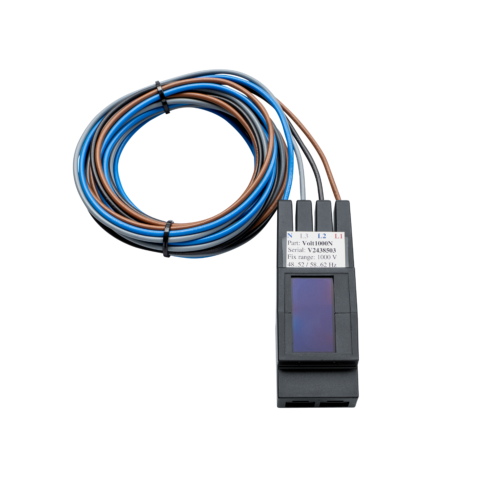
The Volt 1000S three-phase voltage measurement module is designed for utilities and industrial operators that require reliable voltage monitoring in the distribution grid. It can be easily installed on a standard DIN rail in transformer substations or switchgear/control cabinet panels and measures line-to-neutral voltages in three-phase systems without requiring external transformers.
The module provides real-time data via Modbus RTU, enabling integration into SCADA systems or PLCs for remote monitoring and control.
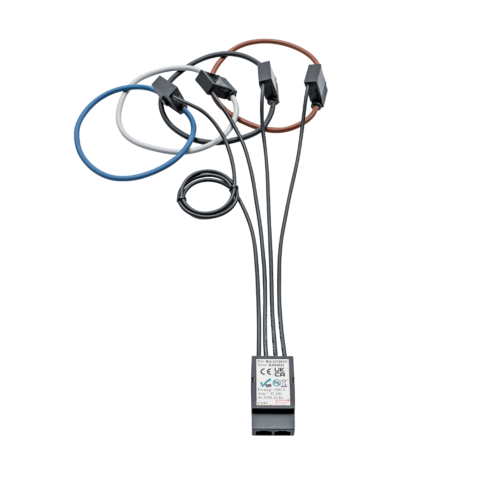
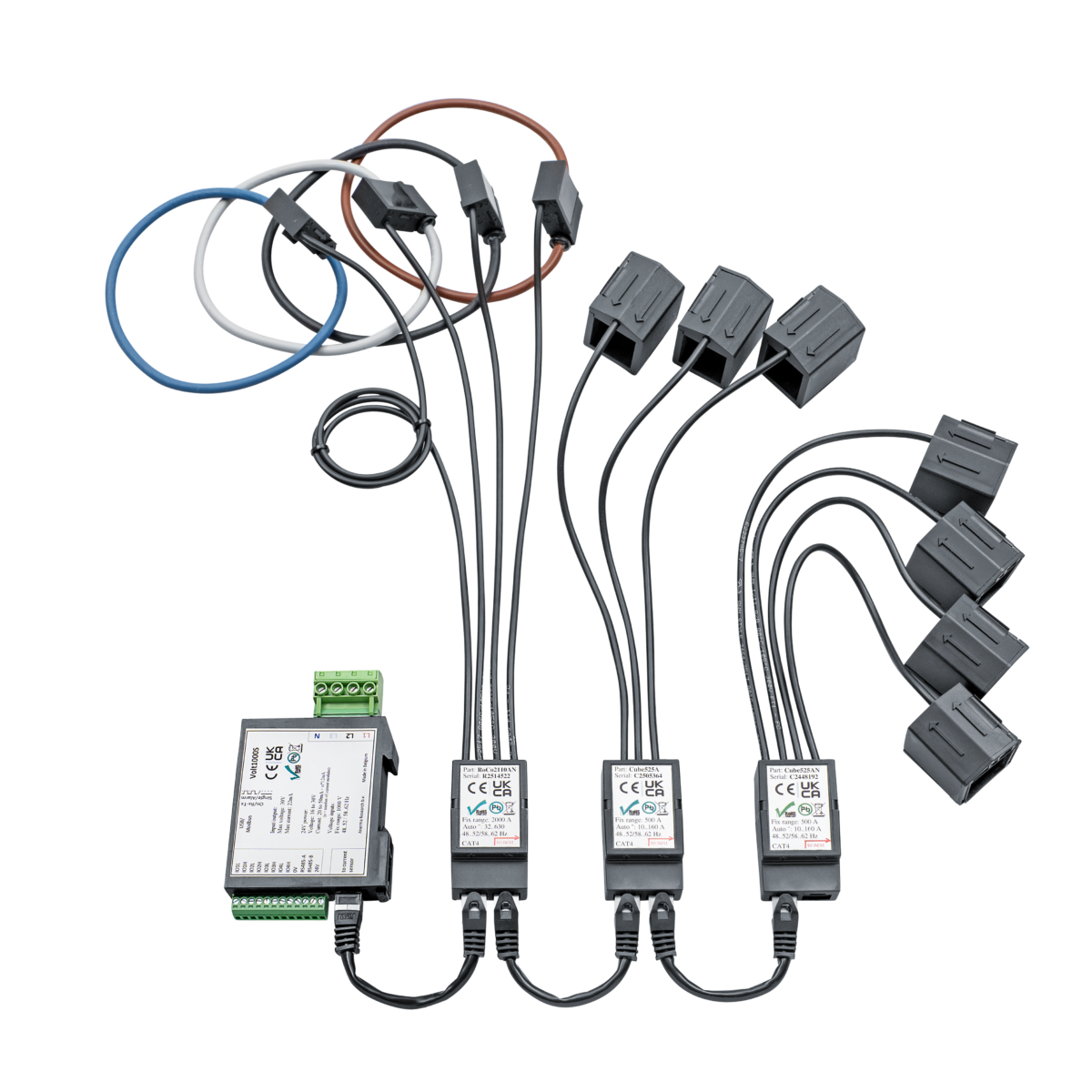
Thanks to its modular design, it can be used together with suitable current sensor modules to provide a complete picture of feeder loads, power, and power quality parameters.
By capturing feeder-specific voltage levels and voltage dips, the Volt 1000S helps grid operators quickly identify overloads, phase imbalances, or voltage quality issues.
This solution supports the growing demand for smart grid monitoring — for example, to comply with new grid regulations requiring updated local voltage data at regular short intervals (for instance, every 5 minutes).
Range features
A high level overview of what this range offers
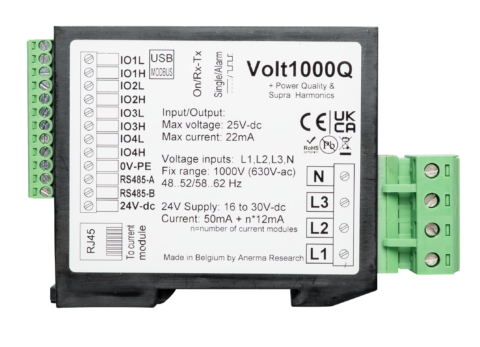
- Four-phase voltage measurement (L1, L2, L3, N) – Monitors an entire 3-phase circuit (including neutral) for comprehensive voltage visibility in real time.
- Modbus RTU (RS-485) interface – Simple integration into existing SCADA systems or PLCs, enabling remote data acquisition and control over a standard industry protocol.
- Built-in threshold alarms – Continuously watches voltage, current, and phase angle values and can trigger alerts if any parameter strays beyond set limits, supporting proactive grid management.
- Support for Rogowski coil inputs – Designed to work with optional clip-on current sensor modules, so you can easily add multi-circuit current measurements and calculate power and energy per feeder via the same system.
- USB configuration port – Onboard USB interface for convenient setup, parameter configuration, and firmware updates using a PC, without special programming tools.
- Four configurable I/O channels – Versatile digital/analogue inputs and outputs that can be assigned to various functions (such as alarm relay output, door-open sensor, temperature probe, fault detection, or 0–24 V/4–20 mA analogue inputs) to extend monitoring and control capabilities.
- Visual status indicators – Equipped with a green power LED and a red alarm LED on the front panel, providing immediate at-a-glance confirmation of normal operation or fault conditions.
- Slim DIN-rail design – Compact form factor (only ~20 mm width) mounts on standard 35 mm DIN rails, making it ideal for retrofitting into crowded electrical panels without major rework.
- Robust encapsulated construction – The module’s electronics are potted in resin for insulation and durability, ensuring reliable operation in harsh substation environments (temperature fluctuations, humidity) and enhancing electrical safety.
- Non-volatile memory for data logging – Internal memory (FRAM) retains critical measurement counters or energy data even during power loss, allowing the device to track cumulative values securely over time.
Downloads
for Volt 1000S 3-phase voltage meter for power distribution systems
What’s in this range?
All the variants in the range and a comparison of what they offer
| Specification | Volt 1000S | Volt 1000Q |
|---|---|---|
Phase measurement | 3-phase + Neutral (4-wire) | 3-phase + Neutral (4-wire) |
Nominal system voltage | 3× 230 V/400 V AC (50/60 Hz) | 3× 230 V/400 V AC (50/60 Hz) |
Voltage input connection | Direct (no external VT required) | Direct (no external VT required) |
Supply voltage | 24 V DC (fed via bus connector) | 24 V DC (fed via bus connector) |
Communication interface | RS-485 Modbus RTU (RJ45 port) | RS-485 Modbus RTU (RJ45 port) |
Configurable I/O channels | 4 (digital/analogue selectable) | 4 (digital/analogue selectable) |
USB port for configuration | Yes | Yes |
Status indicators | Power LED (green), Alarm LED (red) | Power LED (green), Alarm LED (red) |
Data memory | Yes (non-volatile FRAM for logs) | Yes (non-volatile FRAM for logs) |
Mounting & form factor | 35 mm DIN rail (module width ~20 mm) | 35 mm DIN rail (module width ~20 mm) |
Volt 1000S and Volt 1000Q are variants in the same product family. Both share the core specifications listed above. (Detailed feature differences between the S and Q models are minimal and primarily relate to their intended application focus.)
FAQs
for Volt 1000S 3-phase voltage meter for power distribution systems
The Volt 1000S acts as the central voltage unit in a modular measurement system. It measures the three-phase voltages, and it can forward timing signals and data to cascaded current sensor modules (such as Rogowski coil modules) via a high-speed local bus. Each current module in the chain uses the Volt 1000S’s voltage reference to calculate power (kW, kVA, etc.) for its phase. The Volt 1000S then collects those power readings and makes them available over Modbus as a combined data set. In essence, the Volt 1000S is the first module on the local meter bus – it provides the voltage reference and communication bridge for up to about 15–20 downstream current modules, which are typically attached to individual feeders. This modular approach allows monitoring of multiple circuits by adding sensor modules, all synchronized through one Volt 1000S unit.
The module communicates via RS-485 using the Modbus RTU protocol, which is widely supported in SCADA and industrial automation systems. The Volt 1000S has an RJ45 connector that carries the RS-485 signals (and also the 24 V DC power) for the Modbus network. In a typical setup, a PLC or SCADA concentrator acts as the Modbus master and polls the Volt 1000S (and any chained modules) as slaves. All key measurements – per-phase voltage, any alarm status, and even attached current sensor readings – are accessible through Modbus registers. This makes it straightforward to integrate the Volt 1000S into existing energy management systems, using standard Modbus read/write commands to retrieve data or configure alarm setpoints.
Primarily, the Volt 1000S continuously monitors the RMS voltage on all three phases and the neutral connection. It also keeps track of the phase relationships (e.g. phase angle differences) and can indirectly monitor current values when used with the companion current sensors. The device’s firmware allows you to configure threshold limits for various parameters – for example, if a phase voltage drops or rises beyond a set limit, or if an imbalance occurs between phases. If such a condition is detected, the Volt 1000S will activate its alarm output (one of the configurable I/O channels can be set as an alarm relay or signal) and the red alarm LED will light up. This alarm can also be relayed over Modbus so that the SCADA/master system knows a threshold violation occurred. In summary, it provides real-time voltage level monitoring with the ability to alert operators to abnormal conditions like undervoltage, overvoltage, or significant phase angle shifts.
Yes – the Volt 1000S was developed with modern grid requirements in mind, especially the need for real-time low-voltage network monitoring in secondary substations. For instance, regulations in some regions now require that utilities obtain feeder-specific voltage and load data at regular short intervals (on the order of minutes) to manage distributed energy resources and new loads like electric vehicle chargers. The Volt 1000S can help meet these requirements by providing continuous per-feeder voltage readings and by supporting the addition of current sensors for load measurements. Its fast data update (configured typically in seconds or minutes) and remote communication capability mean it can supply the necessary information to a control center within the mandated timeframe. In a practical scenario, deploying Volt 1000S modules across multiple local transformer stations enables an operator to document compliance with quality-of-supply standards (e.g. voltage level consistency) and respond quickly to emerging issues in the network.
The Volt 1000S has four multi-purpose I/O points that you can configure to suit your monitoring or control needs. For example, one I/O can serve as an alarm output (dry contact or transistor output) that triggers an external alarm siren or informs another system whenever a threshold event occurs. Another I/O could be wired to a door switch on the substation cabinet – if someone opens the cabinet door, the Volt 1000S can detect it and forward that status (for security or safety monitoring). The inputs can also accept analogue signals: you might attach a temperature sensor (with an analogue output) to monitor the ambient temperature inside the electrical enclosure, or use a 4–20 mA input from an external transducer (for example, a fault passage indicator or an earth-fault sensor). Additionally, one of the channels could be configured as a voltage input (0–24 V DC) to read an external signal, while another as a current input (4–20 mA). The flexibility of these I/O channels allows the Volt 1000S not only to measure voltage but also to act as a mini remote terminal unit, gathering auxiliary data and status signals from the site and integrating them into the Modbus telemetry.
Both Volt 1000S and Volt 1000Q are three-phase voltage measurement units in the same family, and they share the same fundamental capabilities (measuring 3-phase voltages and interfacing with current sensor modules and SCADA). The Volt 1000S is the model that emphasizes extended I/O and configurability – it includes the four configurable input/output channels, USB port, and is tailored for versatile integration and control tasks. The Volt 1000Q, on the other hand, is a variant intended for slightly different application priorities. In practice, the core hardware and performance are very similar, but the Q variant may focus more on pure monitoring functions or specific power quality analysis features. For example, utilities might use the Volt 1000Q in cases where advanced power quality metrics (such as detailed harmonic or flicker measurements) are needed, whereas the Volt 1000S would be chosen for installations requiring more local sensor/actuator integration. It’s worth noting that the provided datasheet covers both S and Q models, indicating that their specifications are largely alike – any differences come down to feature set and use-case focus rather than raw performance. In summary, most users will find either model delivers reliable 3-phase monitoring; the choice between S and Q will depend on whether additional I/O and flexibility (S model) or a dedicated monitoring focus (Q model) better suits the project.
The Volt 1000S is designed for simple installation on a standard 35 mm DIN rail, which is commonly found in electrical cabinets and substation control panels. It has a very slim profile, so it can be added into existing panels with limited free space. For wiring, the device has plug-in terminal connectors. Typically, you will wire the three phase conductors (L1, L2, L3) and the neutral (N) from the low-voltage busbars directly into the Volt 1000S’s voltage input terminals – no external voltage transformers are needed as it’s built to handle nominal 400 V AC systems. The unit also needs a 24 V DC supply, which is usually provided via the same RJ45 connection that links it into the Modbus network. The RJ45 out-port is then used to daisy-chain from the Volt 1000S to any additional current sensor modules or simply terminated if there are none. During installation, once the wiring is done, you will configure the device (via the USB port or over Modbus) for things like device ID, baud rate, and any alarm set-points. In operation, the Volt 1000S will continuously measure the voltages of the connected feeder. Because it’s fully enclosed and potted, it doesn’t require any maintenance – just an initial calibration or verification if desired, and then it should run reliably as part of the substation’s monitoring infrastructure.