Volt 1000Q Power Quality Voltage Meter for Power Distribution Systems
- Technology
- Modular power meters
- Partner
- Acal BFi
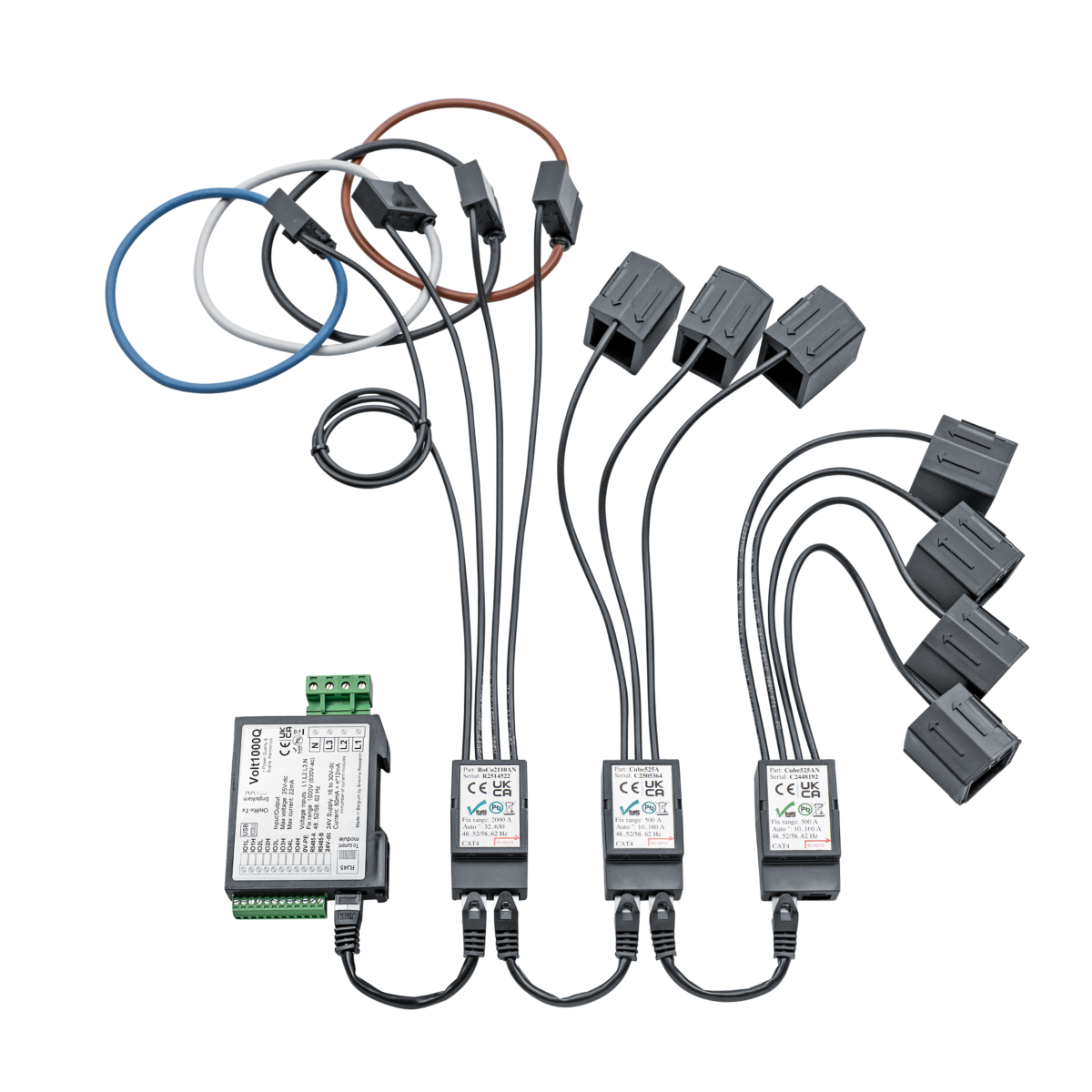
The Volt 1000Q is a DIN-rail mounted 3-phase voltage measurement device engineered for power distribution networks where voltage quality is critical. It continuously monitors L1, L2, L3 and neutral in real time, enabling grid operators and industrial engineers to spot dips, surges or imbalances as they occur. Designed for easy installation in transformer substations or switchgear panels, the compact module connects directly to 230/400 V AC lines without requiring external voltage transformers. All readings are made available via an RS-485 Modbus RTU interface, so the Volt 1000Q can seamlessly integrate into SCADA systems or PLCs for remote monitoring and control. As part of the Volt 1000 series (which includes the Volt 1000S), the Q model puts extra emphasis on power quality metrics, making it ideal for applications like networks with high renewable feed-in or sensitive equipment, where maintaining regulatory voltage standards is essential. The unit’s modular design also means it can link with optional current sensor modules to provide a more complete picture of feeder loads, power levels and overall energy quality across the distribution grid.
Range features
A high level overview of what this range offers
- Four-phase voltage measurement – Monitors a full three-phase circuit (L1, L2, L3 plus neutral) to give a comprehensive real-time view of all line voltages.
- Dedicated power quality focus – Optimised to track voltage stability and anomalies (dips, over-voltages, phase imbalance), helping maintain power quality standards and prevent disturbances in the network.
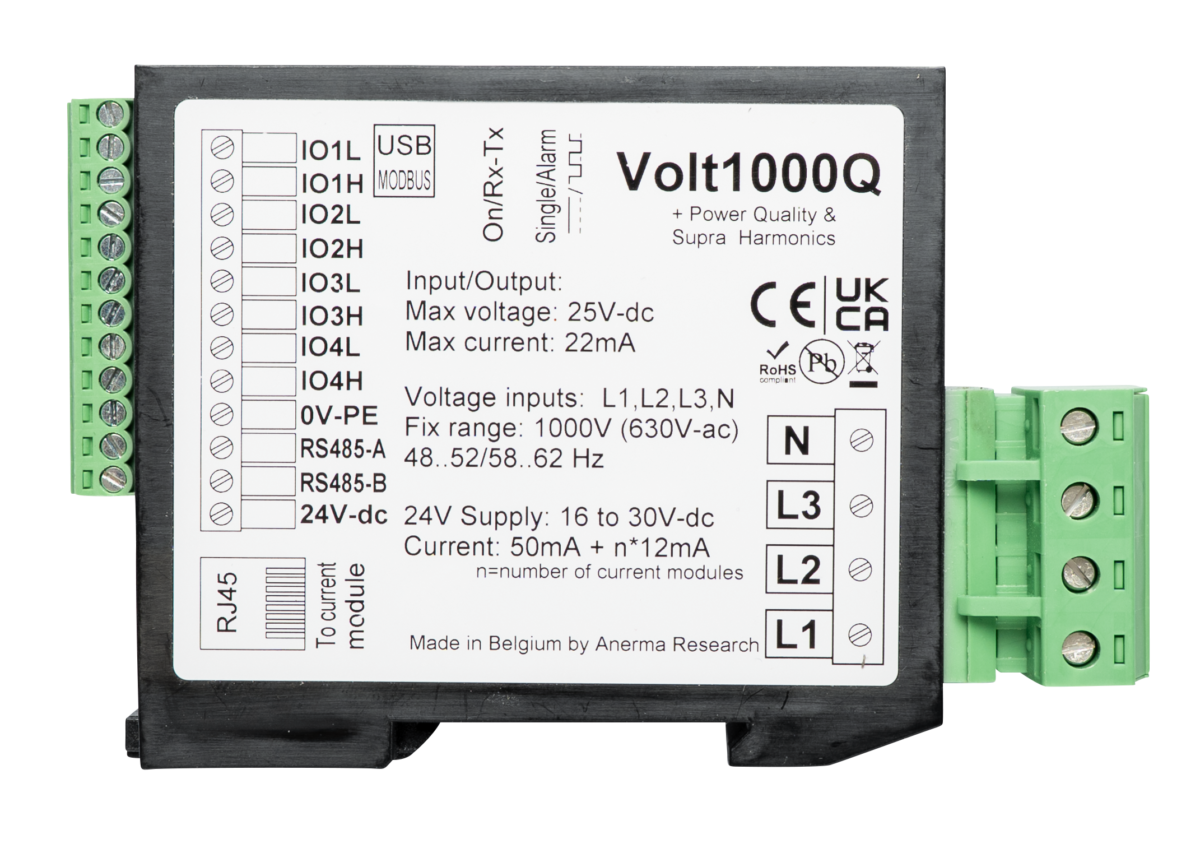
- Modbus RTU communications – Built-in RS-485 (RJ45) interface for straightforward integration into SCADA systems and PLCs, allowing remote data acquisition and configuration over a standard industry protocol.
- Configurable threshold alarms – Continuously watches voltages (and linked current/phase values) and triggers an alert if any parameter strays beyond set limits (for example, a sudden voltage sag or surge), enabling operators to respond swiftly to emerging issues.
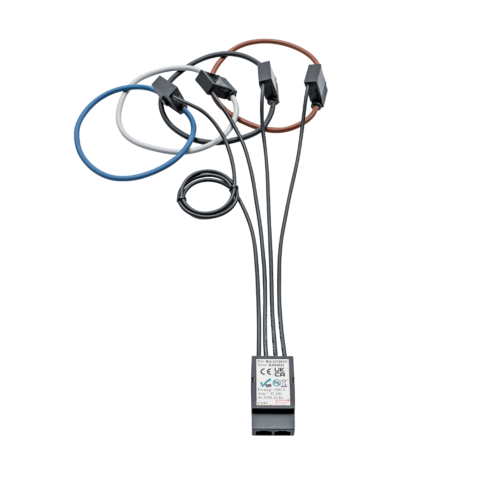
- Supports add-on current sensors – Works with optional Rogowski coil or other current sensor modules for multi-point current measurements; combined with the Volt 1000Q’s voltage readings, this enables per-feeder power and energy calculations in the same system.
- USB port for setup – An on-board USB interface allows convenient configuration and firmware updates from a PC. Technicians can easily set network addresses, alarm thresholds, or update software without special tools or taking the device offline.
- Four versatile I/O channels – Includes four configurable channels that can serve as digital inputs/outputs or analogue inputs. These can be assigned to functions such as an alarm relay output, door-open switch input, temperature sensor, fault detection, or 0–10 V/4–20 mA analogue measurements, extending the module’s monitoring and control capabilities.
- LED status indicators – Front-panel LEDs (green for power status, red for alarm) provide immediate, at-a-glance confirmation of normal operation or fault conditions, aiding quick diagnostics on site.
- Slim, rugged DIN-rail design – Compact housing (~20 mm width) that snaps onto standard 35 mm DIN rails, ideal for retrofitting into crowded cabinets. The electronics are potted and encapsulated for durability and safety, ensuring reliable operation in harsh substation environments (wide temperature range, humidity) and immunity to dust or vibration.
- Non-volatile memory logging – Equipped with internal FRAM memory to retain critical data logs and counters even if power is lost. This secure data retention means cumulative energy values or recent event records (like voltage excursions) remain stored for analysis and compliance tracking.
Downloads
for Volt 1000Q Power Quality Voltage Meter for Power Distribution Systems
What’s in this range?
All the variants in the range and a comparison of what they offer
| Specification | Volt 1000S | Volt 1000Q |
|---|---|---|
Phase measurement | 3-phase + Neutral (4-wire) | 3-phase + Neutral (4-wire) |
Nominal system voltage | 3× 230 V/400 V AC (50/60 Hz) | 3× 230 V/400 V AC (50/60 Hz) |
Voltage input connection | Direct (no external VT required) | Direct (no external VT required) |
Supply voltage | 24 V DC (fed via bus connector) | 24 V DC (fed via bus connector) |
Communication interface | RS-485 Modbus RTU (RJ45 port) | RS-485 Modbus RTU (RJ45 port) |
Configurable I/O channels | 4 (digital/analogue selectable) | 4 (digital/analogue selectable) |
USB port for configuration | Yes | Yes |
Status indicators | Power LED (green), Alarm LED (red) | Power LED (green), Alarm LED (red) |
Data memory | Yes (non-volatile FRAM for logs) | Yes (non-volatile FRAM for logs) |
Mounting & form factor | 35 mm DIN rail (module width ~20 mm) | 35 mm DIN rail (module width ~20 mm) |
FAQs
for Volt 1000Q Power Quality Voltage Meter for Power Distribution Systems
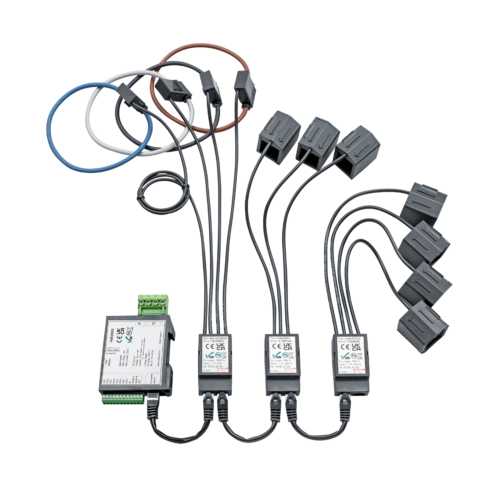
The Volt 1000Q serves as the central voltage-measuring unit in a modular system. It measures the three-phase voltages and can synchronize with chained current sensor modules (such as clip-on Rogowski coil modules) via a high-speed local bus connector. Each added current module uses the Volt 1000Q’s accurate voltage reference and timing to calculate real-time power values (kW, kVAR, power factor, etc.) for its respective feeder. The Volt 1000Q then aggregates these measurements and makes the combined data available over Modbus. In practical terms, one Volt 1000Q can coordinate with roughly 15–20 downstream current modules, all sharing the same voltage reference, to monitor multiple circuits simultaneously in a substation.
The Volt 1000Q communicates via an RS-485 serial link using the Modbus RTU protocol. It features an RJ45 port that carries the RS-485 signals (and also the 24 V DC supply via the bus connector). In a typical deployment, a SCADA system or PLC acts as the Modbus master and polls the Volt 1000Q (and any linked sensor modules) as slave devices. All key data – including per-phase voltages, alarm statuses, and any attached current sensor readings – are accessed through Modbus registers. This standards-based interface makes it straightforward to integrate the Volt 1000Q into existing energy monitoring systems using common Modbus read/write commands.
The module continuously monitors the RMS voltage on all three phases as well as the neutral connection. It also tracks mains frequency and the phase relationships (phase angles between phases). You can configure threshold limits for various parameters – for instance, if any phase voltage rises above or falls below a set level, or if a significant imbalance between phases occurs. If such a condition is detected, the Volt 1000Q will activate an alarm output (one of the configurable I/O channels can be designated as an alarm relay). At the same time, the red alarm LED will illuminate, and an alert flag can be communicated via Modbus to the central system. This allows both local personnel and remote operators to be notified immediately of abnormal voltage conditions.
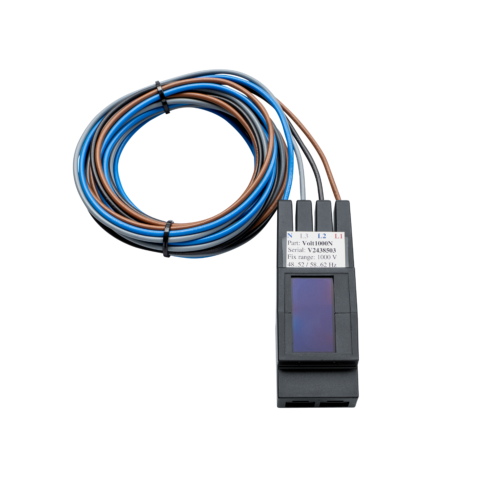
No. The Volt 1000Q is designed to connect directly to low-voltage three-phase networks (nominal 3× 400 V AC line-to-line, 230 V phase-to-neutral). It has an internal input circuit that can handle the standard distribution voltages without needing any external potential transformers (PTs). The device is rated for CAT III up to 600 V, meaning it’s safe and suitable for direct installation on typical utility distribution cables and busbars. Eliminating external VT units simplifies installation and reduces system cost and complexity.
Both the Volt 1000Q and Volt 1000S are part of the same product family and share the same core hardware and specifications. The key difference lies in their application focus: the Volt 1000S is geared towards general three-phase voltage monitoring and forms the base unit in a modular metering setup (often paired with current sensor modules for load/power monitoring). In contrast, the Volt 1000Q is targeted more at power quality monitoring – it places a stronger emphasis on capturing voltage anomalies and quality parameters. In practice, this means the Q model’s firmware and usage are optimised for logging events like dips or surges and helping ensure compliance with voltage quality standards, whereas the S model is typically used for routine voltage measurement and grid integration tasks. Aside from this focus, the physical design, interfaces, and performance of the two models are essentially the same.
By itself, the Volt 1000Q measures voltages (and frequency/phase data) only – it does not include internal current sensing hardware. To monitor current or to calculate power and energy values, you would use the Volt 1000Q in combination with external current sensor modules (for example, clip-around Rogowski coils or other compatible current transducers). The Volt 1000Q provides the voltage reference and timing to those sensors, and together they can compute per-circuit power (kW, kVA, etc.) and energy usage. Without the external current modules, the Volt 1000Q will report only the electrical parameters related to voltage and phase; adding the current sensors turns it into a complete power monitoring solution.
The Volt 1000Q’s voltage measurement accuracy is on the order of ~1% of full scale, which is sufficient for operational monitoring and power quality oversight in distribution systems. This accuracy class is not intended for revenue/billing (which typically demands 0.2% or 0.5% class meters). Instead, the Volt 1000Q is designed for grid management, troubleshooting and compliance monitoring where a 1% accuracy provides reliable trend data and event detection. In short, it’s excellent for tracking network voltage conditions and diagnosing issues, but utility billing would generally require a higher-precision metering device.
The Volt 1000Q keeps a continuous watch on the line voltage levels and phase status, so it can detect a range of power quality disturbances in the low-voltage network. For example, it will note voltage sags (dips) if a phase drops below its allowable level, over-voltage surges if a phase rises too high, and phase imbalances where one phase significantly deviates from the others. It also measures line frequency, so it can flag frequency drift outside acceptable bounds. While the Volt 1000Q does not perform detailed harmonic analysis (it focuses on fundamental frequency measurements), the combination of its threshold alarms and logging can capture many common PQ events. This allows network operators to identify issues like under-voltage events or unstable phase conditions and investigate their causes (such as sudden load changes or faults) before they lead to equipment problems or violations of power quality standards.
Installation is designed to be straightforward. The Volt 1000Q has a slim DIN-rail mount – you simply snap it onto a standard 35 mm DIN rail inside your cabinet or substation panel. It is typically positioned at the beginning of a measurement chain. The three phase conductors (L1, L2, L3) and neutral are connected to the module’s voltage measurement inputs using the appropriate terminal connectors (the device is built to accept direct connection to 400 V class circuits). The module itself is powered with 24 V DC, which is often supplied via the system’s bus connector or a separate 24 V feed; multiple modules can share the bus power and communication link. The communication wiring is done through the RJ45 port – you run a twisted-pair cable from the Volt 1000Q’s RS-485 port to your Modbus network (daisy-chaining with other devices if needed). After physical wiring, a PC can be connected via USB for any initial configuration (device Modbus address, baud rate, alarm setpoints, etc.). Once mounted and wired, the Volt 1000Q will begin monitoring immediately, and it can be polled from the SCADA or logging system to retrieve live data.